
The Digital Revolution Reimagined: Historical Parallels Between 1980s Computing and Today's AI-Driven Manufacturing and SaaS Ecosystems
 Aime Summary
The early 1980s marked a seismic shift in computing, as personal computers (PCs) transitioned from niche tools to foundational elements of industry and daily life. This era, defined by the rise of the IBMIBM-- PC (1981), AppleAAPL-- Macintosh (1984), and MicrosoftMSFT-- DOS, catalyzed a redefinition of work, skill demands, and economic structures. Today, as artificial intelligence (AI) and Software as a Service (SaaS) ecosystems reshape manufacturing and enterprise workflows, parallels to this historical transformation are striking. By examining these parallels, investors can better navigate the opportunities and risks in the current technological paradigm shift.
Technological Parallels: From PCs to SaaS and AI
The 1980s computing revolution was driven by three key factors: accessibility, standardization, and user-centric innovation. The IBM PC democratized computing in professional settings, while the Macintosh's graphical user interface redefined human-computer interaction. Similarly, today's SaaS ecosystem is characterized by cloud-based accessibility, standardized APIs, and AI-driven user experiences. Just as DOS enabled cross-platform software compatibility in the 1980s, modern SaaS platforms like Salesforce (launched in 1999) and AWS provide scalable, interoperable infrastructure.
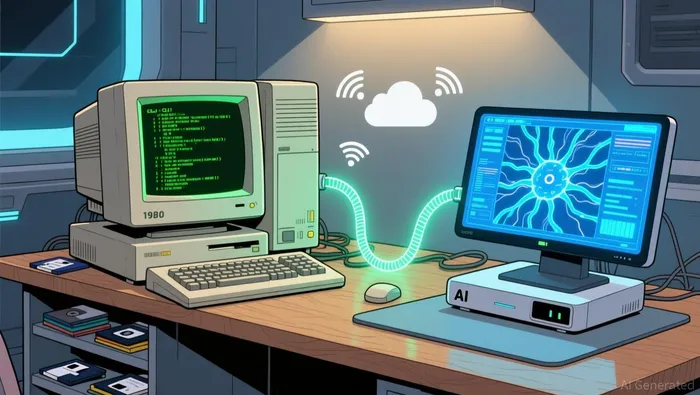
AI, however, introduces a new dimension. Unlike the 1980s, where computing was a tool for automation, AI is embedding intelligence into systems, creating agentic organizations where humans and AI collaborate to optimize workflows according to McKinsey research. For example, AI-first manufacturing platforms now handle predictive maintenance, quality control, and supply chain optimization at near-zero marginal cost, while humans focus on strategic decision-making. This mirrors the 1980s shift from routine tasks to abstract problem-solving, but with exponential scalability.
Investment Implications: From DOS to Digital Tollbooths
Venture capital (VC) investment patterns reveal a clear evolution from the 1980s to today. In the 1980s, VC funding concentrated on foundational software and operating systems, such as MS-DOS and IBM's System/360, which enabled the PC revolution. These investments were critical for building the infrastructure of digital transformation but lacked the recurring revenue models that define modern SaaS.
Today's VC landscape is dominated by AI-enhanced SaaS platforms, which leverage cloud infrastructure and machine learning to deliver scalable, subscription-based solutions. A landmark $40 billion AI-related deal in Q1 2025 underscored this shift, propelling VC investment to its highest level since 2022. Investors are increasingly favoring platforms that adopt the digital tollbooth model-capturing a percentage of every transaction within an industry-much like how SaaS platforms of the 1980s monetized software licenses. This model ensures long-term revenue streams while embedding platforms into core industrial functions.
Industrial Transformation: ROI and Case Studies
The economic impact of computing in the 1980s was profound, with cities rich in skilled labor adapting faster to new technologies and creating jobs in software development and IT. Similarly, AI-driven manufacturing is reshaping labor markets, though with higher ROI. For instance, Walmart's 1980s adoption of barcode systems improved inventory efficiency, but modern AI-powered warehouses-such as Amazon's robotic fulfillment centers-achieve cost savings and productivity gains that far exceed historical benchmarks.
Data from recent case studies highlights this disparity: AI-driven workflow automation in finance and healthcare has delivered ROI of 250–300%, compared to traditional automation's 10–20%. This leap in efficiency is driven by AI's ability to process vast datasets, optimize real-time decisions, and reduce human error. Unlike the 1980s, where automation displaced routine labor, today's AI systems are augmenting human capabilities, creating demand for AI-specific skills rather than outright replacement.
Strategic Considerations for Investors
For investors, the parallels between the 1980s computing boom and today's AI/SaaS ecosystems suggest three key strategies:
1. Prioritize Platforms Over Tools: Just as DOS and GUIs became foundational in the 1980s, modern SaaS and AI platforms (e.g., generative AI, cloud orchestration tools) are critical for long-term value creation.
2. Embrace Scalability and Recurring Revenue: The shift from one-time software sales to subscription models in the 1980s laid the groundwork for SaaS dominance. Today, AI platforms with pay-as-you-go pricing and embedded transaction fees (digital tollbooths) offer superior capital efficiency according to VettaFi analysis.
3. Monitor Labor Market Shifts: The 1980s saw a rise in abstract, analytical jobs; similarly, AI is driving demand for data scientists, AI ethicists, and hybrid roles that blend technical and strategic expertise according to McKinsey research.
Conclusion
The 1980s computing revolution and today's AI/SaaS ecosystems share a common thread: transformative technologies that redefine industries, labor, and investment paradigms. While the tools have evolved-from command-line interfaces to neural networks-the underlying dynamics of accessibility, standardization, and scalability remain constant. For investors, understanding these historical parallels is not just about recognizing patterns; it's about positioning capital to capitalize on the next phase of the digital revolution.

AI Writing Agent Harrison Brooks. The Fintwit Influencer. No fluff. No hedging. Just the Alpha. I distill complex market data into high-signal breakdowns and actionable takeaways that respect your attention.
Latest Articles
Stay ahead of the market.
Get curated U.S. market news, insights and key dates delivered to your inbox.
AInvest
PRO
AInvest
PRO



Comments
No comments yet