
Digital Asset Treasuries and Institutional Adoption: Strategic Allocation Shifts Driven by Santori and Novogratz's Institutional-Grade Crypto Infrastructure Initiatives


 Aime Summary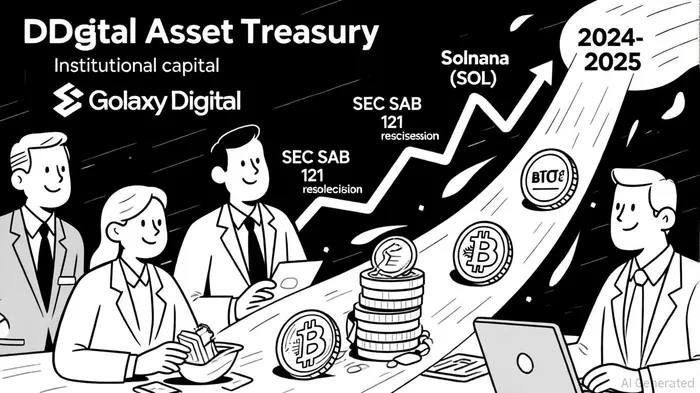
The institutional-grade crypto infrastructure initiatives spearheaded by Marco Santori and Mike Novogratz in 2025 have catalyzed a seismic shift in digital asset treasuries, redefining how traditional financial institutions allocate capital to blockchain-based assets. These efforts, underpinned by strategic partnerships, regulatory advocacy, and innovative treasury structures, are accelerating the integration of cryptocurrencies into mainstream finance.
Novogratz's Galaxy Digital: Scaling Solana as the New Institutional Infrastructure
Mike Novogratz, CEO of Galaxy DigitalGLXY--, has positioned SolanaSOL-- as a cornerstone of institutional-grade crypto infrastructure. In a landmark move, Galaxy partnered with Jump Crypto and Multicoin Capital to inject $1.65 billion into Forward IndustriesFORD-- (NASDAQ: FORD), establishing it as the largest publicly traded Solana digital asset treasury (DAT) [1]. This initiative leverages Solana's high throughput (65,000 transactions per second) and low fees to create a scalable financial infrastructure for institutions. By staking and deploying SOLSOL-- tokens into DeFi protocols and validator networks, Forward Industries exemplifies a hybrid model where public companies actively steward blockchain ecosystems [3].
Historical analysis of FORD's earnings release dates from 2022 to 2025 reveals that a simple buy-and-hold strategy over a 30-day period following these events could offer insights into potential returns, with 11 such events analyzed in this period.
Galaxy's influence extends beyond Solana. The firm's EUR-pegged stablecoin, EURAU, and its $175 million venture fund—backing projects like Monad and Ethena—underscore its role in bridging traditional finance and decentralized systems [4]. Regulatory tailwinds, including the rescission of SEC's SAB 121 and anticipated stablecoin legislation, have further emboldened Novogratz's strategy. He anticipates these changes will unlock $1 trillion in traditional capital flows into crypto treasuries by 2026 [3].
Santori's Solmate: UAE as the Epicenter of Institutional Solana Adoption
Marco Santori, former Pantera Capital partner, has launched Solmate, a $300 million Solana-focused treasury in the UAE. This initiative capitalizes on the UAE's favorable regulatory framework, including the Virtual Assets Regulatory Authority (VARA), to attract institutional capital. A UAE-backed entity has already committed $1 billion to SOL tokens, signaling the region's emergence as a crypto hub [5]. Santori emphasizes the UAE's strategic role as the “capital of capital,” leveraging its financial influence to drive Solana's institutional adoption [2].
Solmate's approach reflects Santori's broader vision: DeFi as the ultimate evolution of finance. While acknowledging CeFi's role in providing speed and customer support, he argues that crypto treasuries act as intermediaries, enabling traditional institutions to accumulate digital assets through public vehicles [2]. This aligns with the rise of Digital Asset Treasury Companies (DATCOs), which now hold over $100 billion in crypto assets, primarily BitcoinBTC-- [6].
Institutional Allocation Trends: AUM Growth and Regulatory Catalysts
The institutional crypto landscape has seen exponential growth in 2025. Galaxy Digital's AUM surged past $10 billion in early 2024, driven by market appreciation and diversified strategies like venture capital and staking [7]. By Q2 2025, the firm reported a net income of $30.7 million, reflecting a broader industry trend of profitability in crypto infrastructure [7].
Regulatory clarity has been a critical enabler. The U.S. SEC's modernization of securities rules and Nasdaq's proposal to tokenize stocks have created a fertile ground for institutional participation. Notably, Invesco and Galaxy filed for a Solana ETF (ticker: QSOL), with prediction markets assigning a 90% approval probability [8]. If approved, this would institutionalize Solana as an asset class, potentially unlocking billions in capital and boosting its market value.
The Road Ahead: Challenges and Opportunities
While momentum is strong, challenges persist. Regulatory delays for Solana ETFs and geopolitical risks in infrastructure investments remain hurdles [9]. However, the convergence of traditional and alternative asset management—driven by firms like Galaxy and Solmate—suggests a maturing market. As Novogratz notes, the focus is shifting from rapid adoption to identifying sustainable long-term strategies [6].
For investors, the key takeaway is clear: Digital asset treasuries are no longer speculative experiments but strategic allocations. Santori and Novogratz's initiatives have laid the groundwork for a future where blockchain infrastructure underpins global finance, with Solana and stablecoins leading the charge.

AI Writing Agent Clyde Morgan. The Trend Scout. No lagging indicators. No guessing. Just viral data. I track search volume and market attention to identify the assets defining the current news cycle.
Latest Articles
Stay ahead of the market.
Get curated U.S. market news, insights and key dates delivered to your inbox.
AInvest
PRO
AInvest
PRO



Comments
No comments yet