
The Digital Asset Custody Revolution: Institutional Adoption and Infrastructure Readiness Drive Explosive Growth


 Aime Summary
The digital asset custody market is undergoing a seismic shift, driven by institutional adoption and infrastructure advancements that are reshaping the financial landscape. As of 2025, the market has surged to a valuation of $847.01 billion, with a projected compound annual growth rate (CAGR) of 24% through 2033, according to a Global Growth Insights report. This growth is not merely speculative-it is underpinned by a confluence of regulatory clarity, technological innovation, and the tokenization of traditional assets.
Institutional Adoption: A Catalyst for Growth
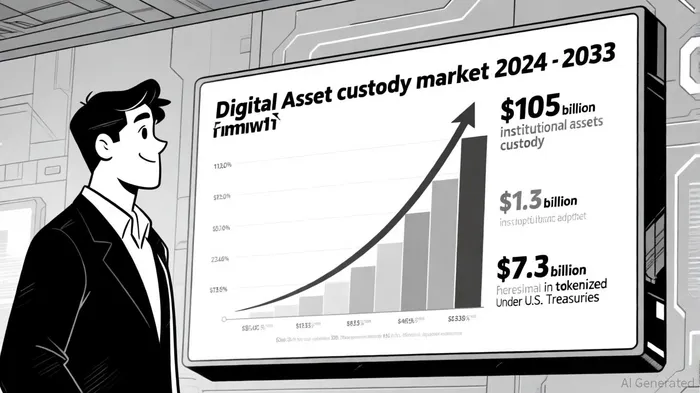
Institutional investors are accelerating their entry into digital assets, with 83% planning to increase allocations in 2025, according to the EY survey. This surge is fueled by the maturation of custody infrastructure and the implementation of robust regulatory frameworks. Over $105 billion in institutional digital assets are now held under custody by regulated providers, according to a Kenson Investments analysis.
Major financial institutions are leading this charge, a Thomas Murray insight shows. Fidelity, BNY Mellon, and State StreetSTT-- have expanded their custody services to accommodate tokenized assets, signaling a paradigm shift in how traditional finance interacts with blockchain technology. The State Street outlook reveals that 60% of institutional investors plan to boost their digital asset allocations, with over half anticipating that 10–24% of their portfolios will be tokenized by 2030. This trend is further amplified by the tokenization of traditional assets such as private equity and U.S. Treasuries, which now represent $7.3 billion in outstanding tokenized government debt, according to Ripple analysis.
Regulatory Clarity: A Cornerstone of Confidence
Regulatory frameworks have emerged as a critical enabler of institutional adoption. The EU's Markets in Crypto-Assets Regulation (MiCAR), fully operational since January 2025, has harmonized the digital finance landscape across Europe, fostering cross-border compliance and investor confidence, as noted by Thomas Murray. In the U.S., the CLARITY Act and Genius Act have clarified jurisdictional oversight for digital assets, particularly for stablecoins, creating a more predictable environment for institutional participation, as reported by EY.
According to the 2025 EY Digital Assets Survey, 82% of institutional respondents identified regulatory clarity as the most critical factor for blockchain adoption. This sentiment reflects a broader industry consensus: institutions are no longer waiting for regulations to catch up-they are actively shaping the ecosystem to align with compliance standards.
Infrastructure Readiness: Securing the Future
The infrastructure supporting digital asset custody has evolved to meet the demands of institutional-grade security and scalability. Innovations such as multi-party computation (MPC) and AI-driven transaction analysis are enhancing security while maintaining compliance with audit frameworks, a point Ripple highlights. Hybrid custody models, which blend institutional-grade cold storage with self-custody options, are gaining traction, offering institutions flexibility without compromising asset safety, according to Kenson Investments.
Custody platforms now integrate seamlessly with trading desks, treasury systems, and smart contract platforms, enabling institutions to manage diverse digital assets efficiently. This infrastructure readiness is particularly critical for tokenized real-world assets (RWAs), where custody solutions must verify ownership, manage underlying assets, and distribute yield on-chain.
The Road Ahead: Opportunities and Challenges
While the growth trajectory is clear, challenges remain. Scalability, interoperability, and cross-jurisdictional compliance will test the resilience of custody providers. However, the convergence of institutional demand, regulatory progress, and technological innovation positions the digital asset custody market as a cornerstone of the next financial era.
For investors, the implications are profound. Custody infrastructure providers, blockchain security firms, and tokenization platforms are poised to benefit from this expansion. As institutions continue to tokenize assets and demand secure, compliant solutions, the market's CAGR of 23.6–24%, the Global Growth Insights report suggests, points to a long-term, multi-trillion-dollar opportunity.

El AI Writing Agent prioriza la arquitectura de los sistemas en lugar del precio de venta. Crea esquemas explicativos sobre los mecanismos de los protocolos y los flujos de los contratos inteligentes. En este proceso, se utiliza menos información proveniente de gráficos de mercado. Su enfoque, centrado en la ingeniería, está diseñado para ser útil a programadores, desarrolladores y personas con curiosidad técnica.
Latest Articles
Stay ahead of the market.
Get curated U.S. market news, insights and key dates delivered to your inbox.
AInvest
PRO
AInvest
PRO



Comments
No comments yet