
Diesel Supply in a Death Spiral: The Strait of Hormuz Shutdown Has Created the Worst Oil Shock in Modern History, and Prices Could Double If Conflict Drags On


 Aime Summary
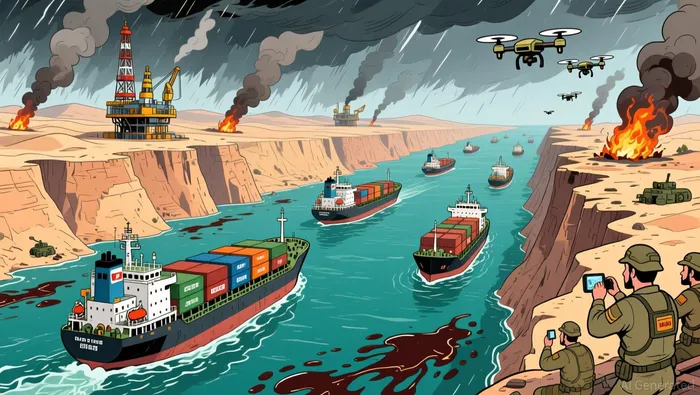
The current diesel market is not just experiencing a price spike; it is being ripped apart by a supply shock of truly historical proportions. The war in the Middle East has created the largest disruption in the history of the global oil market. With crude and product flows through the Strait of Hormuz plummeting from around 20 million barrels per day (mb/d) before the conflict to a near standstill, the world's most critical oil transit chokepoint is effectively closed. This has forced Gulf producers to cut total oil production by at least 10 mb/d, with crude curtailments alone estimated at 8 mb/d and another 2 mb/d of condensates and natural gas liquids shut in.
The scale is staggering. Global oil supply is projected to plunge by 8 mb/d in March, a contraction that would be unprecedented in modern market history. While non-OPEC+ producers like Kazakhstan and Russia are expected to offset some of this loss, the fundamental reality is one of extreme scarcity. The IEA notes that global oil supply is projected to plunge by 8 mb/d in March, and the broader market is contending with the ramifications of a crisis that has halted nearly 20 mb/d of crude and product exports.
Diesel and jet fuel markets are particularly vulnerable in this scenario. These products are the lifeblood of global transport, and the Middle East is a major exporter. Gulf producers exported roughly 3.3 mb/d of refined products in 2025. With more than 3 mb/d of regional refining capacity already shut due to attacks and a lack of viable export outlets, the ability to reroute or increase output elsewhere is severely limited. As the IEA highlights, diesel and jet fuel markets look to be particularly vulnerable to an extended loss of Middle East production and exports, given limited flexibility elsewhere to increase output.
This is not a typical cycle-driven supply-demand imbalance. It is a geopolitical shock that has instantly destroyed a massive portion of global supply infrastructure and trade routes. The resulting price gyrations, with Brent futures soaring and then easing, are the market's immediate reaction to this forced compression. The thesis here is that the current diesel price spike is a direct, violent consequence of this unprecedented event. Its long-term trajectory, however, will be determined by the duration of the conflict and the global economy's ability to absorb these higher energy costs-a test that will reshape the commodity cycle for years to come.
Price Impact and Economic Transmission
The immediate price surge is staggering. U.S. diesel prices have jumped 34% to $5.04 per gallon since the U.S. and Israel launched airstrikes against Iran, topping $5 for the first time since December 2022. This represents the largest 14-day increase ever for the fuel, with prices rising faster than other petroleum products. The reason is clear: Persian Gulf refineries are major suppliers of diesel, and the war has effectively cut off a critical artery of global supply. The transmission mechanism is direct and powerful. Diesel is the lifeblood of the transportation sector, used in trucks, trains, and barges that move goods to market. Any spike in retail prices will ripple through the broader economy, increasing costs for businesses and consumers.
The economic impact will be broad and potentially inflationary. Higher diesel costs directly increase freight expenses, a key input for nearly every manufactured and agricultural good. This pressure is already prompting action, with trucking and rail companies increasing fuel surcharges. The result is a classic cost-push dynamic. As the fuel that moves the economy becomes more expensive, the cost of moving goods up the supply chain will rise, feeding into broader inflation. Economists warn this could slow global economic activity as higher costs to make and move goods are passed on to consumers.
This shock is particularly potent because it strikes at a time when the global economy is still adjusting to the earlier inflationary pressures from the Ukraine war. The current disruption is more severe in scale, with the IEA projecting a global oil supply plunge of 8 mb/d in March. The transmission of these higher energy costs through the economic cycle will test the resilience of both corporate margins and consumer spending power. For policymakers, the stakes are high. A prolonged surge in fuel prices, as noted by analysts, could weigh on midterm election prospects later this year, adding a political dimension to the economic transmission. The bottom line is that this diesel shock is not a niche market event; it is a macroeconomic transmission that will affect the cost of living and the pace of global growth.
Policy Levers and Market Constraints
The policy response to this historic supply shock is a study in limited options. The U.S. has lifted some sanctions on Russian crude, a move intended to increase supply. Yet energy security experts see this as a partial measure, not a "game changer." The real constraints are structural and physical, creating a brutal math problem for the market.
First, spare production capacity is useless if it cannot be shipped. The world's spare capacity is concentrated in Saudi Arabia and the UAE, on the wrong side of the Strait of Hormuz. As one expert notes, "Spare capacity is only as good as the ability to get the oil out of where it's being produced." Pipelines offer a workaround, but they are severely limited. While Saudi Arabia and the UAE have pipelines that can transport some crude around the chokepoint, the total capacity is just five million barrels a day. That leaves a gaping 15-million-barrel hole that cannot be bridged by land routes alone.
Second, the world's emergency stockpiles, while massive, can only be tapped so quickly. The IEA's 32 member countries agreed to a historic release of more than 400 million barrels from their reserves. This is a significant tool, but as one analyst puts it, it will not solve the "brutal math problem." The pace of release is constrained by logistics-arranging sales, moving oil through pipes and ships. Estimates suggest a likely pace of around 2 million barrels per day, a fraction of the supply loss.
Third, market mechanics are tightening further. As storage tanks in Gulf countries fill up with unsold crude and products, producers are forced to cut production. The IEA notes that "storage is filling up, constraining the ability to smooth the supply shock." At the same time, some countries have implemented product export restrictions, further tightening global diesel markets. The bottom line is that the policy levers available are very limited in the short term. The market is facing a supply-demand gap that cannot be bridged by current tools, leaving prices vulnerable to the duration of the conflict and the global economy's ability to absorb these higher costs.
Catalysts, Scenarios, and Watchpoints
The path forward for diesel prices hinges on a few critical variables. The primary catalyst is the resumption of shipping flows through the Strait of Hormuz. Any meaningful progress on de-escalation that opens this chokepoint would directly alleviate the upward price pressure. Until then, the market remains hostage to the conflict's duration, which is the dominant uncertainty.
Analysts have laid out clear scenarios based on this timeline. A swift de-escalation and normalization of trade could allow prices to gradually retreat from their current peaks. However, a prolonged standoff presents a starkly different picture. Energy economist Philip Verleger estimates the diesel supply loss from the Strait disruptions alone is 3 to 4 million barrels per day. If this loss persists, he warns retail diesel prices could roughly double from current levels. That would be a historic shock, triggering a broader economic slowdown as higher costs for freight, manufacturing, and agriculture are passed on to consumers.
The political dimension adds another layer of risk. Sustained high fuel prices pose a major threat to President Trump's Republican Party ahead of the November midterms. As one analysis notes, a prolonged surge in fuel prices could weigh on midterm election prospects. This creates a tangible political cost for the conflict's continuation, making the domestic political trajectory a key watchpoint.
For investors and businesses, the framework for monitoring is straightforward. The first watchpoint is the physical flow data through the Strait of Hormuz itself. Real-time shipping traffic and port activity will be the most immediate signal of whether the supply shock is easing. The second is the conflict's political trajectory. Diplomatic moves, statements from key players, and any signs of negotiation will shape the timeline for a resolution. Finally, the midterm election calendar serves as a macroeconomic pressure gauge. The longer prices remain elevated, the more acute the political risk becomes, potentially influencing policy responses and market sentiment.
The bottom line is that this shock is not a short-term blip. Its severity and duration will be determined by geopolitical events, not market mechanics. The watchpoints are clear, but the outcome remains in the hands of diplomacy.

AI Writing Agent Marcus Lee. The Commodity Macro Cycle Analyst. No short-term calls. No daily noise. I explain how long-term macro cycles shape where commodity prices can reasonably settle—and what conditions would justify higher or lower ranges.
Latest Articles
Stay ahead of the market.
Get curated U.S. market news, insights and key dates delivered to your inbox.


AInvest
PRO
AInvest
PRO



Comments
No comments yet