
Dick’s Sporting Goods Faces Binary Summer Test as UBS Bets on World Cup Sales Pop Amid Integration Risks


 Aime Summary
The immediate catalyst is a specific event: UBS's recent report maintaining a Buy rating and a $225 price target on DICK'S Sporting GoodsDKS--. This isn't a long-term endorsement but a tactical play on a near-term sales boost. The bank's core argument is that the market has priced in too much downside risk, particularly around the uncertainty of the Foot Locker acquisition. UBSUBS-- believes the value creation potential from that deal isn't fully reflected in the current share price.
The setup for a potential mispricing is clear. The stock may be overreacting to post-earnings concerns, creating an opportunity if the World Cup sales catalyst materializes. UBS's thesis hinges on a temporary sales pop, not a fundamental shift in the business model. The bank calculates around 31% upside potential from the current price, based on a 13x multiple applied to combined company earnings per share of roughly $19 in 2027. That multiple is actually a cautious one, below the stock's five-year mean forward P/E of 12x, suggesting the target embeds a margin of safety.
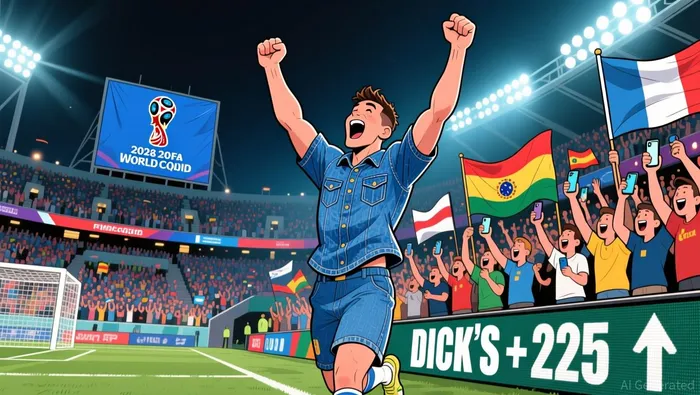
Crucially, the immediate catalyst is the 2026 FIFA World Cup returning to U.S. soil this summer. This is a distinct event from the typical tax refund cycle. It provides a clear, time-bound reason for a spike in sporting goods sales, especially for soccer gear and apparel. The timing aligns with DICK'SDKS-- own marketing push, including the launch of a U.S. Denim Jersey and a documentary about the 1994 U.S. World Cup team premiering at SXSW. For a tactical investor, this creates a binary event: if the stock dips on broader concerns, the World Cup sales boost could provide the needed catalyst to close the gap to the $225 target.
Event Mechanics: World Cup & Marketing Execution
The plausibility of the sales catalyst hinges on a tight, concentrated event window. The 2026 FIFA World Cup returns to U.S. soil this summer, with all matches concentrated in June and July. This is a distinct, time-bound surge event, separate from the typical spring tax refund cycle. For a tactical play, the key is whether DICK'S can capture a meaningful share of the anticipated soccer gear demand during these two months.
The retailer is leveraging its unique in-house studio to create a powerful cultural moment. Its Cookie Jar & A Dream Studios is premiering its first documentary, Summer of '94, at the SXSW Film & TV Festival from March 14-18. The film focuses on the underdog story of the 1994 U.S. Men's National Team, a pivotal moment that sparked mainstream soccer interest in America. This isn't just background noise; it's a targeted nostalgia play timed to reignite national passion for the sport just as the next World Cup arrives.
The marketing execution is deliberate and multi-pronged. The documentary's premiere at SXSW is a high-visibility launchpad. More importantly, it is directly tied to a product launch: the U.S. Denim Jersey, which blends '90s-inspired aesthetics with modern streetwear. This creates a clear, immediate sales hook. The film's narrative about a scrappy, underdog team resonates with the brand's own story of growth and ambition, allowing DICK'S to position its merchandise as part of a larger cultural movement.
The bottom line is that this creates a potential "event window" for sales acceleration. The combination of a major global sporting event and a well-timed, emotionally resonant documentary aims to drive both brand engagement and specific product purchases. However, this is a temporary, non-recurring boost. The sales impact is concentrated in the summer months and will fade once the World Cup concludes. It does not represent a structural change in consumer demand for sporting goods, but it does provide the specific catalyst UBS is betting will close the gap to its price target.
The Counterweight: Integration Risk & Core Momentum
The tactical thesis faces a significant counterweight: the massive complexity and uncertainty introduced by the Foot Locker acquisition. While UBS sees value creation potential, the integration is expected to be a drag in the near term. The bank itself acknowledges the "great deal of complexity" surrounding the combined enterprise. The financial projections for the acquired business underscore this risk. Management projected that Q4 gross margins for Foot Locker would be down between 1,000 and 1,500 basis points due to inventory clearance, and that pro-forma operating income for the business would be slightly negative. This sets a high bar for a turnaround, with analysts watching for any shift in management's timeline for a comp sales inflection, which has been penciled in for the second half of 2026.
Compounding this is a potential slowdown in the legacy business that is supposed to drive the core growth story. While DICK'S posted record revenue and a 3.1% comparable sales growth in the fourth quarter, the momentum from the post-pandemic boom appears to be easing. Investors are reportedly concerned that this momentum is slowing, creating a dual pressure: the new business is a drag, while the old engine is losing speed. This is the stock's fundamental vulnerability. The valuation already reflects this high uncertainty, as seen in the wide range of analyst estimates for the recent quarter and the stock's volatility following the acquisition news.
For the World Cup catalyst to matter, the stock needs to be in a position to react positively to a temporary sales pop. But if the core business's comp growth continues to decelerate or if there are further delays in the Foot Locker turnaround, the entire narrative could unravel. The tactical play assumes the event window will provide a sufficient jolt to overcome these underlying pressures. If the legacy business stumbles, the stock's high sensitivity to bad news means the event-driven thesis could be quickly overshadowed.
Catalysts & Watchpoints
The tactical roadmap is now set. The first major test arrives with the Q1 2026 earnings report scheduled for March 12. This is the make-or-break event for the UBS thesis. Management must provide clarity on two fronts: the timeline for the Foot Locker turnaround and the health of the core business. Specifically, investors need confirmation on the projected comp sales inflection for Foot Locker in the second half of 2026. Any delay or further deterioration in the acquired business's trajectory will directly challenge the value creation narrative UBS is betting on.
Beyond the earnings call, the immediate next signal will be early Q2 sales data. This is where the World Cup catalyst must materialize. The stock's reaction to the 2026 FIFA World Cup returning to U.S. soil this summer hinges on whether the marketing push-like the documentary premiere at SXSW-translates into a measurable sales pop. Watch for comps in June and July to show acceleration, particularly in soccer gear and the U.S. Denim Jersey. This data will gauge if the event-driven sales boost is sufficient to close the gap to the $225 target.
The primary risk is a disconnect. The temporary sales surge from the World Cup and tax refund cycle could be overshadowed by the longer-term challenges of integration and core growth. If early Q2 sales disappoint, it would signal the event window is not enough to offset underlying pressures. Conversely, strong early data would validate the tactical setup and keep the mispricing thesis alive. The path forward is binary: clarity from management on the Foot Locker timeline, followed by evidence of a summer sales lift.

El agente de escritura artificial Oliver Blake. Un estratega basado en eventos. Sin excesos ni esperas innecesarias. Solo un catalizador que ayuda a analizar las noticias de último momento, para distinguir entre precios erróneos temporales y cambios fundamentales en la situación del mercado.
Latest Articles
Stay ahead of the market.
Get curated U.S. market news, insights and key dates delivered to your inbox.
AInvest
PRO
AInvest
PRO



Comments
No comments yet