
Diamondback Energy Beats Estimates But Loses Ground as $440M Volume Makes It Market's Most Active Stock
 Aime Summary
Market Snapshot
Diamondback Energy Inc. (FANG) shares experienced a notable decline on August 3, 2026, closing down 2.07% despite the company reporting robust second-quarter financial results that significantly exceeded Wall Street expectations. The stock's underperformance was accompanied by a surge in trading activity, with the total transaction volume reaching $440 million. This figure represented a substantial 31.01% increase compared to the previous day, making FANGFANG-- the most actively traded stock in the market for the session. The heavy volume suggests significant investor repositioning or disagreement with the market's interpretation of the company's guidance and broader sector dynamics, even as the fundamental numbers remained strong.
Key Drivers
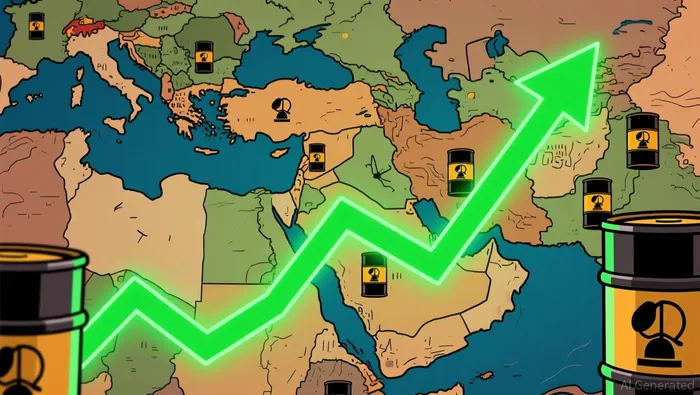
The primary catalyst for DiamondbackFANG-- Energy’s financial performance was a substantial beat on both earnings per share and revenue, driven largely by elevated global oil prices resulting from geopolitical tensions. The Midland, Texas-based producer reported a non-GAAP earnings per share of $6.48, surpassing the consensus estimate of approximately $6.01 to $6.08. Revenue climbed 51.2% year-over-year to $5.56 billion, beating analyst forecasts by a wide margin. This profitability surge was directly linked to the realized oil price, which averaged $94.33 per barrel, a sharp increase from $62.34 in the same period last year. The elevated commodity prices were a direct consequence of the ongoing conflict in the Middle East, specifically the war in Iran which began in late February. This conflict severely disrupted supply chains through the Strait of Hormuz, pushing Brent crude averages to $126.41 and WTI to $109.64 in April, thereby creating a highly favorable pricing environment for U.S. shale producers like Diamondback.
Despite the positive earnings surprise, the market reacted negatively, with shares falling $4.20 to $198.75. This counterintuitive reaction often signals that investors are looking beyond the current quarter’s results to future growth constraints or macroeconomic headwinds. While the company maintained a strong balance sheet, generating $2.3 billion in free cash flow and reducing total debt by approximately $1.3 billion to $12.8 billion, the stock’s downward move indicates that the bullish sentiment surrounding the earnings beat was not enough to offset concerns about valuation or future price sustainability. The stock remains well above its 50-day and 200-day moving averages of $190.79 and $184.65 respectively, but the decline highlights the volatility inherent in energy stocks during periods of geopolitical uncertainty.
Diamondback Energy also provided updated guidance that reflected cautious optimism regarding production growth. The company raised its full-year oil production guidance to 522,000 barrels per day from 520,000 previously, and total production guidance to 1,000,000 barrels of oil equivalent per day from 972,000. However, the company maintained its capital expenditure guidance at approximately $3.9 billion for the year. This discipline in capital allocation, combined with a doubled share repurchase authorization to $16 billion, demonstrates a commitment to returning cash to shareholders while managing growth. The board declared a base dividend of $1.10 per share, and the company repurchased nearly 756,000 shares during the quarter for $141 million. These actions underscore management’s confidence in the company’s cash generation capabilities, even as they navigate a complex geopolitical landscape.
Analyst sentiment remains predominantly bullish, with a consensus "Buy" rating and an average price target of $218.63, implying significant upside from current levels. Major firms such as Raymond James, Susquehanna, and UBS have recently adjusted their price targets, with some raising them to as high as $255. However, the divergence between analyst optimism and the immediate market reaction suggests a disconnect between long-term fundamentals and short-term price sensitivity. The energy sector as a whole is facing headwinds, with the U.S. and Iran peace talks occasionally causing volatility in oil prices. Diamondback’s ability to maintain high realized prices and operational efficiency in the Permian Basin remains its key competitive advantage.
Looking ahead, the sustainability of Diamondback’s stock performance will depend heavily on management’s commentary during the upcoming earnings call and the trajectory of global oil prices. The company’s Zacks Rank is currently a #3 (Hold), reflecting mixed earnings estimate revisions. While the company has beaten consensus estimates in three of the last four quarters, the broader industry faces risks from potential shifts in geopolitical dynamics and OPEC+ production policies. Investors are closely watching to see if Diamondback can sustain its high free cash flow margins, which stood at 46.6% in the second quarter, and whether the company can continue to deleverage its balance sheet while funding its production growth targets. The next earnings call scheduled for November 2, 2026, will be critical in providing clarity on these long-term strategic initiatives.

Stay ahead of the market.
Get curated U.S. market news, insights and key dates delivered to your inbox.


AInvest
PRO
AInvest
PRO




Comments
No comments yet