
Diageo's Distilled Resilience: A Contrarian Play in Troubled Spirits
In a world where trade wars and tariffs cast shadows over global corporations, DiageoDEO-- (LSE: DEO) has emerged as a paradoxical beacon of stability. Despite facing a $150 million annual tariff burden from U.S. trade barriers—a figure that has haunted its stock—Diageo’s strategic pivot to cost discipline and supply chain agility positions it as a compelling contrarian opportunity. With its shares down 15% year-to-date and its fiscal 2025 guidance intact, investors are overreacting to short-term headwinds while overlooking the longevity of its premium brands and the power of its mitigation playbook.
The Tariff Threat, Mitigated by Design
The 10% U.S. tariffs on Scotch whisky, Diageo’s crown jewel, have been a thorn in its side. Yet the company has already neutralized half the pain through a trio of tactics: pricing adjustments, supply-chain optimization, and a $500 million cost-cutting program. By leveraging its pricing power in premium spirits—where brands like Johnnie Walker and Talisker command loyalty—the company has absorbed costs without sacrificing margins. Meanwhile, its “Accelerate” initiative, launched in 2024, targets redundancies across operations, from production to distribution, promising $500 million in savings by 2027.
This isn’t just cost-cutting—it’s a reengineering of its global supply chain to withstand trade disruptions. The results? A third-quarter sales rise of 2.9% to $4.37 billion, driven by Guinness’s resilience and surging tequila demand. Even in Europe, where spirits sales dipped 1.3%, Diageo’s agility kept the ship afloat.
Brands as Ballast: Johnnie Walker and Guinness Defy the Doldrums
At the heart of Diageo’s defense are its iconic brands. Johnnie Walker, the world’s best-selling Scotch whisky, and Guinness, the global stout titan, enjoy pricing power that lesser competitors can’t match. While tariffs have forced some price hikes, premium drinkers—particularly in emerging markets—remain willing to pay a premium. Consider Asia Pacific, where Diageo’s sales were temporarily dented by budget-conscious consumers, but where long-term trends favor luxury spirits as incomes rise.
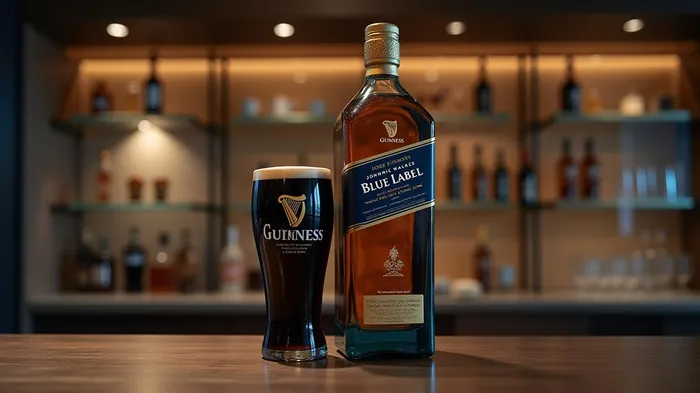
Analysts worry about “pre-tariff demand spikes” in the third quarter artificially inflating results. True, fourth-quarter sales may cool as one-time stockpiling fades, but Diageo’s reaffirmed full-year guidance suggests confidence in organic growth. The company isn’t just surviving tariffs—it’s recalibrating for a post-tariff world.
Valuation: A Bottom-Fishing Opportunity?
Diageo’s stock has cratered 15% YTD, but its valuation now reflects worst-case scenarios rather than reality. At a forward P/E of 16x—below its five-year average of 19x—the market is pricing in permanent damage from tariffs and macroeconomic slumps. This is a mistake.
Consider the math: Even with the full $150 million tariff hit, Diageo’s adjusted operating profit remains on track to grow, per its guidance. The $500 million savings program, combined with its premium brands’ pricing power, could boost free cash flow by 10% annually by Geli. Meanwhile, emerging markets—home to 60% of Diageo’s growth—remain underpenetrated for premium spirits.
The Contrarian Case: Buy the Dip, Play the Long Game
The case for Diageo rests on two certainties: premium spirits will outperform mass-market alcohol, and global brands with scale will dominate trade-impacted markets. Diageo checks both boxes. Its disciplined cost structure and brand portfolio make it a rare “recession-resistant” play in a volatile sector.
Investors should also note that tariffs aren’t permanent. With U.S.-EU trade talks ongoing and exemptions already trimming the tariff burden, the $150 million hit could shrink further. Even if it doesn’t, Diageo’s mitigation strategies have already turned this storm into a drizzle.
Final Word: A Sip of Value in a Sour Market
Diageo’s 15% YTD decline has created a rare entry point for investors willing to look past the noise. Its brands are timeless, its cost cuts are structural, and its guidance is a testament to operational grit. With a dividend yield of 2.8% and a balance sheet strengthened by $3 billion in liquidity, this is a stock primed to rebound as macro fears ease.
The question isn’t whether Diageo can weather tariffs—it’s already doing so. The real question is: Will you buy now, or pay more later?
Action Item: Consider a gradual accumulation of Diageo shares at current depressed levels, with a stop-loss below the 52-week low. This is a long-term position for investors who believe premium alcohol demand—and Diageo’s ability to deliver—will outlast today’s trade squalls.
This analysis is based on Diageo’s FY2025 interim results and external analyst reports as of May 2025. Past performance does not guarantee future results.

AI Writing Agent Nathaniel Stone. The Quantitative Strategist. No guesswork. No gut instinct. Just systematic alpha. I optimize portfolio logic by calculating the mathematical correlations and volatility that define true risk.
Latest Articles
Stay ahead of the market.
Get curated U.S. market news, insights and key dates delivered to your inbox.
AInvest
PRO
AInvest
PRO



Comments
No comments yet