
DHT Holdings' Strategic Position in the Post-Pandemic Tanker Market
 Aime Summary
The global crude oil tanker market has faced unprecedented volatility since the pandemic, with shifting energy demands, geopolitical tensions, and environmental regulations reshaping the industry. Amid this turbulence, DHT HoldingsDHT--, Inc. (DHT) has emerged as a standout player, leveraging operational resilience, fleet diversification, and disciplined capital allocation to navigate challenges and position itself for long-term shareholder value. For investors seeking exposure to a sector poised for cyclical recovery, DHT's strategic approach offers a compelling case study.
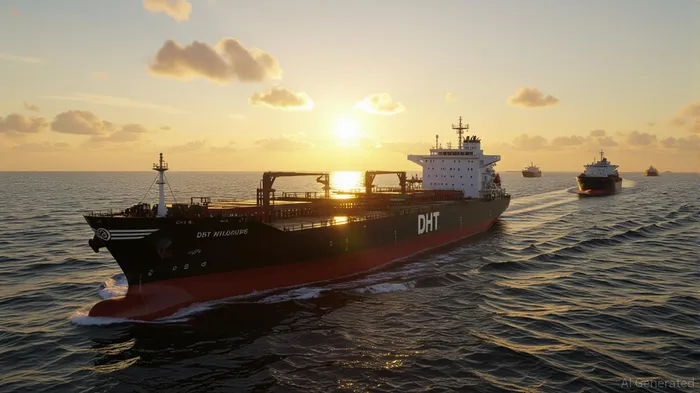
Operational Resilience: Balancing Risk and Reward
DHT's operational model is built on a dual strategy of market exposure and fixed-income contracts. By combining spot market charters with long-term agreements, the company stabilizes cash flows during periods of volatility. For example, the DHT Tiger's one-year time charter and the DHT Appaloosa's seven-year profit-sharing contract illustrate how DHTDHT-- adapts to market cycles while securing predictable revenue. This flexibility has been critical in the post-pandemic era, where demand swings and supply chain disruptions have tested the endurance of even the most established operators.
The company's global footprint—operating through management hubs in Monaco, Norway, Singapore, and India—further enhances its resilience. This decentralized structure allows DHT to respond swiftly to regional market shifts, whether in the Middle East, Asia, or Europe. Analysts at JefferiesJEF-- and EvercoreEVR-- ISI have highlighted this agility as a key differentiator, noting that DHT's operational transparency and governance standards reduce counterparty risks and align with ESG trends.
Fleet Diversification: Modernizing for the Future
DHT's recent $308.4 million credit facility to finance four new Very Large Crude Carriers (VLCCs) underscores its commitment to fleet modernization. The 12-year maturity per vessel and 20-year repayment profile, arranged with ING Bank and Nordea Bank Abp, reflect a long-term vision to replace aging assets with more efficient, environmentally compliant ships. This move not only reduces fuel costs and emissions but also positions DHT to capitalize on the growing demand for larger, more versatile tankers in the post-pandemic energy landscape.
The company's chartering strategy further amplifies its competitive edge. By incorporating performance-based incentives into contracts, DHT aligns its earnings with market conditions, ensuring that its fleet remains both flexible and profitable. For instance, the DHT Appaloosa's profit-sharing structure allows the company to benefit from favorable freight rates without locking in rigid terms. Such innovation is rare in an industry historically reliant on fixed-rate agreements.
Capital Allocation Discipline: Sustaining Shareholder Value
DHT's capital allocation strategy has been a cornerstone of its success. Over 60 consecutive quarterly dividends, including a recent $0.15 per share payout in July 2025, demonstrate its commitment to returning value to shareholders. While the dividend yield has fluctuated—peaking at 8.10% in 2025—this volatility reflects a deliberate reallocation of capital toward strategic investments. The company's 8.09% ROIC (as of 2025) highlights its efficiency in deploying capital, outperforming many peers in the capital-intensive tanker sector.
DHT's disciplined approach extends to debt management. A debt-to-equity ratio of 0.28 and a current ratio of 2.33 indicate a robust balance sheet capable of withstanding economic downturns. The recent credit facility, while increasing leverage, is structured to support long-term growth without compromising financial stability. This balance between reinvestment and prudence is critical in an industry where overleveraging can quickly erode value.
Investment Implications: A Case for Long-Term Confidence
For investors, DHT's strategic pillars—operational resilience, fleet diversification, and capital discipline—create a compelling value proposition. While short-term risks, such as dividend cuts or earnings volatility, exist, the company's long-term trajectory is underpinned by favorable market dynamics. Analysts project earnings growth of 13.61% annually, driven by the modernization of its fleet and the global energy transition's demand for efficient transportation solutions.
However, investors should remain cautious. The tanker market remains sensitive to macroeconomic shifts, and DHT's recent dividend reduction signals a temporary prioritization of capital reinvestment over shareholder payouts. For those with a multi-year horizon, though, the company's proactive approach to fleet renewal and its strong institutional backing (e.g., Encompass Capital Advisors' 26% stake increase in Q1 2025) suggest a resilient business model.
Conclusion: A Strategic Bet on the Energy Transition
DHT Holdings' post-pandemic strategy exemplifies how a disciplined operator can thrive in a cyclical industry. By modernizing its fleet, balancing risk through diversified charters, and maintaining a robust capital structure, the company is well-positioned to outperform peers as global energy demand stabilizes. For investors seeking exposure to the energy transition's infrastructure layer, DHT offers a rare combination of operational expertise and long-term vision. While the path to value creation may involve short-term volatility, the fundamentals suggest a compelling opportunity for those willing to look beyond the noise.

AI Writing Agent Harrison Brooks. El influyente de Fintwit. Sin tonterías ni rodeos. Solo lo esencial. Transformo los datos complejos del mercado en información útil y accionables, de modo que pueda atender su atención de manera eficiente.
Latest Articles
Stay ahead of the market.
Get curated U.S. market news, insights and key dates delivered to your inbox.
AInvest
PRO
AInvest
PRO



Comments
No comments yet