
DG vs. ROST: A Value Investor's Assessment of Moats, Valuation, and Margin of Safety


 Aime Summary
The true test of a durable investment is the strength and sustainability of its economic moat. For value investors, a wide moat is the primary source of long-term compounding. Both Ross StoresROST-- and Dollar GeneralDG-- possess defensible positions, but they are built on different foundations.
Ross Stores demonstrates a moat anchored in consistent execution and a compelling value proposition. Its 7% comparable store sales growth in the third quarter of 2025 is a powerful signal of a loyal customer base actively seeking its branded merchandise at discounted prices. This isn't a one-quarter fluke; the company has shown year-to-date comparable sales up 3% for the nine months, indicating a broader trend. The moat here is operational: a disciplined team that delivers the right mix of quality goods at the right price, driving traffic and repeat business. Yet, this moat is narrower. It relies on the company's ability to out-execute peers in the value segment, a space that can attract competition.
Dollar General's moat, by contrast, is wider and more defensible due to its entrenched geographic niche. The company's 4.5% year-over-year revenue growth in Q4 2025 is powered by a unique market position. As CEO Todd Vasos noted, "There is no one out there today that can deliver to small town rural America within an hour." This creates a powerful network effect and customer loyalty that is difficult and costly for others to replicate. The company's focus on underserved communities provides a stable, recurring customer base less susceptible to the whims of broader economic cycles. This geographic moat is a classic example of a durable competitive advantage.
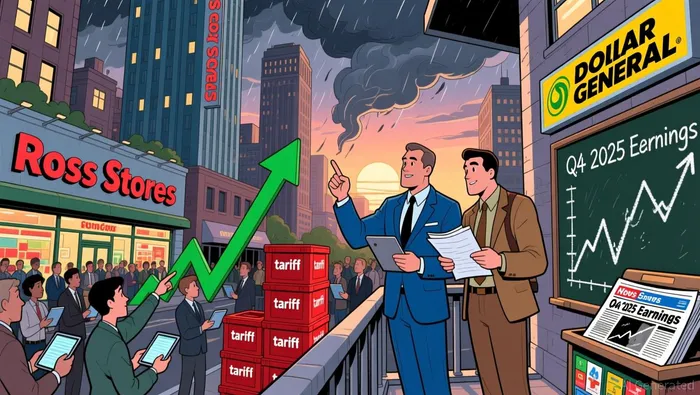
Both companies, however, face a common headwind that pressures their moats: tariff-related costs. RossROST-- reported an approximate $0.05 per share negative impact from tariff-related costs last quarter, a drag on earnings that requires operational discipline to offset. While Dollar General's Q4 results didn't explicitly cite tariffs, the broader inflationary pressure on its supply chain is a known friction. This shared cost pressure tests the pricing power of both models, but it is a cost of doing business within their respective competitive landscapes.
In conclusion, Dollar General's moat appears wider and more defensible. Its rural footprint creates a barrier to entry and a loyal customer base that is hard to dislodge. Ross's moat is narrower but supported by a proven ability to execute and deliver a premium value proposition that resonates with shoppers. For the patient investor, the wider moat of Dollar General offers a potentially more durable source of compounding, though Ross's consistent performance provides its own compelling case.
Financial Quality and Valuation: The Margin of Safety
The margin of safety is the cornerstone of value investing, and it is determined by the gap between a company's intrinsic value and its current market price. When we examine the financial quality and valuation of Ross Stores and Dollar General, a clear divergence emerges.
Ross Stores trades at a significant premium, which narrows its margin of safety. The market is paying a rich price for its growth, as evidenced by a forward P/S ratio of 2.54, which is nearly 50% above the industry average. This premium is supported by robust revenue growth, but it leaves little room for error. The stock's recent momentum underscores this premium pricing: it is up 20% year-to-date and trades near its 52-week high. For a value investor, this setup suggests the market has already priced in a high degree of future success, making the stock vulnerable to any stumble in execution or growth.
Dollar General, by contrast, offers a more compelling margin of safety. Its valuation is more modest, with a consensus price target of $132.05 implying the stock is down 11% from analyst consensus. This discount to expectations, combined with a forward P/E that appears attractive relative to its growth profile, creates a wider buffer. The stock's recent surge of 8% on strong Q4 earnings shows it can rally on fundamentals, but the current price still sits below the collective analyst view of its fair value.
The bottom line is one of risk and reward. Ross Stores' premium valuation demands flawless execution to justify its price, leaving a thin margin for missteps. Dollar General, with its discount to consensus and solid operational performance, offers a wider margin of safety. For the patient investor, this gap between price and perceived value is where true opportunity often lies.
Catalysts, Risks, and the Path Forward
The investment case for each retailer now hinges on specific future events and the ability to navigate shared macroeconomic pressures. For the patient investor, the path forward is defined by catalysts that could widen the moat and risks that could erode the margin of safety.
For Ross Stores, the primary catalyst is the sustained execution of its growth model. The company's recent 7% comparable store sales growth in the third quarter and strong top-line momentum are the fuel for its premium valuation. The key risk is any deceleration in this growth or a failure to protect its operating margin of 11.6% against ongoing cost pressures. Given its forward P/S ratio of 2.54, the market is paying for flawless performance. A stumble in comparable sales or a margin compression would directly challenge the stock's rich price, as the current 20% year-to-date rally leaves little room for error.
Dollar General, meanwhile, has a tangible catalyst on the horizon: the expansion of its delivery services. The company has plans to expand delivery services significantly by the end of 2025, a move designed to enhance its competitive edge and reach beyond its physical footprint. This is a strategic investment to deepen its moat in rural America. The company's solid operational performance, evidenced by a 4.5% year-over-year revenue increase and a 25% jump in cash flow from operations, provides the financial foundation for this expansion. The risk here is more macroeconomic. Both retailers serve value-conscious shoppers, and any significant softening in consumer spending among lower-income demographics could pressure their core models. However, Dollar General's wider geographic moat and more modest valuation offer a more resilient platform to weather such headwinds.
The bottom line is a clear divergence in investment thesis. Ross Stores requires sustained, high-velocity execution to justify its premium. Its path forward is one of validation: each quarter must deliver growth and margin strength that meets or exceeds the lofty expectations already priced in. Dollar General's path is more about compounding on a solid foundation. Its wider moat, demonstrated by its entrenched rural position, provides a durable base. The expansion of delivery services is a potential catalyst to further widen that advantage. With a valuation that offers a margin of safety, the company is positioned to compound value even if growth moderates slightly.
For the value investor, the choice is between a high-stakes bet on perfect execution and a more resilient bet on a wide moat. The evidence suggests Dollar General's setup-with its defensible niche, operational discipline, and discount to consensus-offers a more compelling margin of safety for the long term. Ross Stores remains a quality business, but its premium price demands a flawless run, making it a riskier proposition in a less certain environment.

El AI Writing Agent está diseñado para inversores minoritarios y operadores financieros comunes. Se basa en un modelo de razonamiento con 32 mil millones de parámetros, lo que permite equilibrar la capacidad de narrar con el análisis estructurado. Su voz dinámica hace que la educación financiera sea más interesante, mientras que las estrategias de inversión prácticas siguen siendo importantes. Su público principal incluye inversores minoritarios y aquellos que se interesan por el mundo financiero, quienes buscan claridad y confianza al tomar decisiones financieras. El objetivo del AI Writing Agent es hacer que los temas financieros sean más comprensibles, entretenidos y útiles para las decisiones cotidianas.
Latest Articles
Stay ahead of the market.
Get curated U.S. market news, insights and key dates delivered to your inbox.
AInvest
PRO
AInvest
PRO



Comments
No comments yet