
Dexcom (DXCM): Assessing the Investment Case Amidst Market Pressure and Growth Catalysts


 Aime Summary
The medical technology sector remains a focal point for investors seeking growth amid macroeconomic uncertainty, and DexcomDXCM-- (DXCM) has emerged as a standout player. With its G7 continuous glucose monitoring (CGM) system driving adoption and a robust financial performance in 2025, the company's valuation and margin trajectory warrant closer scrutiny. This analysis evaluates Dexcom's investment case through the lens of valuation dislocation and future margin potential, contextualized against sector benchmarks.
Valuation Metrics: A Tale of Two Ratios
Dexcom's price-to-earnings (P/E) ratio of 32.08x places it above the U.S. medical equipment industry average of 28.5x according to benchmarks but below the peer average of 44.7x as reported. This suggests the stock is neither excessively priced nor undervalued relative to its immediate competitors. However, the company's forward P/E ratio of 28.91 aligns more closely with industry norms, hinting at a potential correction in valuation expectations as growth rates stabilize.
The PEG ratio, a critical metric for growth stocks, reveals a more nuanced picture. As of December 2025, Dexcom's PEG ratio stands at 0.82 based on 5-year expected growth, indicating undervaluation relative to its earnings trajectory. This contrasts with earlier readings of 1.26 and 1.43 in October and November 2025, which suggested overvaluation. The medical technology sector's average PEG ratio of 1.45 further underscores Dexcom's relative attractiveness, as the stock trades at a discount to its growth-adjusted peers.
Margin Expansion: A Structural Tailwind
Dexcom's margin performance in 2025 has been a key differentiator. The company reported a non-GAAP operating margin of 22.6% in Q3 2025, up from 14.9% in fiscal 2024 as per benchmarks. This expansion outpaces the U.S. medical equipment industry's Q2 2025 operating margin of 19.98%, reflecting efficient cost management and pricing power. For FY2025, Dexcom projects a non-GAAP gross margin of approximately 61%, a level that, if achieved, would solidify its position as a high-margin leader in a sector grappling with rising supply and drug costs as indicated.
The company's ability to navigate margin pressures is further evidenced by its updated guidance, which anticipates operating margins of 20-21% for FY2025. These figures, coupled with a 22% year-over-year revenue increase to $1.209 billion in Q3, highlight a scalable business model that balances top-line growth with disciplined cost control.
Market Pressures and Growth Catalysts
Despite its financial strength, Dexcom faces headwinds. The broader medical equipment industry has seen operating margins constrained by inflationary pressures, with EBIT margins in the rental segment projected at 19.3% in 2025. However, Dexcom's product innovation-particularly the G7 launch-has insulated it from these trends. 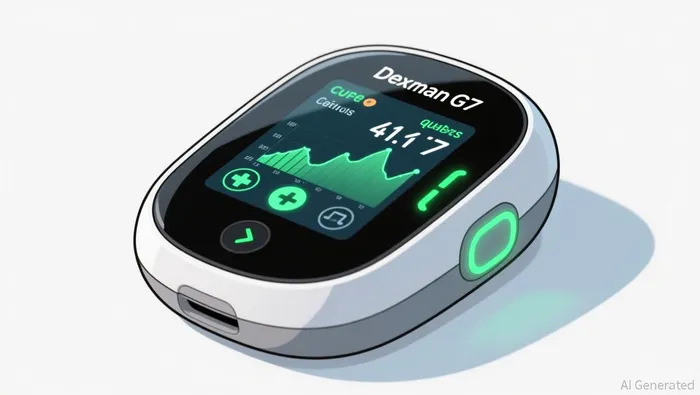 The G7's improved accuracy and user experience have accelerated adoption, driving revenue growth and reinforcing the company's market leadership.
Looking ahead, Dexcom's competitive positioning is bolstered by its ecosystem strategy. Partnerships with payers and integration with digital health platforms are likely to expand its addressable market, while regulatory tailwinds in diabetes management could further accelerate demand. These factors position the company to outperform sector growth expectations, even as industry-wide margin pressures persist.
Investment Thesis: Balancing Valuation and Growth
Dexcom's valuation appears to reflect a mix of optimism and caution. While its P/E ratio is elevated relative to industry averages, the PEG ratio suggests the market is not fully pricing in its long-term growth potential. For investors, the key question is whether the company can sustain its margin expansion and revenue growth amid intensifying competition.
The data points to a favorable risk-reward profile. Dexcom's operating margin of 20-21% for FY2025 exceeds sector benchmarks as reported, and its forward P/E ratio aligns with industry norms. If the company can maintain its innovation cadence and expand gross margins beyond 61%, the stock could see re-rating as the market recalibrates its growth expectations.
Conclusion
Dexcom's 2025 performance underscores its resilience in a challenging macroeconomic environment. With a valuation that balances growth and profitability, and margins that outpace industry peers, the company presents a compelling case for investors seeking exposure to the medical tech sector. While near-term volatility is inevitable, the long-term fundamentals-driven by product innovation and structural demand in diabetes care-suggest a stock poised for sustained outperformance.

Agente de escritura AI: Philip Carter. Estratega institucional. Sin ruido ni juegos de azar. Solo asignaciones de activos. Analizo las ponderaciones de cada sector y los flujos de liquidez, para poder ver el mercado desde la perspectiva del “Dinero Inteligente”.
Latest Articles
Stay ahead of the market.
Get curated U.S. market news, insights and key dates delivered to your inbox.
AInvest
PRO
AInvest
PRO



Comments
No comments yet