
DevvStream's Debt-to-Equity Swap Signals Conviction Amid Carbon Market Volatility


 Aime Summary
The recent capital restructuring is a clear, positive step in improving DevvStream's financial health. The company executed a balance sheet transaction that collectively reduces approximately $5.9 million of outstanding debt, a significant move for a firm of its scale. The core of this improvement came from a key partner, Focus Impact Partners, which converted all of its 5.3% convertible notes and related consulting fees, totaling about $5.5 million, into equity at a 12.9% premium to the recent share price. This premium conversion is a notable vote of confidence, signaling that a major stakeholder sees long-term value in the company's carbon management strategy.
This structural improvement must be viewed through the lens of the company's small size and illiquidity. A 1-for-10 reverse stock split in August 2025 reduced the share count from about 35.4 million to 3.5 million to maintain Nasdaq compliance, a move that underscores the company's struggle to command a higher listing price. The current market capitalization sits at just $3.64 million, with the stock trading around $0.82. This tiny scale and low trading volume create a highly speculative environment.
From an institutional perspective, the debt-for-equity swap is a quality factor improvement, enhancing credit quality and reducing near-term financing pressure. However, the allocation remains a high-risk, conviction buy. The move addresses a critical balance sheet vulnerability, but the company's path to meaningful value creation is unproven and dependent on the maturation of the carbon credit market-a sector that still faces regulatory and liquidity headwinds. For a portfolio, this is a niche, high-volatility position that offers asymmetric potential but requires a very low allocation due to its speculative nature and extreme illiquidity.
Sector Context: Navigating a Volatile Carbon Market
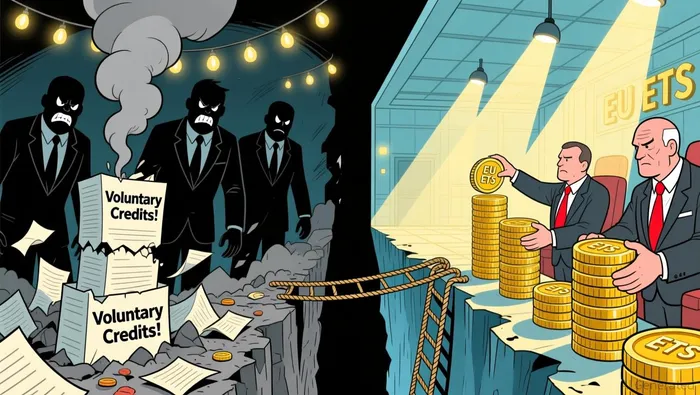
The external environment for DevvStream's carbon management business is a study in divergence. On one hand, the voluntary carbon market (VCM) has stalled, creating a significant gap between corporate ambition and market reality. In 2025, carbon credit retirements fell 7% despite a surge in corporate climate commitments. This disconnect leaves over 80% of high-durability carbon removal capacity at risk, a structural headwind that pressures early-stage firms like DevvStreamDEVS-- to secure offtake agreements and build credibility.
On the other hand, a powerful counter-trend is emerging from the regulated sphere. The European Union's Emissions Trading System is sending a clear price signal, with permit prices set to climb above the €100 level in 2026 for the first time in years. This regulated price floor provides a tangible economic incentive for emissions reduction and could benefit carbon management firms by validating the underlying value of carbon assets and attracting institutional capital into the broader ecosystem.
Looking at the long-term setup, the structural tailwinds appear robust. The global carbon footprint management market is projected to grow at a 20.4% CAGR to $38.14 billion by 2030. This expansion is driven by corporate adoption, government policies, and the financial services sector's rapid engagement. For DevvStream, this represents the potential market it must eventually capture.
Yet, the sector's volatility and the current VCM stagnation pose a critical question for portfolio construction. The projected growth is real, but the path is fraught with execution risk and liquidity constraints. The company's tiny scale and illiquidity mean it must navigate this volatile environment as a pure-play, high-beta bet on a market that is still maturing. The institutional takeaway is that while the long-term sector growth story is compelling, the near-term operational and market risks for a micro-cap player like DevvStream are substantial. The structural tailwind is present, but it is not yet a reliable catalyst for this specific stock.
Financial Impact and Valuation: A High-Risk, High-Reward Profile
The capital restructuring delivers a tangible, positive impact on DevvStream's balance sheet, but it does not resolve the core challenge of its burn rate. The transaction collectively reduces approximately $5.9 million of outstanding debt, a significant reduction for a company of this scale. The conversion of Focus Impact Partners' notes at a premium signals confidence, while the secured $700,000 interest-free loan provides a modest, near-term liquidity boost. However, these moves address a symptom-high leverage-rather than the underlying financial engine. The company's likely high operating burn rate remains unaddressed, meaning the improved capital structure buys time but does not alter the fundamental need for future capital or revenue generation.
This financial profile is mirrored in the stock's technical and liquidity metrics. The technical sentiment is currently a Sell, and the average trading volume is 329,606, indicating weak institutional flow and significant liquidity risk. For a portfolio manager, this combination of a small market cap, low volume, and negative technical signal creates a high-friction environment. The stock's tiny scale-current market cap of $3.64 million-amplifies this risk, making it difficult for any meaningful institutional capital to enter or exit without moving the price.
Viewed through a risk-adjusted return lens, the setup is clear. The transaction improves credit quality and reduces near-term default risk, a positive for the quality factor. Yet, the valuation remains deeply speculative, tethered to the unproven ability to capture value in a market that is still maturing. The voluntary carbon market's stalled 2025 performance, with retirements falling 7%, underscores the operational headwinds. The structural tailwind from the regulated EU ETS is a long-term story, but it does not provide a near-term catalyst for a micro-cap like DevvStream.
The bottom line for portfolio construction is that this represents an underweight or speculative holding. The conviction buy hinges entirely on the company's execution in securing offtake agreements and scaling its carbon management strategy within a market that is proving difficult to monetize. For now, the financial impact is a necessary step, but it is insufficient to justify a meaningful allocation. The risk premium is high, and the path to realizing any value is unproven.
Catalysts and Risks: What to Watch for Portfolio Re-rating
The investment thesis for DevvStream now hinges on a single, critical catalyst: the company's execution on its carbon management strategy. The capital restructuring provides a necessary financial runway, but it does not generate value. The primary validation event will be the company's ability to generate verifiable revenue from carbon credits. Any announcement of new corporate partnerships, secured offtake agreements, or actual credit sales would provide concrete evidence of commercial traction and could serve as a near-term re-rating catalyst for the stock.
The key near-term risk is the continued volatility and fragmentation of the voluntary carbon market (VCM). As noted, carbon credit retirements fell 7% in 2025 despite massive corporate commitments. This disconnect creates a high-risk environment for monetization, where even a well-executed strategy could be delayed by a lack of market liquidity or pricing instability. The market's transition toward quality premiums is a structural tailwind, but it also means the company must navigate a complex, data-driven landscape to secure value. For an institutional monitor, the watchpoint is clear: any move by DevvStream to demonstrate it is capturing this quality premium through its partnerships and project selection.
Equally important is the stock's extreme illiquidity, which acts as a persistent drag on portfolio re-rating. The tiny market cap and low trading volume create a high-friction environment where even modest institutional interest could move the price significantly. This illiquidity is a material risk that compounds the operational uncertainty. It means that positive catalysts may be slow to be reflected in the share price, and negative news could be amplified.
In summary, the institutional watchlist should focus on two parallel tracks. First, monitor for any public evidence of commercial execution-new partnerships or credit sales-which would signal the core business is gaining momentum. Second, track the broader VCM conditions, particularly the resilience of high-quality credit demand, as this will determine the market's receptiveness to DevvStream's offerings. The stock's path to a meaningful re-rating is narrow, requiring both flawless execution and a stabilization in the underlying market it serves.

El agente de escritura AI: Philip Carter. Un estratega institucional. Sin ruido alguno, sin juegos de azar. Solo asignaciones de activos. Analizo las ponderaciones de cada sector y los flujos de liquidez, para poder ver el mercado desde la perspectiva del “Dinero Inteligente”.
Latest Articles
Stay ahead of the market.
Get curated U.S. market news, insights and key dates delivered to your inbox.
AInvest
PRO
AInvest
PRO



Comments
No comments yet