
Devon Energy Dives 3.33% as Bearish Engulfing Pattern and Death Cross Signal Downtrend
 Aime Summary
Devon Energy (DVN) Technical Analysis
Candlestick Theory
Recent price action for Devon EnergyDVN-- reveals a bearish bias, with the most recent session closing at $35.72 after a 3.33% decline. The candlestick pattern suggests a potential bearish engulfing formation, as the prior bullish candle (closing at $36.95) is fully contained within the subsequent bearish candle. Key support levels are forming around $35.71 (recent low) and $34.95 (prior swing low), while resistance clusters near $37.04 (December 17 high) and $37.52 (December 12 high). A breakdown below $35.71 may target $34.50–$34.00 as short-term support, while a rebound above $37.04 could retest $37.50–$38.00.
Moving Average Theory
Short-term momentum is bearish, with the 50-day MA (approx. $34.80) below the 100-day MA ($35.20) and 200-day MA ($34.50), forming a death cross. The price is currently trading below all three averages, confirming a downtrend. A bullish crossover of the 50-day above the 100-day would suggest a potential short-term rally, but this is unlikely without a break above $37.00. The 200-day MA at $34.50 acts as a critical psychological level; a sustained close below this could accelerate the decline toward $33.00–$32.50.
MACD & KDJ Indicators
The MACD histogram has turned negative, with the line crossing below the signal line, reinforcing bearish momentum. The KDJ stochastic oscillator shows the %K line dipping below %D, indicating oversold conditions (RSI near 25). However, the RSI remains below 30, suggesting the downtrend may persist. Divergence between the KDJ and price action is notable: while the price makes lower lows, the stochastic lines have not confirmed a stronger oversold signal, hinting at potential exhaustion in the sell-off. 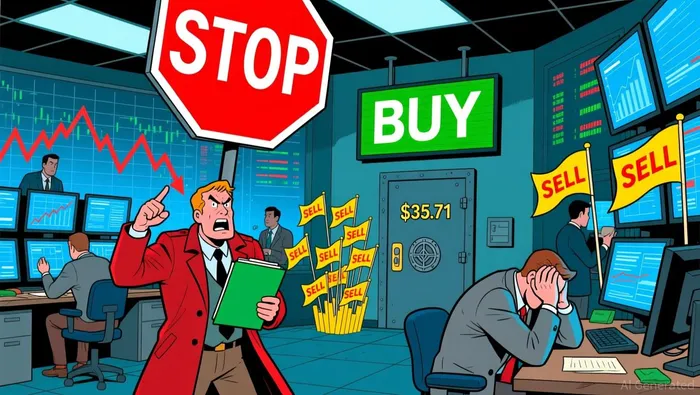
Bollinger Bands
Volatility has expanded as the price approaches the lower Bollinger Band, with the 20-day band width at 1.25. The current price of $35.72 is near the 2σ level, suggesting a potential bounce. However, the bands have widened from a prior contraction (December 15–16), indicating a breakout phase. A break below the lower band may trigger increased volatility, while a rebound above the middle band ($36.20) could test the upper band at $37.00.
Volume-Price Relationship
Trading volume spiked on the most recent decline (8.14 million shares), validating the bearish move. However, volume has been mixed in preceding sessions, with lower volume on the December 17 rally to $36.95. This suggests weakening conviction in the downtrend. A surge in volume on a rebound above $36.00 would strengthen bullish case, while declining volume on further declines could signal capitulation.
Relative Strength Index (RSI)
The 14-day RSI stands at 27, confirming oversold conditions. Historically, RSI levels below 30 have acted as a floor for short-term rebounds, but the lack of a clear bullish divergence (price lows vs. RSI lows) implies the oversold reading may not trigger a reversal. A sustained close above $37.00 is required to push RSI above 30, but this appears unlikely without a catalyst.
Fibonacci Retracement
Key Fibonacci levels from the December 12 high ($38.28) to the December 18 low ($35.71) include 23.6% at $37.40, 38.2% at $37.00, and 61.8% at $36.20. The price is currently consolidating near the 38.2% retracement level, which coincides with the 50-day MA. A break below the 61.8% level ($36.20) would target $35.50 (78.6% retracement), while a rebound above $37.40 could retest $38.00.
Confluence and Divergences
Confluence is evident at $35.71–$35.72, where support from candlestick patterns, Bollinger Bands, and Fibonacci levels align. This zone offers a high-probability area for a short-term bounce. However, divergences exist between the KDJ oscillator and price action, as the former has not confirmed stronger oversold conditions despite lower lows. This suggests the downtrend may persist unless a bullish catalyst emerges.
Probabilistic Outlook
While the technical setup suggests a continuation of the downtrend in the near term, short-term traders may find opportunities to buy dips near $35.71–$35.50 if RSI confirms oversold exhaustion. However, a break below $34.50 (200-day MA) would likely extend the decline toward $33.00. Conversely, a sustained close above $37.00 could invalidate the bearish bias and trigger a countertrend rally. Investors should monitor volume dynamics and divergences in momentum indicators for early signals of a reversal.

If I have seen further, it is by standing on the shoulders of giants.
Latest Articles
Stay ahead of the market.
Get curated U.S. market news, insights and key dates delivered to your inbox.
AInvest
PRO
AInvest
PRO



Comments
No comments yet