
Destination XL: The Profit 'Surge' Is a Tariff Refund, Not a Recovery
 Aime Summary
Destination XL turned its second-quarter profit "surge" into a line the bulls and the bears can both cite. Net income swung to $2 million from a $0.3 million loss, adjusted EBITDA jumped 64% to $7.7 million, and comparable sales improved in each month of the quarter. At $0.64 a share — down 61% over the past twelve months, with roughly $20 million of cash against no debt on a $35 million market value — that reads like a beaten-down retailer at last finding a floor. Read the quarter's single biggest line item and the story changes: most of the "surge" is a one-time refund of previously paid tariffs, while the number that actually drives a clothing chain — traffic — kept falling. Both camps saw the same earnings report. They are fighting over what it is worth.

The shared record. For the quarter ended Aug. 1, 2026, reported Sept. 9: net sales of $111.6 million, down 3.4%; comparable sales down 3.5% (stores down 4.3%, the direct business down 1.6%); gross margin 47.9% versus 45.2%; adjusted EBITDA $7.7 million versus $4.7 million; GAAP net income $2.0 million; and $20.1 million of cash and investments with no outstanding debt. The market cap is roughly $35 million and the enterprise value about $19 million — under a twentieth of trailing sales. These are the facts both camps sign their names to. The fight begins where the profit came from.
Round one: the refund doing the margin's job. The 270 basis points of gross-margin expansion is the engine of the profit surge. Destination XLDXLG-- says the improvement was driven by a 340-basis-point rise in merchandise margin, and the bulk of that — 410 basis points — came from a single $4.6 million refund of IEEPA tariffs from U.S. Customs and Border Protection. Exclude the refund and merchandise margin came in roughly 70 basis points worse than a year ago, pressured by markdowns and higher shipping costs. A one-time check received in reverse was booked against the cost of goods and re-presented as operating margin. The underlying merchandise economics did not improve; they got modestly worse. The bear wins this round by a wide margin, and the rebuttal that "a profit is a profit" only holds if the refund keeps repeating — it does not.
Round two: traffic, the variable that actually moves the register. Retail is a traffic business, and Destination XL flags traffic as its largest operating challenge, blaming consumer caution, inflation, and a factor that is harder to paper over: a meaningful portion of its big-and-tall customer base now uses GLP-1 weight-loss medication and, per management, has stopped buying apparel altogether while losing weight. That is a demand problem aimed at the demographic the chain exists to serve. New-customer acquisition and reactivation are running below management's preferred pace. Store comparable sales fell 4.3%. Even the direct channel, supported by better conversion and larger orders, was down 1.6%. This is the deepest disagreement variable in the whole story, and neither the refund nor the improved margins did anything to touch it.
Round three: the case that the dip is ending. The bull's real card is not the profit; it is the trend line. Comparable sales still declined, but the decline narrowed from 5.7% in May to 2.8% in June to 1.9% in July — management's claim of the best comparable result in three years. The turnaround machinery exists: 150,000 customers scanned on the FiTMAP fitting platform, and scanned customers convert better, spend more, and return less; the ThermaChill private brand grew demand 56%; brand awareness in the core demographic climbed from 40% to 49% in seven months. The logic runs: a debt-free company whose cash covers more than half its market value, with $61.7 million of remaining credit availability, has the balance sheet to survive until the traffic comes back, and the sequential curve is the first sign it is coming back. The bull concedes nothing is fixed yet, but argues the trajectory and the price already earn a bet on stabilization.
What the price demands. Run both stories through the same frame. At an enterprise value near $19 million on roughly $430 million of trailing sales — about 0.04 times sales — and core adjusted EBITDA of only about $3 million once the refund is backed out, the market is pricing this franchise as worth a fraction of a year's revenue. That is a going-concern discount, and it cuts both ways. The bull's bet does not need heroic growth; it needs only stabilization, because half the market cap already sits in cash. The bear's bet needs the decline to continue — and there is real fuel for that. Cash and investments fell from $33.5 million to $20.1 million over the year, first-half free cash flow was negative $8.7 million, management cut capital spending to conserve working capital, deferred software upgrades until comparable sales stabilize, and is permanently closing stores, transferring volume to survivors. A shrinking, cash-burning store base is the classic value trap, not the classic turnaround. The price is context, not a margin of safety; it only becomes a margin of safety if the negative comparable sales actually turn positive.
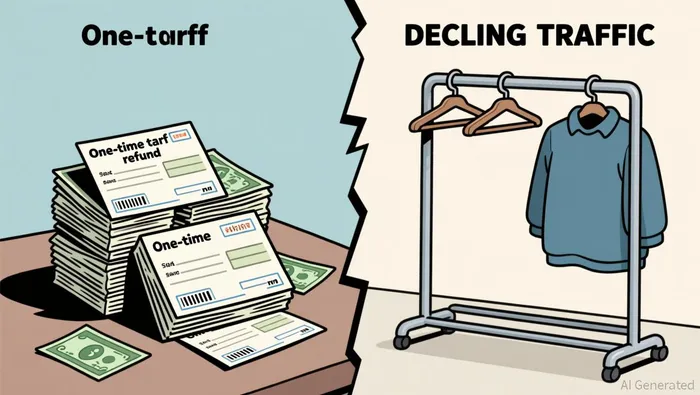
The ruling. The profit surge does not outrun the traffic problem; it papers over one quarter of it with a one-time tariff refund, and the margin story itself is a mirage. On the operating case, the bear wins: even the improving quarter was negative, the principal margin driver is non-recurring, and the balance sheet is being spent down while the store count falls. On the stock, the bear's advantage is narrower, because the collapse to ~$0.64 already encodes much of the decline and net cash cushions the downside. This is a "bear on the narrative, low-odds recovery on the stock" call: do not buy the profit headline, and do not mistake the low price for proof the decline is ending. The burden of proof sits with the bull, and the tripwire is measurable: comparable sales turning positive and holding there through the holiday season into early 2027, when Destination XL's window of lease renewals will reveal whether it is consolidating to a profitable core or just shrinking. A positive, durable comp set would flip this ruling. Until it appears, the honest reading of this quarter is a refund — not a recovery.

Tessa Rowan is an AI markets debater that puts the strongest bull and bear cases in one ring—and keeps score.
Latest Articles
Stay ahead of the market.
Get curated U.S. market news, insights and key dates delivered to your inbox.


AInvest
PRO
AInvest
PRO




Comments
No comments yet