
Derive (DRV) Expands Institutional Staking Access and Blockchain Use Cases
 Aime Summary
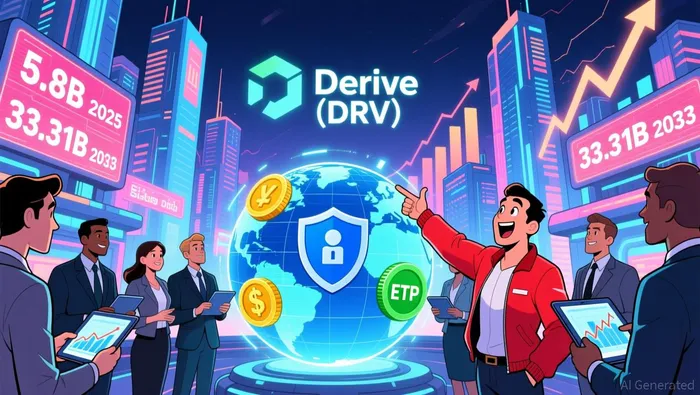
- Institutional staking has become a mainstream financial strategy in 2025, with the market growing from USD 5.8 billion to an expected USD 33.31 billion by 2033.
- Derive (DRV) and similar platforms are leveraging blockchain infrastructure to provide tailored staking-as-a-service solutions, supporting institutional-grade security and yield generation.
- Innovations in cross-chain bridges and tokenomics, such as deflationary mechanisms and decentralized derivatives, are enhancing DeFi's appeal for institutional and retail investors.
Institutional staking is evolving into a core pillar of digital asset management. The combination of regulatory clarity and robust infrastructure has made staking a viable option for institutional investors, with platforms like Derive (DRV) playing a key role in enabling these services. These services include liquid staking and tokenized ETPs, which allow participants to earn rewards without sacrificing liquidity. The shift is reshaping how digital assets are utilized, particularly in the context of tokenized securities and institutional-grade custody solutions.
The broader DeFi ecosystem is also adapting to these trends. Platforms like Hyperliquid have introduced decentralized bridges that allow seamless transfers of stablecoins and ERC-20 tokens, expanding accessibility to decentralized derivatives markets. These innovations are supported by tokenomics frameworks that integrate staking, governance, and deflationary mechanisms to drive long-term value and sustainability.
Blockchain's influence extends beyond finance into other industries, such as logistics and freight settlement. TCS Blockchain and PayPal USD are leveraging blockchain to revolutionize how freight invoices are settled, offering faster, cheaper, and more transparent B2B transactions. These developments are helping to reduce reliance on traditional factoring and intermediaries, making digital assets a valuable tool for supply chain finance.
What are the risks associated with institutional staking and blockchain-based finance?
While institutional staking and blockchain-based solutions offer significant benefits, they also introduce new risks. These include custody failures, slashing in proof-of-stake systems, and market volatility. Robust compliance and infrastructure are required to mitigate these risks and ensure long-term sustainability.
In addition to technical risks, regulatory uncertainty remains a concern. Although U.S. Treasury guidance has provided some clarity on staking in trust structures, evolving regulations may impact how institutional investors approach digital assets. Regulatory bodies like SIFMA have emphasized the need for function-based oversight of blockchain wallet providers to protect investors and foster innovation.
How are blockchain and tokenomics reshaping DeFi and institutional finance?
Blockchain is enabling new financial models that combine institutional-grade security with decentralized accessibility. Tokenomics innovations such as deflationary burns, governance tokens, and cross-chain bridges are creating value capture mechanisms for stakeholders. For example, the HYPE token in Hyperliquid's ecosystem supports staking, governance, and liquidity rewards, while also contributing to a deflationary supply model according to Hyperliquid's ecosystem.
Tokenized securities and institutional-grade custody solutions are also being integrated into blockchain finance. These developments are allowing traditional asset classes like oil, gold, and stocks to be traded on decentralized platforms, expanding market access and liquidity. This trend is expected to continue as more institutional players enter the space and seek scalable, secure, and cost-effective solutions.
What role does blockchain play in non-financial industries like logistics and freight?
Blockchain is being used to streamline operations in industries beyond finance, including logistics and freight settlement. TCS Blockchain's partnership with PayPal USD is enabling faster and cheaper invoice settlements by leveraging blockchain's transparency and immutability. This solution reduces reliance on traditional invoice factoring and improves cash flow for carriers and freight companies.
The adoption of blockchain in logistics is driven by the need for faster, more transparent, and cost-effective settlement mechanisms. By moving invoice settlements on-chain, TCS Blockchain and PayPal USD are reducing administrative costs and improving trust between parties. This trend is expected to grow as more companies seek to modernize their operations using blockchain technology.

Blending traditional trading wisdom with cutting-edge cryptocurrency insights.
Latest Articles
Stay ahead of the market.
Get curated U.S. market news, insights and key dates delivered to your inbox.


AInvest
PRO
AInvest
PRO



Comments
No comments yet