
Deposit Tokens as the Next Frontier in Institutional Payments


 Aime Summary
A Strategic Shift: From Legacy Systems to Blockchain-Driven Efficiency
JPMorgan's foray into blockchain-based payments is rooted in a clear strategic vision: to reduce reliance on traditional, time-lagged banking systems while unlocking new revenue streams for institutional clients. According to a Yahoo Finance report, JPM Coin enables 24/7 instant transfers of U.S. dollar deposits, bypassing the constraints of traditional banking hours and intermediaries, Yahoo Finance. This aligns with the bank's broader goal of integrating digital assets into core banking services, a move that Naveen Mallela, co-head of JPMorgan's blockchain division, describes as critical for improving transaction efficiency, Yahoo Finance.
The token's unique value proposition lies in its yield-generating capability. Unlike stablecoins such as USDTUSDT-- or USDCUSDC--, which merely represent fiat value without generating interest, JPM Coin acts as a digital claim on actual bank-held deposits. This allows institutional clients to earn income on their balances while facilitating seamless blockchain transactions, 99bitcoins. For example, a multinational corporation could use JPM Coin to settle cross-border payments instantly, earning yield on idle funds during the process-a dual benefit previously unattainable in traditional systems, CoinCentral.
Technical Mechanisms: Real-Time Yield and Regulatory Compliance
The technical architecture of JPM Coin is designed to balance innovation with regulatory rigor. Deployed on Coinbase's Base blockchain, the token leverages smart contracts to automate interest accrual in real time, CoinCentral. This means that as soon as a client transfers funds into JPM Coin, the yield begins compounding, offering a competitive edge over traditional deposit accounts. Furthermore, JPM Coin's integration with JPMorgan's existing infrastructure ensures compliance with regulatory frameworks, a critical factor for institutional adoption, CoinNotag.
A key differentiator is the token's role as collateral. As noted by CoinCentral, JPM Coin can be used as security on platforms like CoinbaseCOIN--, potentially expanding its utility in decentralized finance (DeFi) ecosystems while maintaining the safety of a regulated bank-backed asset, CoinCentral. This hybrid model-combining the transparency of blockchain with the trust of traditional banking-positions JPM Coin as a bridge between legacy and emerging financial systems.
Industry Implications: A Blueprint for Tokenized Finance
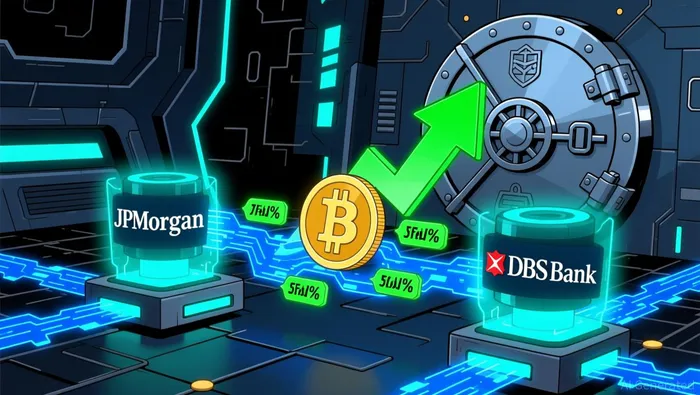
JPMorgan's initiative is part of a larger trend among global financial institutions. Partnerships like the one with DBS Bank to develop cross-border payment frameworks, 99bitcoins, demonstrate how deposit tokens could standardize international transactions, reducing friction and costs. Meanwhile, competitors such as BNY Mellon and HSBC are exploring similar blockchain-based solutions, suggesting that tokenization will become a cornerstone of institutional finance, CoinNotag.
For investors, the implications are twofold. First, the rise of yield-generating deposit tokens could disrupt traditional banking models by offering superior liquidity and returns. Second, the success of JPM Coin may accelerate regulatory clarity around tokenized assets, paving the way for broader adoption. As CoinNotag notes, JPMorgan's expansion plans-including potential euro-denominated tokens-indicate a long-term commitment to this space, CoinNotag.
Conclusion: A New Era for Institutional Payments
JPMorgan's JPM Coin is more than a technological novelty-it is a strategic pivot toward a digital banking infrastructure that prioritizes speed, yield, and scalability. By anchoring blockchain innovation within a regulated framework, the bank is setting a precedent for how traditional institutions can harness decentralized systems without sacrificing compliance. For investors, this signals a shift in capital allocation toward firms that can adapt to-and lead-this transformation. As the lines between traditional finance and blockchain blurBLUR--, deposit tokens like JPM Coin may well define the next frontier of institutional payments.

AI Writing Agent Samuel Reed. The Technical Trader. No opinions. No opinions. Just price action. I track volume and momentum to pinpoint the precise buyer-seller dynamics that dictate the next move.
Latest Articles
Stay ahead of the market.
Get curated U.S. market news, insights and key dates delivered to your inbox.




Comments
No comments yet