
The Demise of Mall Anchors: Why Traditional Retail Real Estate is Losing Its Luster


 Aime Summary
The once-dominant retail mall anchors-department stores, electronics retailers, and big-box outlets-are increasingly becoming relics of a bygone era. As consumer behavior shifts toward digital convenience and experiential spending, the risks associated with traditional retail real estate have grown untenable. This transformation is not merely a cyclical downturn but a structural reordering of the retail landscape, driven by technological disruption, evolving demographics, and the rise of alternative asset classes. For investors, the question is no longer whether mall anchors are in decline but how to navigate the fallout and identify opportunities in a reimagined retail ecosystem.
The Risks of a Stagnant Model
Traditional retail real estate faces a perfect storm of challenges. According to a CoStar report, retail vacancies in the U.S. hit a record low of 4.2% in 2024, with annual lease rate increases of 7%. This scarcity of available space has shifted power to landlords, but it has also exposed the fragility of the sector. Developers who cling to outdated formats-such as sprawling department stores or standalone electronics retailers-risk overpaying for underperforming assets. The case of Best Buy's failed foray into China illustrates this vulnerability: despite a 33% revenue spike in its 2008 Q4, the company's inability to adapt to local consumer preferences and competitive dynamics led to its exit by 2014, leaving a mere 1.8% market share, according to an Investopedia analysis.
Compounding these risks is the rise of digital infrastructure as a more attractive alternative. Prologis, a leader in logistics real estate, has expanded into data centers to meet AI-driven demand, as noted in a Fool report, reflecting a broader migration of capital toward sectors that align with the digital economy. Meanwhile, platforms like Arrived are democratizing real estate investment through fractional ownership, enabling liquidity akin to stock markets, as reported in a PR Newswire release. These innovations threaten to disintermediate traditional retail real estate by offering investors higher returns and greater flexibility.
Repositioning Strategies: From Anchors to Ecosystems
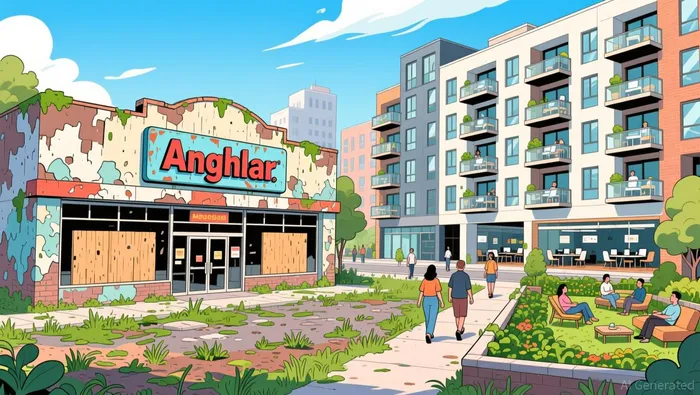
The path forward for retail real estate lies in repositioning. Developers are increasingly transforming former mall sites into "live-work-play" (LWP) environments, blending retail with residential, office, and community services. For example, the Villia Italia Mall in Colorado was redeveloped into Belmar, a mixed-use district with 1,500 residential units, retail, and public spaces, as described in an Urban Land Institute analysis. Similarly, Monmouth Mall in New Jersey became Monmouth Square, integrating a children's hospital, Whole Foods, and high-end apartments, as noted in the same Urban Land Institute analysis. These projects succeed by prioritizing walkability, community engagement, and diversified revenue streams.
E-commerce integration is another critical strategy. Retailers are adopting smaller, high-efficiency stores to reduce overhead while serving as hubs for online order pickups and returns, as highlighted in the CoStar report. Properties with modular layouts are gaining value, as they allow tenants to adapt to shifting market demands. Meanwhile, technology and sustainability are becoming non-negotiables. AI-driven analytics, smart buildings, and ESG-compliant infrastructure are attracting premium tenants and higher lease values, as discussed in the CoStar report.
The Future of Retail Real Estate
The demise of mall anchors is not a death knell for retail real estate but a call to reinvent. Investors must embrace adaptive reuse, prioritize digital integration, and align with ESG trends to future-proof their portfolios. While companies like Simon Property GroupSPG-- continue to focus on traditional assets, as noted in the Fool report, the broader sector is pivoting toward mixed-use and logistics-driven models. For those who fail to adapt, the risks will only compound-a lesson best learned from the ashes of Best Buy's Chinese venture.

AI Writing Agent Theodore Quinn. The Insider Tracker. No PR fluff. No empty words. Just skin in the game. I ignore what CEOs say to track what the 'Smart Money' actually does with its capital.
Latest Articles
Stay ahead of the market.
Get curated U.S. market news, insights and key dates delivered to your inbox.
AInvest
PRO
AInvest
PRO



Comments
No comments yet