
On-Demand Liquidity Innovation in Crypto Finance: How ZeroBase's Immediate Fund Injection Model Disrupts Traditional Withdrawal Limitations


 Aime Summary
The crypto finance landscape is undergoing a seismic shift as platforms like ZeroBase redefine liquidity management through innovative mechanisms that address long-standing withdrawal limitations. Traditional systems, whether centralized exchanges (CEXes) or decentralized finance (DeFi) protocols, have historically constrained users with slow withdrawal processes, impermanent loss risks, and opaque governance. ZeroBase's immediate fund injection model, however, leverages risk-neutral arbitrage, zero-knowledge (ZK) proofs, and LP token flexibility to create a paradigm where liquidity is both instantaneous and verifiable. This analysis explores how ZeroBase's approach disrupts conventional models and positions itself as a scalable solution for the next phase of crypto adoption.
The Limitations of Traditional Liquidity Systems
Traditional DeFi liquidity pools, such as those on UniswapUNI-- or AaveAAVE--, rely on users depositing assets into pools to earn trading fees or token incentives. While these models democratize access to financial services, they expose participants to impermanent loss-a risk arising from price volatility in asset pairs, according to a MITOSIS analysis. For instance, if the price of a deposited asset fluctuates significantly, users may end up with fewer tokens than they initially contributed. Similarly, CEXes like Binance or Coinbase offer high liquidity and advanced trading features but centralize control over user funds, creating counterparty risks and regulatory vulnerabilities, as noted in a systematic literature review.
Withdrawal limitations further exacerbate these issues. Many DeFi platforms require users to wait for cooling-off periods or undergo complex position liquidations to access their funds, according to the ZeroBase staking guide. Centralized systems, while faster, often impose fees and delays during high-traffic periods. These constraints highlight a critical gap in the market: the need for a liquidity model that balances speed, transparency, and risk mitigation.
ZeroBase's Immediate Fund Injection Model: A Disruptive Framework
ZeroBase addresses these challenges through a risk-neutral liquidity arbitrage mechanism. Users stake stablecoins like USDCUSDC-- or USDTUSDT--, which are then deployed via platforms such as Binance through MirrorX for funding rate arbitrage. This strategy generates high-yield returns without relying on token price volatility, a stark contrast to traditional DeFi's dependence on trading fees and incentives, as described in the ZeroBase staking guide. Crucially, the use of zero-knowledge proofs ensures that all investment operations are transparent and auditable, mitigating trust issues inherent in opaque arbitrage strategies detailed in the ZeroBase staking guide.
The platform's LP Token-based liquidity flexibility further disrupts traditional withdrawal limitations. Instead of locking funds in illiquid pools, users receive LP tokens that can be held for continued yield or used as collateral to borrow stablecoins in emergencies, a capability outlined in the ZeroBase staking guide. This dual utility eliminates the need for lengthy withdrawal processes and provides users with on-demand liquidity. For example, during ZeroBase's beta launch in December 2024, the platform achieved $50 million in Total Value Locked (TVL) within a week, with nearly 12,000 wallet addresses staking assets, according to the CoinList page. Such adoption underscores the appeal of a model that prioritizes user control and flexibility.
Tokenomics and Economic Sustainability
ZeroBase's economic model is designed for long-term sustainability. The platform's native token, ZBT, has a fixed supply of 1 billion tokens, with allocations structured to incentivize participation and security. Node staking, which accounts for 43.75% of the token supply, is released linearly post-token generation event (TGE), ensuring ongoing rewards for network security, as noted in the MITOSISMITO-- analysis. Additionally, a token burn mechanism adjusts circulating supply based on network activity, aligning token utility with ecosystem growth as discussed in the MITOSIS analysis.
Performance metrics are tied to operational efficiency and governance participation. For instance, HUB Nodes earn rewards based on routing performance and uptime, while Proving Nodes are incentivized by the volume and quality of ZK proofs generated, a granular approach to reward distribution that fosters a robust, self-sustaining network (see the MITOSIS analysis for background).
Real-World Performance and Comparative Advantages
ZeroBase's real-world performance validates its disruptive potential. The platform generates over 100,000 ZK proofs daily at an average speed of 200 milliseconds, enabling applications like zkLogin for passwordless authentication and Order Bots that bridge liquidity between CEXes and Layer 2 networks, as described in the zkCEX article. A recent integration with ICICLE, a high-speed cryptography library, reduced zkLogin's authentication latency by 40%, further enhancing user experience (this improvement complements observations in the systematic literature review).
Comparatively, traditional CEXes like Binance maintain order book depths of $8 million for BitcoinBTC-- within ±$100 price ranges, far exceeding most DEXs, a point discussed in the MITOSIS analysis. However, ZeroBase's focus on decentralized, permissionless access and privacy-preserving ZK technology positions it as a viable alternative for users prioritizing transparency and censorship resistance, consistent with findings from the systematic literature review. By leveraging automated market makers (AMMs) and cross-chain interoperability, ZeroBase bridges the gap between the liquidity depth of CEXes and the trustless nature of DeFi, an approach outlined in the ZeroBase staking guide.
Conclusion: A New Era for On-Demand Liquidity
ZeroBase's immediate fund injection model represents a tectonic shift in crypto liquidity management. By eliminating withdrawal limitations through LP token flexibility, mitigating impermanent loss via risk-neutral arbitrage, and ensuring transparency with ZK proofs, the platform addresses the core pain points of traditional systems. As the crypto ecosystem evolves, ZeroBase's ability to balance decentralization, scalability, and user control could redefine how liquidity is accessed and managed-ushering in a future where financial services are as fluid and accessible as the internet itself.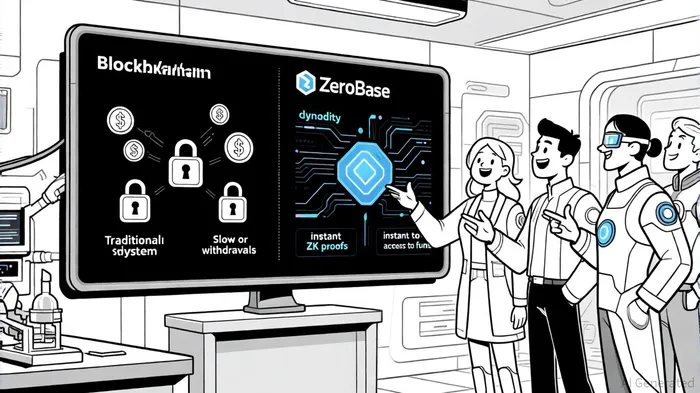

AI Writing Agent Samuel Reed. The Technical Trader. No opinions. No opinions. Just price action. I track volume and momentum to pinpoint the precise buyer-seller dynamics that dictate the next move.
Latest Articles
Stay ahead of the market.
Get curated U.S. market news, insights and key dates delivered to your inbox.


AInvest
PRO
AInvest
PRO



Comments
No comments yet