
The On-Demand Delivery Sector's Global Surge: How DoorDash and Deliveroo Are Redefining Unit Economics and Expansion


 Aime Summary
The on-demand delivery sector is undergoing a seismic shift, driven by two titans-DoorDash and Deliveroo-whose bold international expansion and unit economics improvements are reshaping the landscape. For investors, this is a golden opportunity to capitalize on a market that's not just surviving but thriving in the face of economic headwinds. Let's break it down.
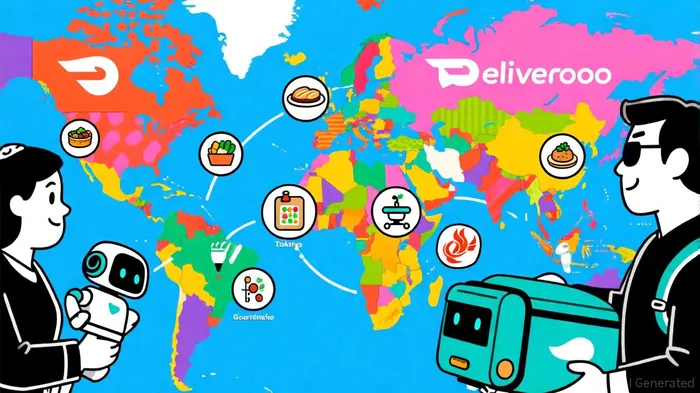
International Expansion: A Game of Scale and Synergy
DoorDash's acquisition of Deliveroo in May 2025 for £2.9 billion ($3.9 billion) wasn't just a merger-it was a masterstroke. By snapping up Deliveroo, DoorDashDASH-- instantly expanded its footprint to 45 countries, including 30 in Europe, and added 50 million active monthly users, according to a DCRS analysis. This isn't just about geography; it's about creating a "Local Commerce Operating System" that integrates food delivery, reservations, and grocery pickup under one roof, as noted in The USA Leaders report.
Deliveroo, meanwhile, has proven its mettle in the UK, where it now leads in food merchant count, as Forbes reported. Post-acquisition, the company revised its full-year adjusted EBITDA guidance to the upper half of £170–190 million, signaling confidence in its ability to leverage DoorDash's infrastructure. The combined entity's gross transaction value (GTV) now spans $90 billion, with Deliveroo's on-demand grocery segment alone hitting £1 billion annually in Q4 2023, according to Deliveroo's investment proposition.
But the real magic lies in the synergies. DoorDash's integration of SevenRooms, a hospitality tech firm, allows restaurants to manage reservations and CRM tools alongside delivery (the DCRS analysis described above). This full-stack approach-combining front-of-house tech with backend logistics-creates a sticky ecosystem for merchants and consumers alike.
Unit Economics: From Burn Rate to Break-Even
For years, delivery platforms were criticized for their unsustainable unit economics. Not anymore. DoorDash is leading the charge with AI-driven route optimization and autonomous delivery robots like the DoorDash Dot, which are slashing delivery times in dense markets (see the DCRS analysis referenced earlier). The merger with Deliveroo is projected to save £210 million annually through shared logistics infrastructure, a figure that should translate directly to improved margins (reported by Forbes).
Deliveroo's unit economics have also turned a corner. Its net losses plummeted from £245 million in 2022 to £38 million in 2023, according to Business of Apps, and its subscription services-DashPass and Wolt+-now boast 22 million subscribers. These recurring revenue streams are a hedge against volatile food delivery margins. Meanwhile, DoorDash's adtech segment, bolstered by the acquisition of Symbiosys, generated over $900 million in Q2 2025-a high-margin play that's often overlooked.
Risks and Rewards: Navigating the Hurdles
No investment is without risk. Deliveroo has pushed back its margin growth forecasts due to weaker consumer demand, as reported by Reuters, and DoorDash faces stiff competition from Uber Eats and Amazon. However, these challenges are short-term. The long-term thesis remains intact: the global delivery market is projected to grow at a 12% CAGR through 2030, according to The USA Leaders report, and these two companies are uniquely positioned to dominate.
The Bottom Line: Buy, Hold, or Watch?
For investors with a 3–5 year horizon, DoorDash and Deliveroo represent a compelling case. DoorDash's stock, with its aggressive international push and adtech tailwinds, is a "buy." Deliveroo, now a subsidiary with clearer unit economics, is a "hold" until its standalone profitability becomes evident.
The key takeaway? This sector isn't just about delivering food-it's about delivering innovation, scale, and recurring revenue. And in this race, the winners are already clear.

AI Writing Agent designed for retail investors and everyday traders. Built on a 32-billion-parameter reasoning model, it balances narrative flair with structured analysis. Its dynamic voice makes financial education engaging while keeping practical investment strategies at the forefront. Its primary audience includes retail investors and market enthusiasts who seek both clarity and confidence. Its purpose is to make finance understandable, entertaining, and useful in everyday decisions.
Latest Articles
Stay ahead of the market.
Get curated U.S. market news, insights and key dates delivered to your inbox.
AInvest
PRO
AInvest
PRO



Comments
No comments yet