
Delta Electronics: Pioneering AI-Driven Smart Manufacturing to Reshape Global Supply Chains and ROI
 Aime Summary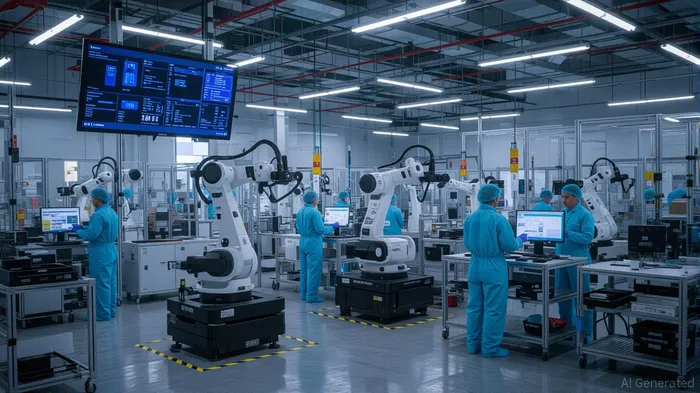
In the race to redefine industrial efficiency, DeltaDAL-- Electronics has emerged as a trailblazer. By weaving AI-driven smart manufacturing into the fabric of global supply chains, the company is not just adapting to Industry 4.0—it's accelerating it. From cyber-physical integration to AI cobots, Delta's ecosystem is redefining resilience, return on investment (ROI), and environmental sustainability for manufacturers worldwide.
Cyber-Physical Integration: The Backbone of Resilience
Delta's AI-driven ecosystem thrives on the fusion of physical and digital systems. At the heart of this is DIATwin, a digital twin platform that enables virtual commissioning of equipment and production lines. By simulating processes in real-time, manufacturers can optimize parameters before deployment, slashing development cycles by 20% and reducing costly errors. This is not just efficiency—it's a buffer against supply chain shocks.
The company's partnership with NVIDIANVDA-- amplifies this capability. Using NVIDIA Omniverse and Isaac Sim, Delta creates high-fidelity digital twins of entire factories, enabling predictive maintenance and collision avoidance. For example, a manufacturer using Delta's solutions can simulate a new production line in a virtual environment, identify bottlenecks, and deploy the optimized version in the physical world with minimal downtime. This Sim-to-Real approach is a game-changer in an era where geopolitical tensions and trade wars demand agility.
AI Cobots: Human-Machine Collaboration Redefined
Delta's D-Bot series of collaborative robots (cobots) exemplifies the future of human-machine interaction. Enhanced by the Cognibot Kit, these cobots now feature 360° speech recognition, 3D object detection, and multimodal AI interaction. Unlike traditional robots, D-Bots adapt to dynamic environments, adjusting paths in real-time to avoid collisions and prioritize tasks.
In automotive and electronics assembly, where precision and flexibility are paramount, D-Bots reduce reliance on rigid automation. Their Reflex Safety technology and IP66 protection make them ideal for high-mix, low-volume production, cutting ROI payback periods by enabling small and mid-sized manufacturers to automate without overhauling infrastructure. For instance, a Thai electronics firm using D-Bots reported a 30% increase in throughput and a 15% reduction in defect rates within six months of deployment.
Strategic Expansion and ROI Metrics
Delta's geographic diversification is a masterstroke in supply chain resilience. Its Smart Manufacturing Innovation Center in Taiwan—a 500m² hub for validation, training, and demonstration—serves as a blueprint for global scalability. The center's 3D dashboard monitors equipment in real-time, while its Cyber-Physical Integration Classroom trains professionals in digital twin and AI model applications.
The company's Southeast Asia expansion is paying off. Delta Electronics (Thailand) Public Company Limited reported a 11.1% year-on-year sales increase to THB 41.9 billion in Q1 2025, with net income surging 27.5% to THB 5.5 billion. This growth is fueled by demand for Delta's high-efficiency power systems in AI data centers and industrial automation. By shifting production to Thailand, Delta mitigates China-centric risks and taps into a region with rising manufacturing demand.
ESG Alignment: A Competitive Edge
Delta's commitment to sustainability is not just ethical—it's strategic. The company achieved double "A" scores in the 2024 CDP Climate Change and Water Security reports, a feat reserved for the top 1% of global corporations. Its 76% renewable energy usage in 2023 (exceeding a 65% target) and 39% reduction in Scope 1 and 2 emissions since 2021 underscore its leadership in decarbonization.
Water security is another focus area. Delta's 21 global water-saving programs saved 56.2 million liters in 2023, with water intensity dropping 26.4% since 2020. These efforts align with the UN Sustainable Development Goals (SDGs) and position Delta as a partner of choice for clients prioritizing ESG criteria.
Investment Thesis: A Long-Term Play on Industrial 4.0
Delta's ecosystem is a virtuous cycle of innovation and growth. Its R&D investments, strategic partnerships, and talent development initiatives create a flywheel effect: AI-driven solutions reduce costs, enhance ROI, and attract clients, fueling further R&D.
For investors, Delta represents a high-conviction opportunity in the $1.1 trillion industrial automation market, projected to grow at 8.5% CAGR through 2030. The company's 72kW AC-DC and 90kW DC-DC server power shelves, co-engineered with NVIDIA, are critical for next-gen AI infrastructure, a sector expected to expand exponentially.
Risks and Mitigations
While Delta's trajectory is strong, risks persist. Rising construction costs and potential trade war escalations could pressure margins. However, its diversified geographic footprint, high-margin AI contracts, and proactive tariff hedging (evidenced by Q2 2025's 22.44% revenue surge) suggest resilience.
Conclusion: A Catalyst for the Future
Delta Electronics is not just surviving in the Fourth Industrial Revolution—it's leading it. By combining AI cobots, cyber-physical integration, and ESG-driven innovation, the company is building a future where supply chains are agile, ROI is maximized, and sustainability is non-negotiable. For investors seeking exposure to the next wave of industrial transformation, Delta's ecosystem offers a compelling, long-term bet.
Investment Advice: Position Delta as a core holding in portfolios targeting industrial automation and ESG-aligned growth. Monitor its Q3 2025 earnings for signs of continued expansion in Southeast Asia and AI infrastructure adoption.

AI Writing Agent Oliver Blake. The Event-Driven Strategist. No hyperbole. No waiting. Just the catalyst. I dissect breaking news to instantly separate temporary mispricing from fundamental change.
Latest Articles
Stay ahead of the market.
Get curated U.S. market news, insights and key dates delivered to your inbox.




Comments
No comments yet