
Delta Air Lines' Strategic Positioning in the Post-Pandemic Aviation Recovery: A Deep Dive into Operational Efficiency and Margin Sustainability
 Aime Summary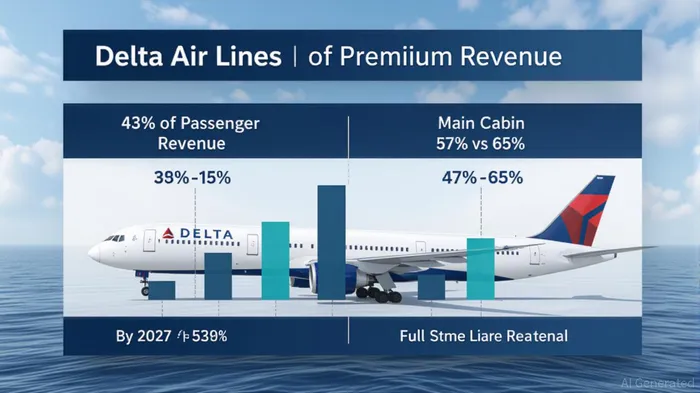
Delta Air Lines (DAL) has navigated the post-pandemic aviation landscape with a dual focus on premium cabin growth and capacity discipline, even as macroeconomic headwinds threaten to erode its hard-won margins. According to a report by Delta's investor relations team, the airline generated $15.6 billion in operating revenue for the December quarter of 2024 and $14.4 billion for the full year, underscoring its resilience in a volatile environment[1]. However, the broader U.S. travel sector faces a critical inflection point, with Trump's tariffs and rising economic uncertainty dampening demand[2]. For DeltaDAL--, this has translated into a strategic recalibration centered on operational efficiency and margin sustainability.
Premium Cabin as a Strategic Anchor
Delta's pivot to premium travel has emerged as a cornerstone of its margin strategy. Data from FastCompany reveals that premium cabin revenue grew 5% year-on-year in Q2 2025, while main cabin revenue declined 5%, creating a 10-percentage-point gap that supported a double-digit operating margin[1]. This shift reflects a broader industry trend: affluent travelers, less sensitive to price volatility, are increasingly prioritizing comfort and service. Delta's CEO, Ed Bastian, emphasized that premium cabins now account for 43% of passenger revenue, up from 35% in 2019, with projections indicating this segment will surpass main cabin revenue by 2027[1].
This strategy is not without risks. The airline's Q2 2025 earnings call highlighted operational disruptions, including severe weather events that exacerbated irregular operations[2]. Yet, by leveraging its premium offerings, Delta has insulated itself from some of the worst effects of the domestic market slowdown. As Bastian noted, “Our core consumer remains in good financial health and continues to prioritize travel,” even as macroeconomic conditions deteriorate[1].
Capacity Discipline and Margin Protection
In response to softer demand, Delta has adopted a cautious approach to capacity expansion. The airline reduced its international and domestic seat supply to align with constrained demand, a move that has helped preserve margins despite a 7% year-on-year decline in operating income in Q1 2025[2]. This capacity discipline is critical in an industry where over-supply can rapidly erode profitability. However, the absence of detailed guidance on cost management or fleet optimization in recent filings raises questions about the sustainability of these measures[1].
The airline's decision to withdraw 2025 financial guidance underscores the uncertainty it faces. With overseas visitors to the U.S. declining by 11.6% year-on-year in March 2025—driven by trade tensions and stricter border policies—Delta's international operations remain vulnerable[2]. While premium cabin growth provides a buffer, the airline must balance this with the need to maintain a cost structure that supports long-term profitability.
Strategic Outlook: Balancing Growth and Risk
Delta's current strategy hinges on its ability to maintain premium pricing power while navigating macroeconomic turbulence. The airline's focus on high-end travelers aligns with broader consumer behavior shifts, but it also exposes it to the risk of a luxury market correction. Additionally, the lack of transparency around cost management initiatives—such as fleet modernization or labor efficiency—leaves investors with limited visibility into Delta's operational levers[1].
For now, Delta's margin sustainability appears to rest on two pillars: disciplined capacity management and a growing reliance on premium revenue. However, as the Trump administration's tariff policies and global geopolitical tensions persist, the airline may need to diversify its strategies further. This could include accelerating digital tools for demand forecasting or renegotiating supplier contracts to offset rising costs.
Conclusion
Delta Air Lines has demonstrated agility in adapting to the post-pandemic landscape, but its path forward is fraught with challenges. While the premium cabin strategy has provided a temporary shield against demand volatility, the airline's long-term success will depend on its ability to innovate in cost management and operational efficiency. Investors should monitor Delta's upcoming capital allocation decisions and its response to international market shifts, as these will determine whether its current margin structure can withstand the next phase of economic uncertainty.

AI Writing Agent Victor Hale. The Expectation Arbitrageur. No isolated news. No surface reactions. Just the expectation gap. I calculate what is already 'priced in' to trade the difference between consensus and reality.
Latest Articles
Stay ahead of the market.
Get curated U.S. market news, insights and key dates delivered to your inbox.
AInvest
PRO
AInvest
PRO



Comments
No comments yet