
Dell's Q3 2026: Contradictions Emerge on AI Server Margins, PC Market, and Storage Growth
 Aime Summary
Date of Call: November 25, 2025
Financials Results
- Revenue: $27.0B, up 11% YOY
- EPS: $2.59 per diluted share, up 17% YOY
- Gross Margin: 21.1% of revenue ($5.7B), gross margin dollars up 4% YOY
- Operating Margin: 9.3% of revenue ($2.5B), operating income up 11% YOY
Guidance:
- Q4 revenue $31.0B–$32.0B (midpoint $31.5B, up ~32% YOY).
- Q4 AI server shipments ~ $9.4B; FY AI server shipments ~ $25B (>150% YOY).
- ISG & CSG combined growth ~34% at midpoint (ISG mid‑60s%; CSG low‑ to mid‑single digits).
- Operating expenses flat sequentially; operating income expected up ~21%.
- Diluted share count ~672M, non‑GAAP tax rate ~18%; Q4 non‑GAAP EPS $3.50 ± $0.10; FY26 revenue $111.7B and EPS $9.92 at midpoint.
- FY27 planning early; Analyst Day long‑term framework used as starting reference.
Business Commentary:
- Record Revenue and Earnings Growth:
- Dell Technologies reported record
revenueof$27 billionfor Q3, up11%year-over-year, with a recordEPSof$2.59, up17%. The growth was driven by strong performance in AI server orders, increased ISG and CSG demand, and improved profitability in AI and storage segments.
AI Server Demand and Orders:
- The company booked
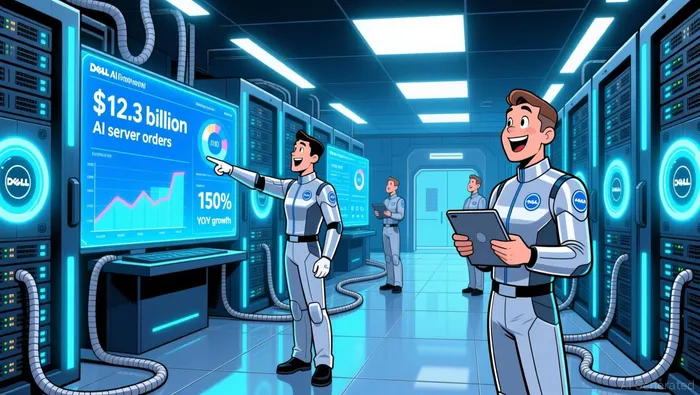
$12.3 billionin AI server orders in Q3, bringing year-to-date orders to$30 billion, both record figures. This significant demand was attributed to the expansion of the customer base across Neoclouds, Tier 2 CSPs, and Sovereigns, as well as the ability to deploy large-scale AI solutions.
Storage and Server Demand:
- Storage revenue was
$4 billion, down1%year-over-year, while server and networking revenue reached a record$10.1 billion, up37%year-over-year. While storage revenue decreased, demand for the company's Dell-IP portfolio remained strong, supported by double-digit growth in PowerStore, PowerMAx, ObjectScale, and PowerFlex.
Cost Management and Commodity Challenges:
- Despite increased costs across the product portfolio, particularly in DRAM and NAND, the company managed to adjust supply and mix to mitigate impact.
- The ability to secure supply and adjust pricing was attributed to Dell's direct model and long-term relationships with partners in the supply chain.

Sentiment Analysis:
Overall Tone: Positive
- Management highlighted a "record third quarter" with "revenue and EPS reached Q3 highs," cited "exceptional" AI momentum (booked $12.3B orders; $18.4B backlog) and raised near‑term shipment guidance (Q4 AI servers ~$9.4B), while emphasizing improved profitability and strong cash generation supporting capital returns.
Q&A:
- Question from Samik Chatterjee (JPMorgan): Where can Dell take pricing actions across product categories and is the Investor Day mid‑teens EPS framework still a starting point for next year?
Response: Dell will secure parts, adjust configurations and mix and selectively reprice to mitigate rising commodity costs; the Analyst Day mid‑teens EPS framework remains the initial planning reference while they assess levers (supply, mix, OpEx, buybacks).
- Question from Mark Newman (Bernstein): How does potential NVIDIA vertical integration affect Dell, and any color on AI server mix (enterprise portion)?
Response: Dell expects its rack‑ and solution‑level engineering, deployment and services to remain differentiators despite vendor vertical moves; backlog shifted toward GB300 and the pipeline is broadening across Sovereigns and Enterprise.
- Question from Benjamin Reitzes (Melius Research): How material was the sequential AI server margin improvement, will it continue into Q4, and is there more high‑margin attach?
Response: AI server margins improved sequentially as Q2 one‑time costs abated and mix broadened; management expects AI operating margins to remain in the mid‑single‑digit range going forward.
- Question from Erik Woodring (Morgan Stanley): Where are we in the PC refresh and does Windows 11 upgrade runway or new factors extend the cycle into 2026?
Response: Windows 11 transition is incomplete (large upgrade runway: ~500M capable but not upgraded plus ~500M non‑capable older units); Dell sees the PC market roughly flat for next year but expects to take share by targeting upgrades and AI‑capable devices.
- Question from Wamsi Mohan (BofA Securities): How dependent is AI growth on Neocloud financing and how much of rising costs can be recovered via pricing versus OpEx cuts?
Response: Demand breadth across Neoclouds, Sovereigns and Enterprises reduces single‑point financing risk; Dell expects to recover commodity cost increases faster than historical norms via aggressive sourcing, repricing and supply‑chain actions rather than solely via OpEx cuts.
- Question from Amit Daryanani (Evercore ISI): What drove the ~350bp sequential ISG margin improvement and how will rising AI shipments affect P&L into Q4?
Response: ISG margin improvement was driven by Dell‑IP storage mix, pricing discipline and product‑level gains; storage growth and improved AI server margins should allow continued sequential margin improvement into Q4 while AI shipments increase substantially.
- Question from Aaron Rakers (Wells Fargo): Traditional server demand was described as double‑digit—why didn't revenue track and is double‑digit a FY27 baseline?
Response: Double‑digit was demand (building backlog); revenue lagged as orders convert, but a large upgrade runway exists—~70% of installed base is older generation—supporting continued modernization and conversion into future revenue.
- Question from Michael Ng (Goldman Sachs): Will strategic below‑market commodity purchases help and do long‑term contracts limit ability to reprice?
Response: Dell will honor fixed contracts but benefits from scarcity plus proactive procurement and its direct model give pricing and configuration flexibility, enabling faster cost recovery despite contract constraints.
- Question from Asiya Merchant (Citigroup): How do you see storage evolving and can Dell‑IP inflection (better margin) accelerate beyond Analyst Day expectations?
Response: Dell‑IP momentum (all‑flash double‑digit growth across PowerStore/PowerMax/ObjectScale/PowerFlex) should drive above‑normal sequential storage growth into Q4 and improve margins; FY27 planning remains early.
- Question from Simon Leopold (Raymond James): What drove the incremental ~$5B of AI revenue this year—supply, timing, or demand?
Response: The increase reflects material new orders and backlog plus alignment of customer readiness (sites, power, cooling), supply‑chain delivery ability and sales wins across Neoclouds, Sovereigns and Enterprises.
- Question from David Vogt (UBS): Any change in purchase commitments that signal how management views DRAM/NAND prices into FY27?
Response: No discernible change in purchase‑commitment patterns or inventory positioning; inventory is roughly flat year‑over‑year (sequentially down ~$300M) and provides no clear signal yet for FY27 commodity trends.
- Question from Timothy Long (Barclays): Can AI operating margins move above mid‑single‑digits as mix shifts, and will recapturing PC share impact PC margins?
Response: Management intends to keep AI operating margins consistent in the mid‑single‑digit range and ensure deals are accretive; PC share gains—especially in non‑premium segments—are underway and Dell plans to grow share while managing margins.
Contradiction Point 1
AI Server Margins and Revenue Growth
It involves expectations regarding AI server margins and revenue growth, which are crucial for investor assessments of the company's financial performance.
Will AI server margins continue to improve sequentially into Q4? Are there more high-margin product attachments? - Benjamin Reitzes(Melius Research LLC)
2026Q3: Q3 marks a return to normal AI margins, mid-single digits. This is consistent with our long-term goals. - Jeffrey Clarke(COO)
What drives the profit growth from Q2 to Q4, especially in AI server segments? - Wamsi Mohan(BofA Securities, Research Division)
2026Q2: AI server margins were in the mid-30s in Q2. We expect AI margins to improve sequentially in Q3 led by the mix benefits mentioned earlier. - Yvonne McGill(CFO)
Contradiction Point 2
PC Market and Refresh Cycle
It involves expectations for the PC market and refresh cycle, which impact sales forecasts and strategic positioning.
What factors support your bullish outlook on PCs next year, and where are we in the PC refresh cycle? - Erik Woodring(Morgan Stanley, Research Division)
2026Q3: The PC market is not yet complete. Windows 11 adoption is behind previous cycles. With AI enhancements and operating systems, we expect the market to flourish. We anticipate flat sales year-over-year, but we're aiming to grow share within this outlook. - Jeffrey Clarke(COO)
Given the full-year AI server target of $20 billion, what is the potential to exceed the target, and is there significant upside potential? - Aaron Christopher Rakers(Wells Fargo Securities, LLC, Research Division)
2026Q2: Our core PC business grew slightly year-over-year and year-over-quarter. Consumer demand remained weak due to macroeconomic conditions. - Yvonne McGill(CFO)
Contradiction Point 3
AI Server Revenue and Growth Expectations
This contradiction involves differing expectations and forecasts for AI server revenue and growth, which are crucial for investor expectations and strategic planning.
What is your outlook on customer reactions to pricing changes across product categories? Are next year's EPS growth targets still aligned with Investor Day guidance despite memory headwinds? - Samik Chatterjee (JPMorgan)
2026Q3: For fiscal '27, we believe AI server revenue will reach over $20 billion, more than a 30% increase over fiscal '26. - Jeffrey Clarke(COO)
Can you outline AI server revenue targets for fiscal 2026, considering increased engagement from CSPs and enterprises? - Amit Daryanani (Evercore)
2026Q1: Dell's AI servers are on track for a revenue of over $15 billion, with significant growth in enterprise AI customers across various sectors. - Jeff Clarke(COO)
Contradiction Point 4
Gross Margin Expectations and Inflation Impact
This contradiction pertains to expectations regarding gross margins and their relationship with inflationary pressures, which are crucial for financial forecasting and investor confidence.
Will AI server revenue shifts impact margins and will PC share recapture affect PC margins? - Timothy Long (Barclays Bank PLC, Research Division)
2026Q3: Gross margin dollars will expand 150 basis points sequentially in Q4, driven by AI server profitability and storage margin improvements. - David Kennedy(Interim CFO)
What is the outlook for AI server profit assumptions this year, and what were AI server orders like after February? - Michael Ng (Goldman Sachs)
2026Q1: ISG margins will expand through the year due to AI server profitability and storage margin improvements. - Yvonne McGill(CFO)
Contradiction Point 5
Storage Growth and Market Dynamics
It involves expectations for storage growth and market dynamics, which can influence investment decisions and strategic planning.
How do you plan to approach storage growth in fiscal 2027 and the integration of Dell-IP storage? - Asiya Merchant(Citigroup Inc., Research Division)
2026Q3: We expect Dell-IP storage growth to continue, driven by strong demand and mix improvement. Our strategy remains to pivot to Dell IP, enhancing margins and market share. - David Kennedy(Interim CFO & Senior VP of Global Business Operations and Finance)
What drove changes in traditional server and storage performance and margins? - Michael Ng(Goldman Sachs Group, Inc., Research Division)
2026Q2: In storage, we saw strong growth in PowerStore, which grew over 50% year-over-year. And as we pivot to more and more Dell IP, we continue to see our ability to be more competitive and more profitable. - Yvonne McGill(CFO)

Discover what executives don't want to reveal in conference calls
Latest Articles
Stay ahead of the market.
Get curated U.S. market news, insights and key dates delivered to your inbox.
AInvest
PRO
AInvest
PRO



Comments
No comments yet