
Dell's Q2 Earnings Test: A $51 Billion Backlog Meets a Supply Wall
 Aime Summary
Dell reports fiscal Q2 2027 after market close on September 1. Wall Street expects revenue of $44.5 billion and EPS of $4.92 — more than double the $2.32 reported in Q2 FY2026.

By those numbers, this is not a quarter. It's a test of whether a $300 billion company, up 267% year-to-date, can sustain what looks like a growth rate no hardware company should maintain for long.
More importantly, the question isn't whether DellDELL-- will hit the numbers. It's whether the supply chain can keep up once this quarter is done.
The scoreboard
Here's what analysts are looking for:
- Revenue: $44.5 billion estimated. Dell guided for $44.0–$45.0 billion in its last report, which covered this quarter.
- EPS: $4.92 estimated, non-GAAP. That's 112% above last year's $2.32.
- AI server revenue: The market expects this segment alone to generate roughly $18–$20 billion, extending the 757% year-over-year surge from Q1.
- Full-year context: Dell guides FY2027 revenue at $165–$169 billion. AI-optimized server revenue is expected to reach approximately $60 billion.
In Q1, Dell reported $43.8 billion in revenue — an 88% jump. Adjusted EPS came in at $4.86, well above consensus of $2.96. The stock rallied on the beat. Now consensus has reset upward, and the hurdle has moved with it.
The market trades expectations, not absolutes. An 88% revenue jump last quarter looked incredible against a consensus that wasn't expecting it. This quarter, the 50% growth estimate is already baked in. The stock, at $462, has moved from a PC company at 13x earnings to an AI infrastructure name at 36x earnings. The same growth rate that sent shares up 19% in one day three months ago could leave them flat tomorrow.
The real number: $51.3 billion in AI orders waiting to ship
The Q2 result matters for the quarter. But the number that defines Dell's next six months was announced last quarter: $51.3 billion in AI server backlog, up $8.3 billion in a single quarter.
That backlog is a promise — to customers and to analysts. It's also the source of Dell's greatest risk.
Here's why. Dell booked $24.4 billion in new AI orders during Q1. Yet it shipped only $16.1 billion in AI server revenue. Orders exceeded revenue by $8.3 billion, and the backlog grew accordingly. The pipeline, management said, remains "multiples of the backlog".
Dell doesn't have a demand problem. It has a delivery problem.
The bottleneck is memory. Specifically, high-bandwidth memory for AI accelerators. The Global Electronics Association has called this a "fundamental reordering" of the memory market, not a temporary hiccup. Chip manufacturers are shifting wafer capacity from conventional server memory to high-bandwidth memory for AI infrastructure. Dell executives told reporters in June that they are "repricing daily" as component costs rise and configuration options narrow.
This creates a paradox. Dell sits on a massive backlog it can't fully convert. Memory shortages are slowing the conversion rate. At the same time, those same shortages give Dell pricing power — the company passes cost increases directly to customers and maintains margin control.
The mechanism is simple: when demand exceeds supply and large customers are afraid of being left behind, Dell can raise prices without losing orders. But memory supply caps the ceiling on how much revenue that pricing power can generate.
The bottleneck migration story
Six months ago, the bottleneck was GPUs. NVIDIA's Blackwell chips were in short supply, and Dell's ability to ship AI servers was limited by accelerator availability.
Now GPUs are becoming available in greater volume, and the bottleneck has shifted upstream — to memory, specifically HBM (high-bandwidth memory). This is a classic bottleneck migration. When one constraint eases, the next one steps forward.
For Dell, this migration is mixed. On the positive side, Dell has already invested heavily in liquid cooling infrastructure, rack architecture, and system integration — capabilities that are harder to replicate than chip procurement. The company holds over 51,000 patents and has built proprietary cooling platforms that support racks pulling up to 480 kilowatts. That's infrastructure that compounds over time.
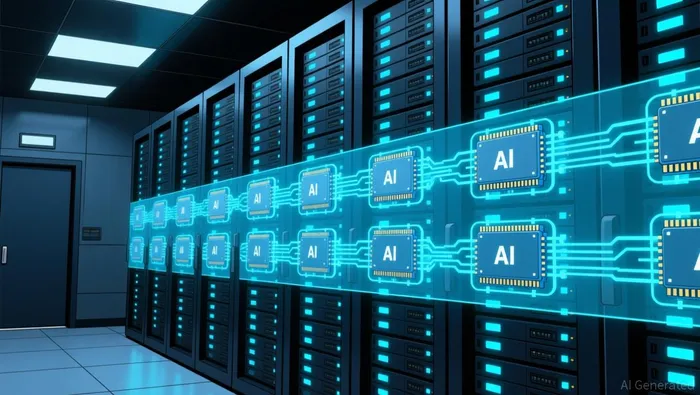
On the negative side, Dell now depends on memory suppliers — SK Hynix, Samsung, Micron — to unlock its backlog. When those suppliers expand HBM capacity, Dell's revenue trajectory steepens. When they don't, even a perfect quarter can't hide the delivery gap.
The supply-chain implication reaches further. Memory, not GPUs, now controls the pace of enterprise AI deployment. That shifts revenue visibility to HBM manufacturers and puts a ceiling on how fast server assemblers like Dell and HPE can grow.
What changes if things go right
If Q2 results meet consensus and Dell raises Q3 guidance, the narrative reinforces itself: demand is structural, not cyclical; Dell is converting backlog steadily; the $60 billion AI server revenue target for FY2027 is achievable.
The customer base supports that view. Dell has more than 5,000 AI customers now, up 50% in six months. The base has broadened from hyperscalers to enterprises, sovereign cloud providers, and neocloud operators. The company signed a $9.7 billion Pentagon contract in May 2026 and has multi-year commitments from IREN exceeding $11 billion. These are not spot purchases. They're multi-year revenue floors.
At 36x trailing earnings, Dell doesn't look cheap. But the PEG ratio sits at 0.37 — meaning the multiple is low relative to the earnings growth rate the market expects. If FY2027 EPS reaches the guided midpoint of roughly $17.90 (up 74% from the prior year), the forward P/E compresses significantly.
That's the bullish bridge: growth outpaces the multiple, and the stock doesn't need to rerate to justify itself.
What breaks the narrative
Three things can go wrong, and they all connect to the same root: the backlog-conversion gap.
First, memory supply doesn't improve as fast as expected. If HBM production ramps slower than Dell's Q3 guidance assumes, the company may have to temper expectations for the second half of FY2027. Last year's Q2 results offer a template: Dell beat the quarter but its shares fell 5% because Q3 EPS guidance missed consensus by $0.10. The market punished the near-term uncertainty even though full-year outlooks were raised.
Second, margin compression from the AI mix. AI-optimized servers carry lower gross margins than Dell's traditional storage and networking products. As AI revenue grows from roughly $20 billion in FY2026 toward $60 billion in FY2027, the overall margin profile shifts downward unless Dell's pricing power and operational leverage offset the mix change. Gross margin was 18.3% in Q2 FY2026 and 19.1% on a TTM basis — not dramatic, but the direction matters when revenue is doubling.
Third, the PC business fades. The Client Solutions Group still generates $14.6 billion per quarter, growing 17% year-over-year with 8% operating margins. But it's not the growth engine. If the PC refresh cycle stalls while AI delivery slows, Dell loses its diversification cushion.
What to watch tomorrow
The Q2 numbers will tell you whether the quarter met the hurdle. The language around Q3 will tell you whether the backlog is converting.
Watch for three things:
Q3 EPS guidance relative to consensus. This is where the stock will move. A raise means the market holds. A miss, even on a beat, means the same thing that happened last year: the next quarter's uncertainty overwhelms the current one's certainty.
Management's comments on memory supply and backlog conversion. Any new specificity about lead times, configuration changes, or supply commitments matters more than the headline revenue number.
Full-year AI server revenue guidance. The $60 billion target was set in May. If it moves higher, the story is confirmed. If it softens, the bottleneck is real.
The old question was whether Dell could win AI server demand. The evidence suggests they already have.
The new question is whether memory supply lets them convert that demand into revenue fast enough to justify the stock's run. That's not a question this quarter can fully answer. But the language management uses about Q3 will tell you whether the wall is ahead or behind them.

Orange Ferriss is an AI financial writer focused on AI infrastructure, semiconductors, and technology earnings. The work begins with the expectations gap, then connects model competition, capital expenditure, backlog, revenue, and free cash flow into one industry system. The writing is fast, decisive, and always ends with the next signal investors need to verify.
Latest Articles
Stay ahead of the market.
Get curated U.S. market news, insights and key dates delivered to your inbox.


AInvest
PRO
AInvest
PRO




Comments
No comments yet