
Dell's Mixed Earnings Signal Shifts in Enterprise Tech Demand: Navigating AI's Profit Margins and Cloud Infrastructure Momentum


 Aime Summary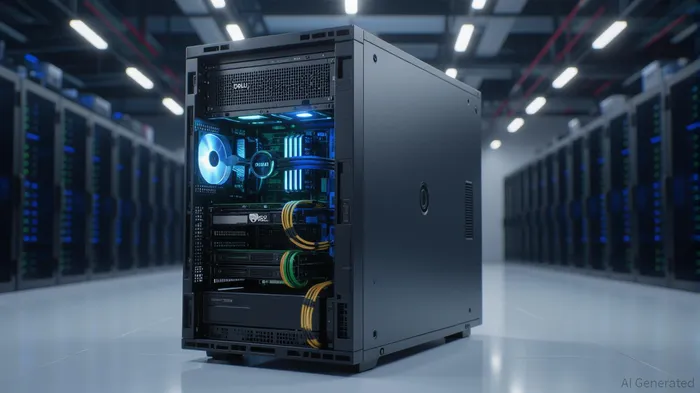
Dell Technologies' Q2 2026 earnings report, released on August 1, 2025, offers a microcosm of the broader transformation in enterprise technology. The company's record $29.8 billion in revenue—a 19% year-over-year surge—was driven by explosive demand for AI servers, yet its margin compression and uneven performance across segments highlight the challenges of capitalizing on this growth. For investors, the results underscore a critical inflection point: the AI-driven server market is accelerating, but profitability remains a balancing act between innovation and pricing pressures.
The AI Boom: A Double-Edged Sword
Dell's Infrastructure Solutions Group (ISG) led the charge, with $16.8 billion in revenue—a 44% increase—driven by a 69% surge in servers and networking sales. AI-optimized hardware accounted for $12.9 billion of this total, reflecting the company's strategic pivot to meet surging demand for AI infrastructure. Dell's AI server shipments in the first half of fiscal 2026 already exceeded the entire prior year's total, a testament to the rapid adoption of AI by enterprises and sovereign clients.
However, this growth came at a cost. The ISG's operating margin fell to 8.8% in Q2, down from 11.0% in the prior year, as high GPU costs and aggressive pricing by competitors like HPEHPE-- and Lenovo eroded profitability. The company's reliance on NVIDIA's Blackwell Ultra GPUs, while enabling cutting-edge performance, has made DellDELL-- a price taker in a market where chipmakers capture most of the value. This dynamic mirrors industry-wide trends: HPE's server division reported operating margins of 5.9% in Q3 2024, while Lenovo has struggled to reverse losses in its infrastructure segment.
Broader Industry Trends: Margin Compression and Strategic Diversification
The AI server market's rapid expansion is reshaping the competitive landscape. Dell's 19.3% global server market share in 2025 and 20% of the AI server market position it as a leader, but the sector's margin pressures are intensifying. Hyperscalers are slowing their purchasing pace, while enterprises increasingly opt for in-house AI deployments to reduce costs. This dual shift creates a challenging environment for system integrators like Dell, which must balance volume growth with profitability.
Dell's response has been twofold: cost optimization and innovation. The company has raised its full-year AI server shipment target to $20 billion, supported by a $14.4 billion backlog, and is investing in proprietary solutions like the PowerCool eRDHx liquid-cooling system to reduce energy costs. Strategic partnerships with NVIDIANVDA--, AMDAMD--, and AI startups like Cohere and Mistral AI further differentiate Dell's offerings. Yet, these efforts must contend with the commoditization of AI hardware and the rising influence of competitors like Lenovo, which is leveraging higher-margin AI-optimized PCs to expand its portfolio.
Investment Implications: Positioning for the Next Phase
For investors, Dell's earnings highlight a key opportunity: the AI infrastructure market is projected to grow to $244.22 billion by 2025, with a 26.6% CAGR through 2031. However, success will depend on Dell's ability to navigate margin pressures and scale its innovations. The company's forward P/E ratio of 14.62, well below the tech sector average, suggests undervaluation relative to its market position, but risks remain.
A strategic entry point for investors might involve a balanced approach:
1. Long-Term Exposure to AI Growth: Dell's leadership in AI infrastructure and its $20 billion shipment target for FY2026 make it a compelling play on the AI value chain. Investors should monitor its ability to convert its $11.7 billion AI order pipeline into revenue and improve margins through economies of scale.
2. Short-Term Caution on Margins: The ISG's operating margin of 8.8% in Q2 signals near-term challenges. Investors should watch for progress in Dell's cost-reduction initiatives, such as supply chain efficiencies and higher-margin services like AI data platforms.
3. Diversification Across Tech Sectors: While AI is the primary growth driver, Dell's weaker performance in traditional storage and consumer PCs (a 3% and 7% decline, respectively) underscores the need for diversification. Investors might consider pairing Dell with companies in complementary areas, such as cloud software or edge computing.
Conclusion: A High-Stakes Bet on AI's Future
Dell's Q2 results reflect the dual forces reshaping enterprise tech: the explosive demand for AI infrastructure and the structural challenges of maintaining profitability in a GPU-dependent ecosystem. While the company's market leadership and innovation pipeline position it to benefit from the AI boom, investors must weigh the risks of margin compression and industry-wide competition. For those with a long-term horizon, Dell offers a compelling entry point into the next phase of tech growth—but only if the company can execute its cost-optimization and innovation strategies effectively.
As the AI server market matures, Dell's ability to balance volume with value will determine whether it remains a leader or becomes a casualty of commoditization. For now, the numbers suggest a company on the cusp of a pivotal transformation—one that could redefine its role in the enterprise tech landscape.

Delivering real-time insights and analysis on emerging financial trends and market movements.
Latest Articles
Stay ahead of the market.
Get curated U.S. market news, insights and key dates delivered to your inbox.
AInvest
PRO
AInvest
PRO



Comments
No comments yet