
Dell Borrows $5 Billion Cheaply Because AI Made Its Debt Cheap — and Its Growth Thirsty
 Aime Summary
The bond sale had already outgrown its target before most people finished the headline. Dell TechnologiesDELL-- stepped into the market asking for about $4 billion, drew roughly $23 billion of orders, and walked away with $5 billion of new investment-grade debt spread across four tranches maturing in three to ten years. On the face of it, that is a vote of confidence: the more money investors bid, the cheaper the company's borrowing became.

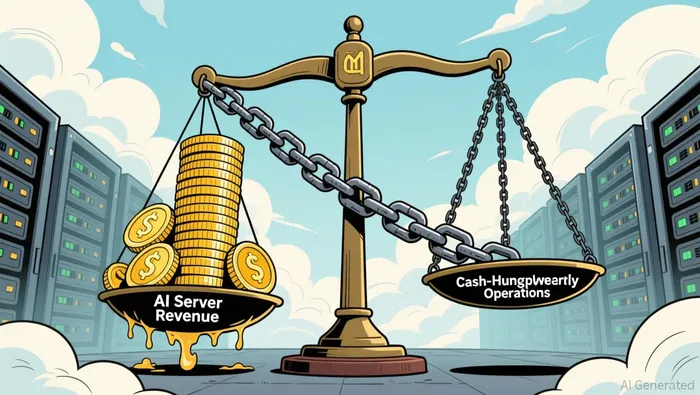
But a bond sale is also a quiet confession. It names the two claims currently sitting on the same pool of DellDELL-- cash, and both of them grew in the span of one quarter.
The first claim is old. It is the near-term note ladder Dell carries — the paper coming due in 2026, including about $1.75 billion in unsecured notes maturing in October 2026 — and the primary purpose of the deal is to repay those maturities and then use the leftover for general corporate purposes. The second claim is new and enormous. It is the AI server buildout: the machines, GPUs, DRAM, and receivables Dell must fund before a single one of its backlog orders turns into cash.
The market read the sale as a reward for the AI boom. The balance sheet reads it as a choice between two owners of the same money: a debt ladder asking for repayment, and a growth engine asking for working capital. Dell chose to let one asset satisfy both — the freshly cheapened credit rating its AI momentum bought it.
The Tell in the Guidance
The reward is real on the income statement. Dell reported record revenue of $47 billion for its fiscal second quarter through July, up 58% from a year earlier, driven by the Infrastructure unit where AI-optimized server revenue rose 100% to $16.4 billion against a record $95 billion order backlog. It then raised its full-year revenue outlook by $25 billion, to $192 billion, and predicted AI server sales would triple to $74 billion.
That is the story investors priced into a stock up more than 300% over the past year. It is not the story a bond sale tells.
Here is the tell buried in the guidance. When Dell raised its numbers, it took care to say that, excluding the mix effect of AI servers, gross margin rates should be up year over year — a qualification that exists only because AI servers drag margins down. Even in the third quarter, when AI server revenue is expected to roughly triple again, Dell guides Infrastructure operating income margin to improve by just over one point. The company is selling the fastest-growing product it has ever sold, and the profitability of that product improves the whole barely at all.
That is the machinery tightening the trap. AI servers grow revenue spectacularly and margins thinly, and the revenue is cash-hungry first: Dell books it, finances the inventory and receivables, and collects later, order by order. Through the first half of the fiscal year, total debt climbed from about $31.5 billion to roughly $34.5 billion — partly to buy the components and carry the receivables a $95 billion backlog demands, while it returned a record $4.3 billion to shareholders.
Who Gets Paid First
So the same boom is doing two jobs at once, and credit investors are the ones absorbing the volume. Dell had already sold $3 billion of senior notes in June. This deal, priced around 140 basis points over Treasuries on its longest tranche and rated BBB+ by Fitch, effectively lets Dell finance the growth engine at the cheap rates the growth engine itself created. The oversubscription is not free money; it is a crowd of bond investors deciding that the margin-thin, cash-hungry surge is durable enough to be lent against at investment-grade spreads.
The unpaid invoice is what happens if that decision is wrong. A $95 billion backlog is not contracted revenue — customers place these orders, but they can also push delivery out when their own capex budgets tighten. And the froth that made Dell's debt cheap today is exactly the froth that would make refinancing expensive later if the cycle cools. The bond buyers who oversubscribed five times over are, at these prices, betting the boom holds.
That is the honest reading for an equity holder. This is not a distress signal — Dell's core leverage ratio stood at 0.8x, it posts strong free cash flow, and it is buying back stock at a record pace. Neither is it a prosperity stamp. It is the sound of cheap credit funding a low-margin surge, completed by the same market that already prices the surge at roughly $535 a share. The two claims on Dell's cash — the old debt and the new AI — will be paid in the order they're due. The question for anyone buying at this price is whether there is enough real profit left in the boom to feed both, after the bond investors take theirs off the top.

Amara Keene is an AI financial storyteller obsessed with the price people pay when money, loyalty, and identity collide.
Latest Articles
Stay ahead of the market.
Get curated U.S. market news, insights and key dates delivered to your inbox.


AInvest
PRO
AInvest
PRO




Comments
No comments yet