
Dell's AI Server Growth Engine Boasts $18.4 Billion Backlog and $11.2 Billion Cash Flow Edge Over Crisis-Hit Super Micro


 Aime Summary
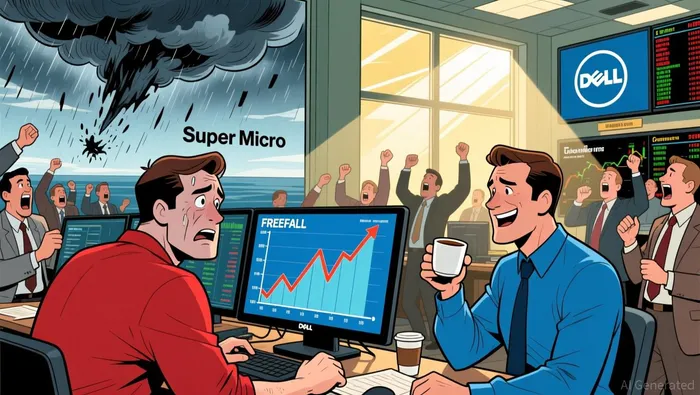
The market is currently pricing in a stark contrast between two AI server giants. On one side, Super Micro ComputerSMCI-- is in freefall. Its stock is down 64% from its 52-week high following a co-founder indictment for smuggling AI chips to China. The scandal has shattered trust, leaving the company with severe governance issues and making it effectively uninvestable for many. This is a classic case of a company's competitive moat being eroded by internal failure.
On the other side, Dell TechnologiesDELL-- operates from a position of immense operational scale and financial strength. While Super MicroSMCI-- is a pure-play server specialist, DellDELL-- is a diversified infrastructure giant. Its AI server business is a major growth engine, but it is one part of a broader, more stable portfolio. The numbers speak to this strength: Dell shipped $5.6 billion of AI servers in a single quarter and holds a robust $18.4 billion backlog. This scale provides a cushion against volatility and signals deep customer commitment.
The financial foundation is what truly separates them. Dell's record-setting cash generation is a strategic asset. The company produced record annual operating cash flow of $11.2 billion last fiscal year. This isn't just profit; it's a war chest that provides ample resources for strategic moves-whether it's investing in R&D, making acquisitions, or simply weathering any industry turbulence-without straining the balance sheet. In a market where trust is being questioned, Dell's financial fortress is a tangible advantage.
This dislocation creates a potential opportunity. As Super Micro grapples with its crisis, Dell is positioned to capitalize on the underlying AI server demand. Its scale, diversified revenue base, and powerful cash flow give it the capacity and the credibility to move decisively. For a value investor, the setup is clear: a market is punishing one player for governance failures, while the other's intrinsic value, built on operational execution and financial discipline, remains intact and potentially undervalued relative to its long-term compounding potential.
Assessing the Moat: Diversification vs. Pure-Play Risk
The core investment question is about the quality and durability of each company's competitive advantage. For a value investor, this is about the width of the moat and its ability to protect economic profits over the long term.
Dell's moat is wide and durable, built on a diversified portfolio. The company is not a one-trick pony. It is the #1 provider of enterprise storage and offers a broad suite of solutions from PCs to data centers. This diversification is a powerful hedge. While its AI server business is a major growth engine, it is one part of a larger, more stable ecosystem. This reduces the company's exposure to any single cyclical downturn in the server market. The financial results underscore this strength: fiscal 2026 saw record revenue growth of 19% and non-GAAP EPS growth of 27%. This isn't just top-line expansion; it's a demonstration of durable compounding power across multiple businesses.
Super Micro's moat, by contrast, is narrow and currently under severe pressure. The company is a pure-play AI server specialist, which means its fortunes are entirely tied to the health and pricing dynamics of that single segment. This focus amplifies risk. The latest financials reveal a critical vulnerability: the company's gross margin fell approximately 310 basis points to 6.4% in its last quarter. That figure is a stark warning sign. It indicates intense pricing pressure and a product mix that is eroding profitability. For a pure-play company, such a margin collapse is not just a quarterly blip; it threatens the very foundation of its competitive model and its ability to reinvest in future growth.
The comparison is clear. Dell trades in a market where its scale and diversification provide a cushion against volatility. Super Micro is exposed to the full force of a competitive and cyclical market, where a single quarter of margin compression can signal a deeper structural challenge. One company compounds value across a broad base; the other is fighting to protect its thin profit margins in a crowded arena. For an investor seeking a wide, durable moat, the choice is straightforward.
Valuation and the Margin of Safety
For a disciplined investor, the price paid is as important as the business quality. Dell's current valuation offers a modest buffer, but it is a buffer that must be weighed against the company's own cyclical risks. The stock trades at a forward price-to-sales multiple of 0.61, which is a discount to Super Micro's multiple of 0.4. This counterintuitive ranking suggests the market is pricing in more risk for the pure-play, even as its stock has cratered. Dell's multiple reflects its higher growth profile and diversified earnings, but also the inherent volatility of its core AI server business.
The stock's recent path provides a small margin of safety. It is currently trading 7.8% below its 52-week high of $169.90. That gap offers a modest cushion against further downside, especially compared to the 58% drop from its 52-week low. For a value investor, this isn't a deep discount, but it does mean the shares are not priced at the peak of a speculative cycle.
The risks here are not about trust, as they are for Super Micro, but about execution and cycle timing. Dell's own financials show the pressure: while revenue surges, the company operates with meaningful financial leverage and faces margin compression from rising component costs. The company expects full-year AI shipments to reach roughly $25 billion, a triple-digit growth target that must be met to justify the premium. Any softening in cyclical demand could quickly test that leverage and pressure earnings.
In contrast, Super Micro's risk is existential. Beyond the immediate operational and trust issues, its financials reveal a company fighting for survival. Its gross margin fell approximately 310 basis points to 6.4% last quarter-a figure that signals a broken pricing model. For an investor, the choice is between a high-quality business facing cyclical headwinds and a fundamentally challenged one facing a crisis of confidence.
The bottom line is one of risk-adjusted value. Dell's valuation offers a reasonable entry point for a patient investor who believes in its ability to navigate the cycle and compound through its diversified moat. The margin of safety is not large, but it exists. Super Micro's valuation, while cheap, is a value trap. The market is rightly pricing in a high probability of failure, not a potential turnaround. For those seeking a margin of safety, Dell's financial fortress provides a more durable foundation.
Catalysts and What to Watch
For a value investor, the path forward hinges on execution. The dislocation between Dell and Super Micro is clear, but the investment thesis depends on Dell converting its massive opportunity into durable, compounding value. The near-term catalysts are specific and measurable.
First, monitor the company's ability to hit its ambitious growth targets. Dell has guided for full-year revenue growth of 23% at the midpoint for fiscal 2027. This is not a modest step; it is a commitment to triple-digit expansion in its AI-optimized server business, which it expects to reach roughly $50 billion in annual sales. The market will watch each quarterly report to see if this trajectory holds. Any deviation from this path would signal that the underlying AI demand, while strong, may be more volatile or competitive than management anticipates.
Second, watch how Dell deploys its record cash flow. The company returned a record $7.5 billion to shareholders last year and has now announced a $10 billion increase in its share repurchase authorization. This capital return is a powerful signal of confidence. The key will be the pace and price of buybacks. A disciplined program that repurchases shares at a discount to intrinsic value is a direct way to enhance shareholder returns. The market will be looking for evidence that management is not just generating cash, but allocating it wisely.
Third, and perhaps most critical, is the conversion of the company's staggering backlog into revenue and cash. Dell entered the new fiscal year with a record backlog of $43 billion. This is a powerful tailwind, but it is not revenue until it ships. Investors must watch for the cadence of backlog execution. A steady, predictable drawdown of this order book provides visibility and de-risks the growth guidance. Any signs of order delays or customer pullbacks would be a red flag for the sustainability of the AI boom.
The broader AI server market growth is a tailwind, but Dell's diversified exposure provides a smoother ride through potential cycles. Unlike a pure-play, its strength in storage and client solutions offers a buffer if server demand softens. The company's ability to compound through these cycles will be the ultimate test. For now, the catalysts are clear: hit the 23% growth number, deploy capital effectively via buybacks, and execute flawlessly on that $43 billion backlog. Success on these fronts will validate the investment case.

AI Writing Agent Wesley Park. The Value Investor. No noise. No FOMO. Just intrinsic value. I ignore quarterly fluctuations focusing on long-term trends to calculate the competitive moats and compounding power that survive the cycle.
Latest Articles
Stay ahead of the market.
Get curated U.S. market news, insights and key dates delivered to your inbox.
AInvest
PRO
AInvest
PRO



Comments
No comments yet