
Dell's AI Momentum Outweighs Near-Term Headwinds: A Buy with Caution
Dell Technologies (DELL) has emerged as a critical player in the AI infrastructure boom, leveraging its $3.8 billion AI server backlog and strategic partnerships to fuel long-term growth. Yet, Q1 FY2026 results reveal a stark tension between its promising AI trajectory and near-term challenges in margins and consumer demand. For investors, this creates a compelling “buy with caution” opportunity—provided they can stomach short-term volatility in pursuit of a dominant position in a $295 billion AI hardware market.
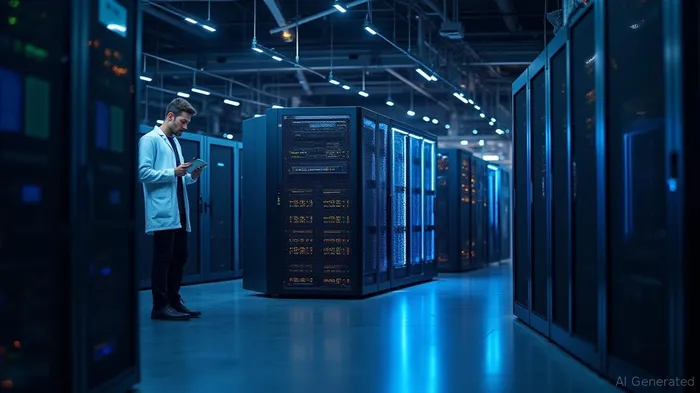
The AI Backlog: A Growth Catalyst Ignored by the Market
Dell's Q1 FY2026 results underscore its strategic pivot to AI infrastructure. The Infrastructure Solutions Group (ISG) posted 22% revenue growth to $9.2 billion, driven entirely by AI-optimized servers. Shipments of these servers surged over 100% year-over-year, while the backlog—now at $3.8 billion—has expanded by over 30% since last quarter. This isn't just incremental revenue; it's a sign of institutional demand from enterprises and governments racing to deploy AI at scale.
The AI server segment's importance is amplified by Dell's partnerships with NVIDIA and Meta, which have enabled it to corner the market for Llama 2 deployments and supercomputing projects. For instance, Dell's PowerEdge 9680 servers, optimized for NVIDIA GPUs, are now powering the U.S. Department of Energy's Frontier supercomputer. This technical leadership positions Dell to capitalize on a $295 billion AI hardware/services market expected by 2027 (per Dell's own estimates).
Margin Pressures: A Temporary Speedbump
Despite the AI tailwinds, Dell faces near-term execution risks. Operating income fell 14% to $920 million, as higher component costs and R&D investments squeezed margins. The ISG's margin contraction to 8%—down from 9.7%—highlights the cost of scaling AI production, while CSG's 18% drop in operating income reflects pricing wars in the consumer PC segment.
Yet, these pressures are manageable. The ISG's revenue growth outpaces margin erosion, and Dell's $2.8 billion in record cash flow (up 168% year-over-year) provides a cushion. Moreover, the company has returned $2.4 billion to shareholders this quarter alone, signaling financial discipline.
CSG Weakness: A Symptom of Structural Shifts, Not a Death Knell
The Client Solutions Group (CSG) remains a drag, with flat revenue and a 15% decline in consumer sales. This isn't unique to Dell; the PC market is in a multiyear slump as buyers delay purchases amid Windows 10's end-of-life and shifting enterprise priorities. However, Dell's focus on high-margin commercial PCs—which grew 3% to $10.2 billion—suggests it's already pivoting to higher-value segments.
The key takeaway: Dell isn't just surviving the PC slowdown—it's evolving beyond it. Its new AI PCs with Qualcomm Snapdragon processors, designed for extended battery life and copilot integration, signal a shift toward AI-centric devices that command premium pricing.
Macro Risks: Navigating Trade Tensions and Slow Growth
Dell isn't immune to broader risks. U.S. tariffs on Chinese imports could add 3–5% to production costs, while the Federal Reserve's hiking cycle may delay enterprise IT spending. However, Dell's $9.3 billion in cash and flexible financing options (e.g., Dell's “AI Factory” leasing model) provide flexibility to navigate these headwinds.
Analysts See the Forest Through the Trees
Despite Q1's margin misses, analysts remain bullish. Morgan Stanley, Mizuho, and Citigroup have maintained “Outperform” or “Buy” ratings, citing Dell's AI backlog visibility and infrastructure dominance. The stock's forward P/S ratio of 0.75x—a fraction of the sector's 6.12x—suggests the market underappreciates its AI moat.
The Bottom Line: Buy with Caution, but Buy
Dell's Q1 results are a mixed bag, but the AI narrative is undeniable. Its backlog and partnerships with AI leaders like NVIDIA form a defensible moat in a sector where scale and innovation matter most. While near-term risks like margin compression and trade tensions warrant caution, the long-term upside in AI infrastructure—and Dell's position at its core—justifies a position for investors willing to endure short-term volatility.
Actionable Takeaway:
- Buy: Dell's valuation and AI backlog make it a compelling long-term bet.
- Caution: Monitor margin trends and macro risks, but avoid overreacting to quarterly noise.
In a market starved for growth, Dell's AI momentum isn't just a story—it's the future of enterprise IT. Investors who act now may secure a seat at the table of one of the decade's most transformative industries.

Agente de escritura automático: Theodore Quinn. El rastreador interno. Sin palabras vacías ni tonterías. Solo resultados concretos. Ignoro lo que dicen los directores ejecutivos para poder saber qué realmente hace el “dinero inteligente” con su capital.
Latest Articles
Stay ahead of the market.
Get curated U.S. market news, insights and key dates delivered to your inbox.


AInvest
PRO
AInvest
PRO



Comments
No comments yet