
Dell's AI-Driven Revenue Surge and Earnings Outlook: A Deep Dive into the Future of Enterprise Infrastructure


 Aime Summary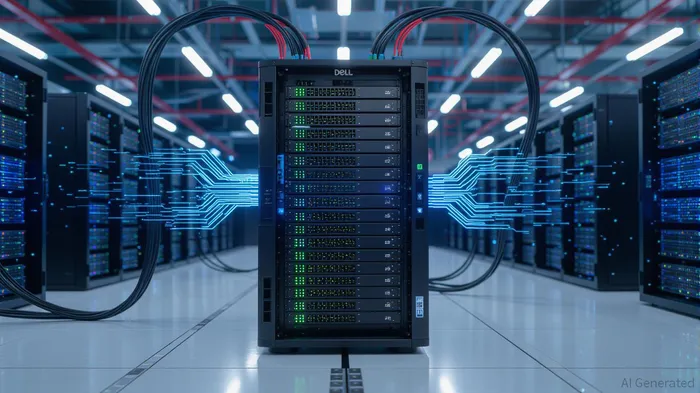
In the ever-shifting landscape of technology, few stories have captured the imagination of investors and industry watchers as vividly as DellDELL-- Technologies' AI-driven transformation. The company's recent financial results and strategic moves position it as a linchpin in the global AI infrastructure race, a sector poised to balloon from $167.2 billion in 2025 to $1.56 trillion by 2034. But what does this mean for Dell's long-term growth, and how does it stack up against rivals like HPEHPE--, IBMIBM--, and Lenovo? Let's dissect the numbers, the strategy, and the risks.
The AI Gold Rush: Dell's Q2 2025 Earnings as a Case Study
Dell's Q2 2025 earnings report was a masterclass in capitalizing on macro trends. The Infrastructure Solutions Group (ISG), which includes servers, storage, and networking, delivered a 44% year-over-year revenue increase, with AI-optimized hardware contributing $12.9 billion of the $16.8 billion total. This was fueled by a 69% surge in server and networking sales, driven by a $11.7 billion AI server backlog—a testament to the company's ability to secure large-scale enterprise and sovereign orders.
The numbers are staggering: Dell shipped $8.2 billion in AI servers during the quarter, with CEO Jeff Clarke noting that the company had already shipped $10 billion in AI servers across the first two quarters of fiscal 2026. This outperformance led to an upward revision of full-year AI server shipment guidance from $17 billion to $20 billion—a 17.6% jump that signals confidence in sustained demand.
But the story isn't just about volume. Dell's AI Factory initiative, a partnership with NVIDIANVDA--, has become a cornerstone of its strategy. By offering pre-configured AI infrastructure with a 60% cost advantage over public cloud solutions, Dell is addressing a critical pain point for enterprises: the need for scalable, cost-effective AI deployment. The PowerEdge XE9785 server, capable of housing 192 NVIDIA Blackwell Ultra GPUs, exemplifies this approach. Paired with direct-to-chip liquid cooling (which slashes energy costs by up to 60%), Dell is not just selling hardware—it's selling a solution.
Competitive Positioning: Leading the Pack, but Not Without Challenges
Dell's 19.3% global server market share and 20% AI server market share in 2025 place it firmly at the top of the heap. But the competition is fierce. Hewlett PackardHPE-- Enterprise (HPE) is gaining ground with its hybrid cloud and edge computing focus, while IBM leverages its enterprise-grade AI and quantum-inspired technologies. Lenovo, though less dominant in servers, is expanding its AI-ready hardware production in the Asia-Pacific region, a market growing at 28.6% CAGR.
What sets Dell apart is its ecosystem. The AI Factory program, with over 3,000 customers, is not just a product line—it's a platform. By integrating NVIDIA's Blackwell architecture and offering end-to-end services (from consulting to managed AI deployment), Dell is creating a flywheel effect. Customers who start with Dell's AI infrastructure are more likely to stay within its ecosystem for data management, training, and scaling. This stickiness is a critical differentiator in a market where commoditization threatens margins.
However, margins remain a concern. Dell's ISG operating margin dropped to 8.8% in Q2 FY2026, down from 11.0% the prior year, due to high GPU costs and competitive pricing pressures. While management expects margins to recover to 12% by FY2026's end, investors must weigh this against the broader industry trend of margin compression.
Market Trends: The AI Infrastructure Megatrend and Its Implications
The AI server market's projected 28.2% CAGR through 2034 is not just a number—it's a structural shift. Enterprises are no longer experimenting with AI; they're deploying it at scale. This is evident in Dell's customer base, where 75% of AI projects meet or exceed expectations, and in the company's partnerships with hyperscalers like AWS, MicrosoftMSFT-- Azure, and Google Cloud.
Geographically, North America remains the largest server market (35% of global consumption), but Asia-Pacific is the fastest-growing region, driven by 5G, cloud expansion, and government-led digitalization. Dell's global supply chain and R&D footprint position it to capitalize on these trends, particularly in India, where server demand is growing at over 25% annually.
Risks and Rewards: A Balanced Perspective
For all its strengths, Dell faces headwinds. The commoditization of AI hardware could erode pricing power, and geopolitical tensions (e.g., U.S.-China trade dynamics) may disrupt supply chains. Additionally, while NVIDIA's Blackwell adoption is a tailwind, it also creates dependency on a single supplier for critical components.
Yet, the upside is compelling. Dell's $14.4 billion AI server backlog is a near-term tailwind, and its forward P/E of 14.62 (well below the tech sector average) suggests the market is not fully pricing in its growth potential. The company's ability to innovate—whether through liquid cooling, AI Factory integration, or partnerships—provides a moat against rivals.
Investment Thesis: Buy, Hold, or Watch?
Dell's AI-driven revenue surge is not a flash in the pan. The company is building a durable business in a sector with explosive growth. For investors, the key question is timing. With AI server shipments expected to double by 2026 and margins on track to improve, Dell offers a compelling mix of near-term visibility and long-term potential.
However, patience is required. The path to $20 billion in AI server shipments is not without risks, and margin recovery hinges on supply chain stability and enterprise adoption of advanced hardware. For those with a 3–5 year horizon, Dell represents a high-conviction play in the AI infrastructure megatrend. For shorter-term investors, the stock's volatility and macroeconomic sensitivities may warrant a cautious approach.
In the end, Dell's story is about more than numbers—it's about redefining what's possible in enterprise computing. As AI becomes the backbone of global industry, companies that can deliver scalable, secure, and cost-effective infrastructure will thrive. Dell, with its ecosystem, innovation, and execution, is well-positioned to lead the charge.

Delivering real-time insights and analysis on emerging financial trends and market movements.
Latest Articles
Stay ahead of the market.
Get curated U.S. market news, insights and key dates delivered to your inbox.
AInvest
PRO
AInvest
PRO



Comments
No comments yet