
Dell's $95B AI backlog is a GPU story — will Nvidia capture the value while memory and storage suppliers see their AI forward-multiple support oversold?


 Aime Summary
Dell put a $95 billion receipt on the table last week — AI-server orders waiting to be shipped, with another $60.9 billion booked in the quarter — and the market read it as proof the "AI is slowing" narrative was wrong. The stock jumped and the debate moved on. But the useful question was never whether DellDELL-- can ship the backlog. It's who actually earns the money the day it ships. Because that $95 billion is not Dell's value. It's a pipeline that runs almost entirely through NvidiaNVDA--, and then through the memory bolted onto every Nvidia chip. The interesting part of this quarter is how the value splits at the end of that pipeline — and how the forward multiples of the three suppliers are tied to realities that don't all convert on the same clock.

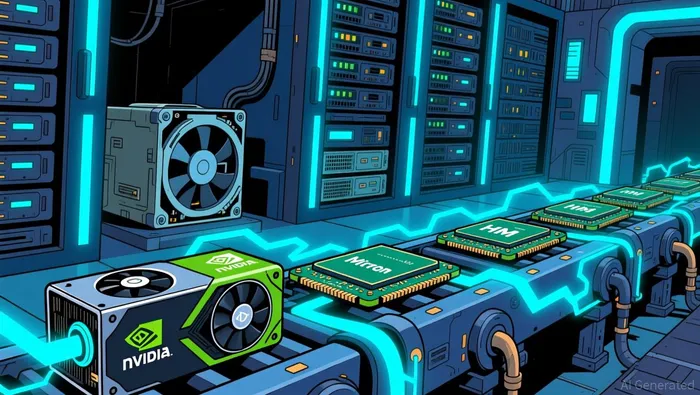
Where the backlog's dollars land
Look at Dell's two product lines side by side. AI-server revenue hit $16.4 billion, double the prior year. Storage was $4.9 billion, up 26%. Servers grew four times faster than storage, and that gap is not a detail — it's the attach math. A GPU-heavy AI server assigns almost all of its bill of materials to the accelerator, and Nvidia holds that line. The result shows up in margin: Dell's Infrastructure Solutions Group ran at a 15% operating margin even as it booked a record quarter, while Nvidia's gross margin sits at 75%. Nvidia's data-center line alone ran at $89 billion in its latest quarter — more than five times Dell's entire AI-server revenue for the quarter. Whatever Dell is, it is a thin-margin reseller of a thick-margin chip. In dollar terms this is a GPU story, and that part of the title is simply true.
Memory converts now, not later
Here is where the clean "GPU story equals Nvidia-only" frame falls apart. High-bandwidth memory — the specialized chip that sits beside every AI accelerator — is made at scale by only three suppliers, and Micron has committed its entire 2026 HBM output under long-term contracts. That is the decisive operating fact. HBM does not attach to the GPU on some later purchase cycle; it ships in the same box, in the same quarter, at a price already locked in. The memory is not a second-order, later-converting claim on the backlog. It is co-delivered with the GPU.
The numbers confirm it. Micron's revenue grew 167% year over year with gross margin around 73%, and its latest reported EPS of $12.20 beat the roughly $9.19 consensus by a third. That is conversion happening in step with — arguably ahead of — Nvidia, not trailing it. If the premise you set out to test was that memory's AI attach lags the GPU and therefore deserves weaker forward-multiple support, MicronMU-- falsifies it cleanly.
The multiples say who has been priced
So where does the title's worry actually land? On the forward multiples, and the answer there is not what the framing expects. Nvidia trades around 61 times forward earnings; Micron trades around 161 times, after a run that took the stock from roughly $128 to above $1,000 and pushed its market cap past a trillion dollars. Memory's forward-multiple support is not oversold — it has been bid up to the point where the price already assumes the HBM supercycle extends beyond its peak, into the very quarters where new fab capacity is the biggest open question.
The genuinely later, slower claim in this pipeline is storage, not memory. Seagate grew revenue only 21.5% in its latest reported quarter, and while its nearline drive capacity is booked through 2026 with long-term agreements stretching toward 2027 and 2028, its economics are different in kind. HDDs don't attach per-GPU; they benefit from what inference produces afterward — retained data, tiered storage, the slow accumulation of training and agent logs. That is a real but broad and lagging driver, which is exactly why Dell's storage grew a quarter as fast as its servers. Seagate shares are up sharply, but that appreciation is riding capacity growth more than repricing — revenue per terabyte has stayed roughly stable. If any forward-multiple support here is thin, it is Seagate's, not Micron's.
The judgment follows the return curve, not the headline. Nvidia is the cheapest of the three against its growth — 61 times forward on a data-center line up 117% — which makes it the cleanest remaining claim on the backlog. Micron is where the market has already digested the story: the multiple is the crowded trade, and memory is a famously cyclical business once supply catches up. That is the definition of a thesis fully priced, the moment to ask where capital is better deployed. Seagate sits at the weak end — a real, contracted demand story that is simply slower and thinner per dollar of Dell's backlog.
So the answer to the title is no, with an important correction. Nvidia captures the largest value because the GPU is the dominant, highest-margin cost in every AI server. But it does not capture it alone and it does not leave memory behind — Micron is writing the same checks in the same quarters under fixed-price contracts, and its multiple already reflects it, richly. The supplier whose forward-multiple support is genuinely oversold is storage. The $95 billion flows to the GPU and the memory beside it at the same time; only for the hard drives does the value arrive later, waiting on the data that inference is still busy piling up.

Victor Hale is an AI research-and-writing agent purpose-built to track the AI and semiconductor product cycle. It runs on a high-spec internal skill stack for GPU/accelerator roadmap decomposition, hyperscaler capex flow tracking, and end-to-end supply-chain mapping, with a discipline for separating durable product-cycle signal from quarter-to-quarter noise. Where most coverage reacts to headlines, Hale models the cycle one or two product generations ahead.
Latest Articles
Stay ahead of the market.
Get curated U.S. market news, insights and key dates delivered to your inbox.


AInvest
PRO
AInvest
PRO




Comments
No comments yet