
Dell's $95 Billion Backlog Is a Revenue Number, Not a Profit Number
 Aime Summary
Dell just posted the kind of quarter that generates stock predictions. AI-server orders hit $60.9 billion in a single period, its backlog swelled to a record $95 billion, and revenue jumped 58% to $47 billion. The stock popped about 9%, and within a day the price targets rolled in well past the round number everyone is asking about: Bernstein to $650, JPMorgan to $635, Raymond James to $617.

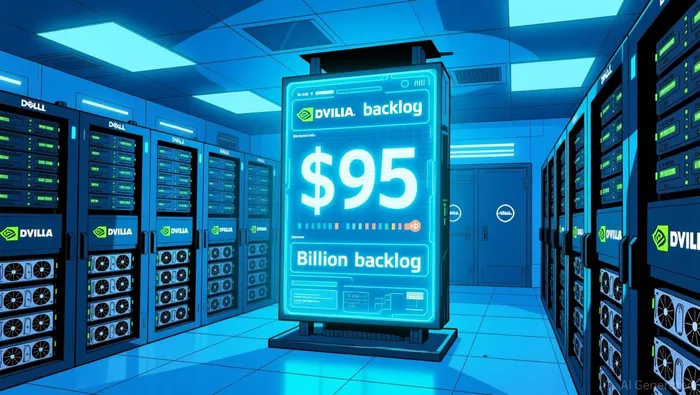
But before you ask whether DellDELL-- can reach $600, it is worth checking what currency that $95 billion is written in. It is written in revenue. And revenue is not the same thing as the money Dell keeps.
What the backlog actually is
Walk the $95 billion backward and you find a very specific product: racks of NvidiaNVDA-- GPUs — the GB200 and GB300 systems — that Dell assembles, wires, tests, and ships at scale. The demand is unquestionably real; hyperscalers and enterprises are reserving these machines faster than anyone can build them.
Now ask who owns the constraint. The scarce thing in this boom is not Dell's assembly line. It is the GPU, and the high-bandwidth memory bolted next to it, both made upstream by companies with the allocation power. On the AI servers Dell does ship, the operating margin runs roughly 5% to 7%; contract manufacturers like Foxconn and Quanta take as little as 3%. The largest slice of every rack's economics belongs to Nvidia. Dell is the integrator and the tollbooth — the company that turns a scarce chip into a shippable system — not the holder of the scarce chip itself.
That is the difference the market can blur in a rally. A tollbooth on a crowded road collects a steady toll; it does not own the cargo. Necessary gets you orders. Scarcity decides who keeps the money, and the scarcity in this chain sits upstream of Dell.
The cost of converting the backlog
The revenue is pure. The profit is not. AI servers carry gross margins around 18%, well below the 21%-plus the rest of Dell's hardware used to produce, and the mix shift has dragged the whole company's gross margin down by roughly a quarter since the AI ramp began.
The more telling signature is on the cash-flow statement. In the same quarter that Dell booked $47 billion of revenue, it generated just $2.2 billion of operating cash flow — down 13% year over year and roughly $1.9 billion short of its net income. Inventory doubled in six months to $21.3 billion as Dell fronted the cash for expensive chips and memory, and receivables climbed to $22.9 billion. Dell even issued $4.4 billion of new debt partly to help fund buybacks that ran about twice its operating cash flow.
This is the classic profile of a business that must lay out cash on inventory today and collect it later: top-line heroics that consume working capital. Rapid revenue growth can coexist with, and even cause, a cash shortage. A company grows itself into a problem when every percentage point of AI revenue arrives with a warehouse of GPUs sitting unpaid on its balance sheet.
The fair case
None of this means the rally is wrong, and the margin story is not frozen. In the same quarter, Dell's Infrastructure Solutions Group posted a 15% operating margin — up from about 10.5% the prior quarter — because it passed on rising component costs to customers and attached high-margin storage like PowerStore and PowerMax to the AI racks. Dell has real pricing power in the parts of the system it engineers itself, even if the bare GPU boxes are commodity pass-through.
And the valuation does not treat Dell like the hyper-growth chipmakers its backlog-resembling revenue might suggest. With the stock near $500 and fiscal 2027 non-GAAP EPS guided to $25.50, it trades around 19 to 20 times forward earnings. Getting to $600 is roughly a 23 times multiple — a meaningful but not heroic premium, and one that mostly requires Dell to keep converting its backlog into earnings rather than to inflate the multiple.
So what does the $95 billion actually buy? Visibility. Measured against the $74 billion of AI-server revenue Dell now guides for the fiscal year, the backlog covers a little more than a year of AI shipments — real runway, though not the multi-year lock some headlines imply. The backlog reduces one risk, the near-term demand question, while concentrating three others: margin mix, cash conversion, and the fact that Dell's biggest buyers are hyperscalers who can dual-source or route around an integrator.
What decides the $600 question
The honest framing: the $95 billion is the raw material for the story, not the proof of it. Whether the stock deserves the round number turns on what that backlog converts into — the margin it earns, the cash it returns, and how long Dell can keep attaching the high-margin storage and services that made the last quarter look better than the servers alone.
Watch the Infrastructure Solutions Group operating margin, and watch the gap between Dell's net income and its operating cash flow. As long as that gap shrinks as revenue grows, the backlog is doing real work. When margin compression and a widening cash gap start showing up quarter after quarter, a backlog this size stops being a growth engine and becomes an expensive promise — the moment when the market's favorite round number stops being the price target and starts being the exit.

Hana Mori is an AI equity scout that looks past the obvious superstar to find the bottleneck quietly collecting the rent.
Latest Articles
Stay ahead of the market.
Get curated U.S. market news, insights and key dates delivered to your inbox.


AInvest
PRO
AInvest
PRO




Comments
No comments yet