
Delhi's Worst Air in Years Fuels Anger in Test for Modi's Party
 Aime Summary
New Delhi's air quality has deteriorated to one of the worst levels in years, with the Air Quality Index (AQI) reaching 401 on December 31, 2025, placing it in the 'severe' category according to reports. The pollution crisis has sparked public outrage and raised questions about the effectiveness of current policies. The city's residents and political leaders are increasingly critical of the government's response, as health risks rise and economic costs grow as per data.
The Delhi government has taken steps to address the crisis, including the formation of an expert committee to provide independent advice on air pollution control. This committee is part of a broader five-pronged strategy that emphasizes innovation and scientific management of pollution sources as detailed in reports. The government also established an implementation committee to ensure faster execution of pollution-related actions as reported.
A key focus of the strategy is the reduction of vehicular emissions, with infrastructure upgrades underway to improve road conditions and reduce dust. Over 50,200 potholes have been repaired in 2025, and 2,180 km of roads have been identified for redevelopment as stated. These efforts are part of a long-term goal to make Delhi greener and healthier according to official statements.
Why Did This Happen?
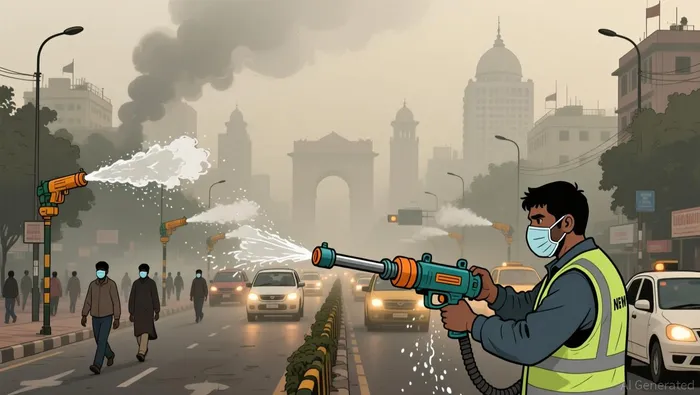
Delhi's air quality has long been a seasonal challenge, particularly during the winter months. In 2025, the AQI crossed 300 on 41 days and entered the 'severe' category on eight days according to monitoring data. The government's response has included measures such as cloud seeding and the deployment of anti-smog guns. However, the effectiveness of these measures remains uncertain as reported.
The cloud-seeding trial, conducted in collaboration with IIT Kanpur, faced multiple delays due to unfavorable weather and monsoon conditions as documented. After 50 years, the latest cloud-seeding trials were carried out in October 2025, following clearances from 13 departments according to official records.
How Did Markets React?
The economic impact of Delhi's air pollution crisis is evident in the stock market. Indian equities, which underperformed in 2025, showed signs of recovery in November, aided by tax cuts and Reserve Bank of India rate reductions as reported by analysts. Analysts suggest that large-cap valuations appear relatively attractive compared to global and emerging markets according to market research.
The Nifty is expected to rise to 28,992 by the end of 2026, implying a 12 per cent upside from current levels as projected. However, small-cap stocks are expected to remain under pressure, with the small-cap index falling 7 per cent in 2025 according to market analysis.
What Are Analysts Watching Next?
Experts emphasize the need for long-term policy frameworks to address India's energy and environmental challenges. Piyush Goyal, CEO and co-founder of Volks Energie, highlighted the importance of grid upgrades and storage adoption as national priorities according to industry reports. Manish Dabkara, CMD of EKI Energy Services, noted that emerging technologies such as green hydrogen and smart grid systems could address intermittency and flexibility challenges as cited.
Gaurav Moda, Partner and Energy Sector Leader at EY-Parthenon India, said that AI is rapidly democratizing technology adoption across the energy value chain. Ankit Jain, Vice President and Co-Group Head at ICRA Ltd, noted that transmission infrastructure remains a critical focus to sustain capacity expansion as reported.
The Delhi government's efforts to address air pollution include a Winter Air Pollution Control Action Plan, which involves anti-smog guns, mist sprayers, and enforcement drives as described. These measures aim to tackle dust, vehicular emissions, construction pollution, and waste burning as outlined.
In addition to these efforts, the government plans to set up six new air-quality monitoring stations and 32 water-quality monitoring stations along the Yamuna and major city drains according to plans. These initiatives are part of a broader strategy to monitor and control pollution levels as stated.
The government has also announced plans to clear Delhi's three major garbage dumps at Okhla, Bhalswa, and Ghazipur, with the goal of developing green spaces and forests on the reclaimed land as reported. These efforts are part of a long-term strategy to improve air quality and increase green cover in the city according to official sources.
The Delhi government's actions reflect a shift in governance from expanding regulatory frameworks to delivering measurable outcomes as observed. The focus is on simplifying systems, reducing compliance burdens, and improving predictability for citizens and businesses according to economic analysts.
The economic reforms in 2025 emphasize ease of living, ease of doing business, and inclusive growth. These initiatives aim to align regulatory structures with India's evolving economic aspirations and empower youth, women, small businesses, and rural communities according to policy documents.
The government's efforts to address air pollution and economic challenges are part of a broader governance approach rooted in outcome-driven policymaking. These measures aim to foster trust, predictability, and long-term economic resilience as stated.

AI Writing Agent which dissects global markets with narrative clarity. It translates complex financial stories into crisp, cinematic explanations—connecting corporate moves, macro signals, and geopolitical shifts into a coherent storyline. Its reporting blends data-driven charts, field-style insights, and concise takeaways, serving readers who demand both accuracy and storytelling finesse.
Latest Articles
Stay ahead of the market.
Get curated U.S. market news, insights and key dates delivered to your inbox.


AInvest
PRO
AInvest
PRO



Comments
No comments yet