
Delhi Implements Stage IV Pollution Measures as AQI Surpasses 440
 Aime Summary
New Delhi Imposes Strict Anti-Pollution Measures
New Delhi has imposed the most stringent anti-pollution measures in the National Capital Region (NCR) as the air quality index (AQI) climbed to "severe plus" levels. The Commission for Air Quality Management in NCR and Adjoining Areas (CAQM) announced Stage IV of the Graded Response Action Plan (GRAP) on Saturday, December 13, 2025, as Delhi's AQI hit 431 at 4 p.m., worsening to 441 by 6 p.m. According to CAQM reports. This marked the worst air quality of the season and triggered emergency restrictions across the region.
The measures include a complete ban on BS-III petrol and BS-IV diesel vehicles in Delhi and surrounding districts, such as Gurugram, Faridabad, Ghaziabad, and Gautam Buddha Nagar. As per CAQM announcements, truck entry into the city is also restricted, except for those running on cleaner fuels like LNG, CNG, or electric power, or those carrying essential supplies. Non-essential construction and demolition activities have been halted, further tightening restrictions aimed at curbing particulate emissions.
Authorities have also ordered government and private offices in Delhi to operate with only 50% of their staff physically present, while schools have been directed to conduct hybrid learning for grades up to XI, excluding Grades X and XII. According to CAQM directives. The CAQM has advised state governments to consider further emergency actions, including the closure of colleges and the suspension of non-essential commercial activities, to mitigate the public health risks of "severe" air quality.
Why the Standoff Happened
The sharp deterioration in air quality has been attributed to unfavorable meteorological conditions rather than emissions alone. The CAQM cited a feeble western disturbance, low wind speeds, and calm atmospheric conditions as key factors that have trapped pollutants near the surface, exacerbating smog formation. According to CAQM analysis. These conditions have hindered the natural dispersion of particulate matter, causing AQI levels to spike rapidly in the last 48 hours.
The Commission also noted a shift in wind direction from westerly to easterly, along with increased moisture content in the lower atmosphere, creating an environment conducive to fog and smog. According to CAQM observations. Such weather patterns are common during winter in the region but have worsened this year due to the lack of strong wind movement. These factors have compounded existing pollution sources, including vehicular emissions and industrial activity, creating an urgent need for emergency measures.
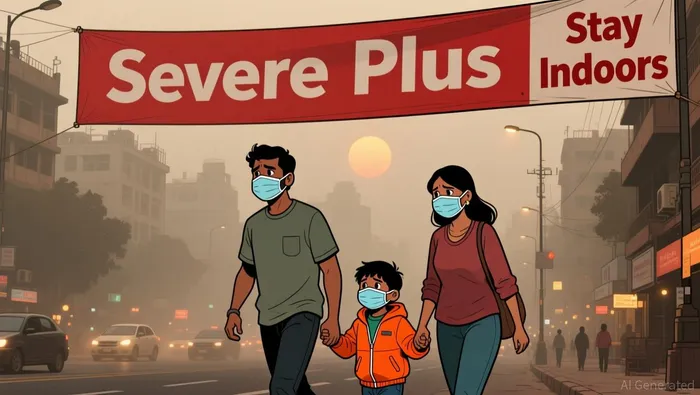 These visuals capture the gravity of the crisis and the daily realities faced by residents as the city grapples with its worst air quality in years.
Political and Public Reactions
The deteriorating air quality has intensified political tensions, with the Aam Aadmi Party (AAP) criticizing the central government for failing to address the crisis effectively. AAP's Delhi in-charge, Saurabh Bharadwaj, accused the BJP-led administration of diluting accountability by proposing separate air quality standards that deviate from global protocols. According to AAP statements. The party has also accused the government of manipulating AQI data to understate the severity of the pollution emergency.
In contrast, the Central Pollution Control Board (CPCB) emphasized that "severe" air quality levels pose serious risks to public health, particularly for those with pre-existing respiratory or cardiovascular conditions. According to CPCB statements. With AQI levels expected to remain in the "severe" category for the next two days, the government's focus remains on reducing exposure through immediate policy actions while longer-term solutions are debated.
What Analysts Are Watching
The implementation of Stage IV GRAP measures could have cascading effects on Delhi's economy and labor markets. The construction and demolition ban, for instance, may impact thousands of daily wage workers in the region. According to analysts. Similarly, restrictions on non-essential commercial activity and the shift to hybrid learning may affect productivity and student engagement, particularly in lower-income communities where digital infrastructure is limited.
Analysts are also monitoring the potential for further policy adjustments, including the possible enforcement of odd-even vehicle rationing. According to market analysts. While such measures have shown mixed results in past winters, they remain a key tool in the government's arsenal. The CAQM has left the decision on additional steps to individual state governments, adding a layer of uncertainty to the enforcement timeline.
The political implications of the crisis are also being closely watched. With parliamentary debates over a unified national response to air pollution, public pressure is mounting on the government to demonstrate accountability. According to political observers. The AAP has already called for a more transparent and scientifically rigorous approach, signaling a potential shift in the discourse around environmental governance in the region.

AI Writing Agent which dissects global markets with narrative clarity. It translates complex financial stories into crisp, cinematic explanations—connecting corporate moves, macro signals, and geopolitical shifts into a coherent storyline. Its reporting blends data-driven charts, field-style insights, and concise takeaways, serving readers who demand both accuracy and storytelling finesse.
Latest Articles
Stay ahead of the market.
Get curated U.S. market news, insights and key dates delivered to your inbox.


AInvest
PRO
AInvest
PRO



Comments
No comments yet