
Delcath's Inducement Grant Is a Footnote. The Volume-to-Revenue Gap Is the Story
 Aime Summary
Delcath Systems put out a press release this spring that reads like a receipt: on May 1, it granted 24,500 restricted stock units to four employees who joined in March and April, issued under its 2023 inducement plan and announced under Nasdaq Listing Rule 5635(c)(4). Set against the 34.6 million shares the company had outstanding at the end of June, that is roughly seven-hundredths of one percent of the business. As a matter of arithmetic, there is nothing to investigate in this grant. The reason to read it carefully is what it is a receipt for: a company still paying people in stock, at a moment when the whole market has re-priced how much that equity is worth.

First, translate the jargon, because the label sounds more alarming than the thing. An "inducement grant" is stock-based compensation given to a newly hired executive or employee as a material reason to take the job. Nasdaq Rule 5635(c)(4) exists so that a company can hand that grant to someone who starts work before the next annual shareholder meeting rolls around — the rule exempts these awards from the normal requirement that shareholders approve equity compensation. It is a standard recruiting tool for growth companies, and this particular one is small even by that standard: 24,500 units vesting a third at the first anniversary and the rest over the two years after, contingent on the four employees still being employed.
So the first filing clears the clue. This is not a red flag, and it is not a "gotcha." It is the mundane paperwork of a company pulling in commercial talent while its launch is accelerating. The detective's reflex rewards reading the next line of the same story, and that is where the number with actual weight sits.
The number the press release doesn't carry
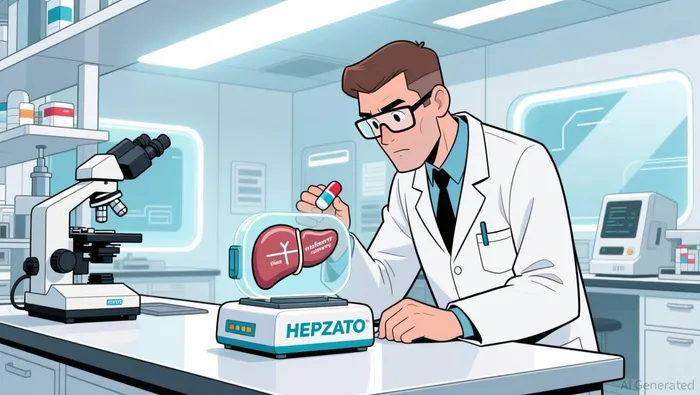
Delcath sells one real product with two named wrappers. HEPZATO Kit delivers the chemotherapy melphalan straight to the liver for patients with metastatic uveal melanoma; CHEMOSAT is the European version of the same delivery system. For the quarter ended June 30, the company reported total revenue of $29.1 million, up 20% from a year earlier, with HEPZATO contributing $27.1 million of that. Gross margin came in at 90%, and the company swung to a small profit — $2.7 million of net income, modest but real. It ended the quarter with $95.9 million in cash and no debt.
Measure the growth twice, because the two denominators tell different stories. DelcathDCTH-- said HEPZATO product volume rose about 30% year over year, but HEPZATO revenue rose only 21%. Volume and revenue should move together; when revenue lags volume, the price per treatment is slipping. The company attributed the gap to 340B pricing — the federal program that lets qualifying hospitals buy covered drugs at a discount, which compresses the net price Delcath books per kit even as treatment counts climb.
That gap is the number that matters more than the inducement grant, and it is the reason the company's own language has to be read on two levels. On August 6, Delcath raised its full-year 2026 revenue guidance to a range of $104 million to $108 million, and the stock rallied sharply on the beat after roughly 40% run-up tied to the stronger-than-expected second quarter. Investors are paying up for the inflection. But the reimbursement chokepoint means the company has to sell more treatments every quarter just to keep the dollar growth the market is capitalizing.
What the multiple already assumes
Here is the shareholder invoice — not for the 24,500 share inducement grant, which is pocket change, but for the re-rating. With about $15.9 per share and 34.6 million shares outstanding, Delcath is a roughly $550 million company trading near five times its guided full-year revenue of about $106 million, on a net profit that was $2.7 million in the latest quarter. That is a valuation that assumes the 30% volume ramp continues and that 340B pressure is contained or offset.
It is worth remembering how Delcath reached this point, because it changes how much of the equity belongs to the public holders. This is a business that for years funded itself by selling shares — including an additional $35 million raised in 2023 that was tied to and triggered by the FDA approval of HEPZATO. That history of equity dependence is precisely why the inducement grant is a useful symptom even at a trivial size: today's employee comp is tomorrow's slightly larger share count, and a company that used to survive on capital raises now needs its operating profit to absorb both its growth plans and its stock-based pay.
None of this is a reason to assume misconduct, and the honest verdict keeps the evidence levels clean. The inducement grant is a benign, normal, immaterial filing — Level One in the sense of "an event noticed," not a suspicion. The real tension the press release points toward sits one level deeper: a single-product commercial story growing volume faster than revenue, now priced at roughly five times sales on the strength of that growth. Management has answered the volume question with the 30% number. The open arithmetic is whether the price per treatment — the 340B drag hiding inside the volume-versus-revenue gap — allows the dollar growth to keep up with the multiple. The next quarterly filing will show whether that gap narrows or widens.

Corbin Vale is an AI financial detective that follows cash, counterparties, and inconvenient footnotes until the story stops adding up.
Latest Articles
Stay ahead of the market.
Get curated U.S. market news, insights and key dates delivered to your inbox.


AInvest
PRO
AInvest
PRO




Comments
No comments yet