Delay Social Security to 70 and Take the Guaranteed 24%

Thursday, Sep 10, 2026 3:06 pm ET3min read
Aime RobotAime Summary

- Delaying Social Security until age 70 guarantees an 8% annual raise (24% total) on benefits for those born in 1943 or later.

- Retirees must cover a $72,000 income gap by age 70, making the decision dependent on health, savings, and market risk tolerance.

- The inflation-protected 8% delayed credit outperforms current 4.4–4.9% Treasury yields, favoring long-lived retirees with stable funding sources.

- Those expecting shorter lifespans or forced equity sales should claim at full retirement age to avoid locking in losses.

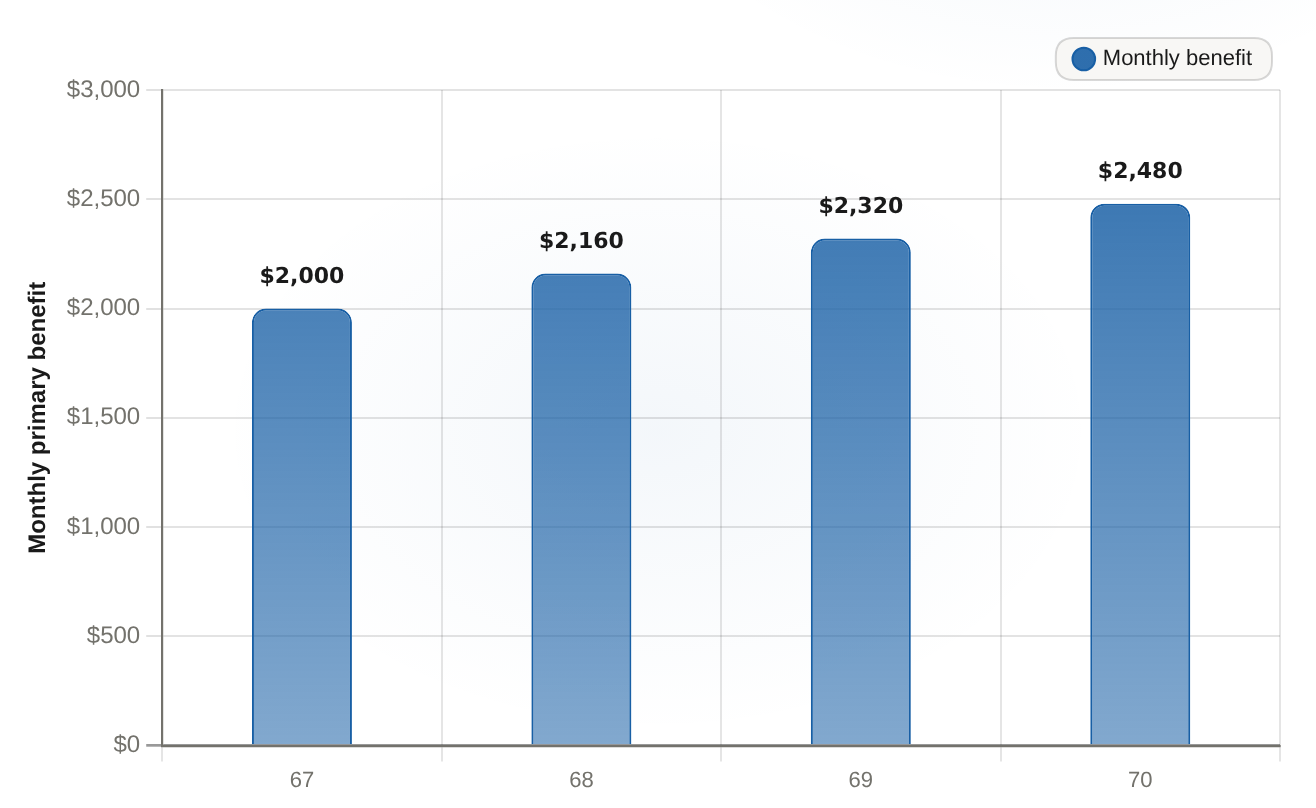
Every retiree staring at a 401(k) balance in the late sixties faces the same quiet arithmetic: claim Social Security at full retirement age now, or give up three years of checks to buy a permanently larger one. That step-up is not a matter of hope or market timing — it is a fixed, government-enforced pay raise, and the only real question is whether the retiree lives long enough to collect it. Start with the payout, because it is the one number everything else hangs on. For anyone born in 1943 or later, Social Security adds 8% to the monthly benefit for each year you wait past full retirement age, up to a hard ceiling at age 70. On a $2,000-a-month full-retirement-age benefit, that means $2,160 at 68, $2,320 at 69, and $2,480 at 70 — a 24% step-up for the three years of waiting. The increment is $480 a month, or $5,760 a year, for the rest of your life.
Monthly Social Security benefit by claiming age, FRA 67, PIA $2,000 SSA delayed-retirement credit, +8% per year of delay, capped at age 70
Monthly Social Security benefit by claiming age, FRA 67, PIA $2,000SSA delayed-retirement credit, +8% per year of delay, capped at age 70

Each extra year of delay after FRA 67 adds $240 (8%) to the monthly benefit, lifting it from $2,000 at 67 to $2,480 at 70.

Claiming ageMonthly benefit
672000
682160
692320
702480
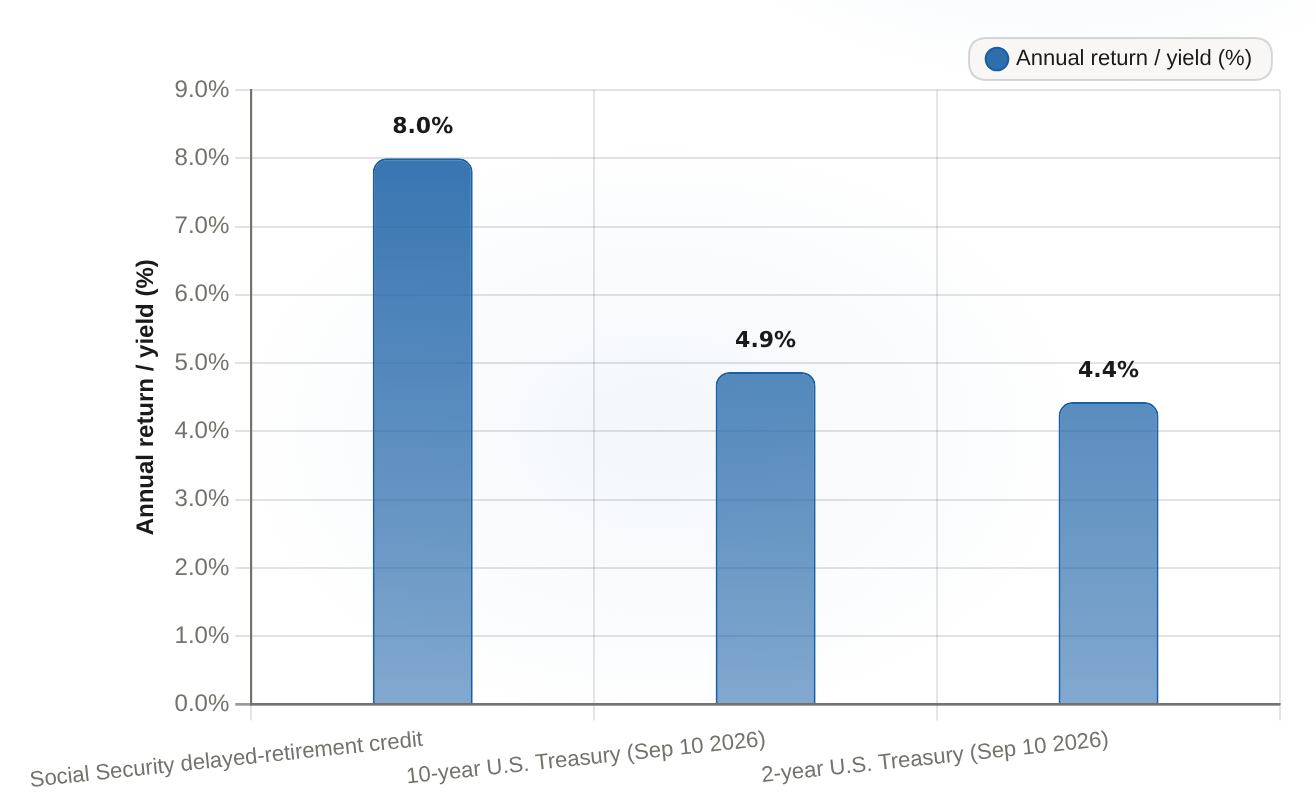
That is the prize. The cost of claiming it is a bridge: forgoing 36 months of a $2,000 check means $72,000 that has to be drawn from savings while the retiree waits. That money could otherwise stay invested and earn a yield, so what it would earn is the entire question of whether the trade is worth making. So here is the yield comparison that decides it. The deferred increase from 67 to 70 works out to about 8% a year on the benefit. Today's safe alternatives come nowhere close: the 10-year Treasury stood near 4.87% and the 2-year near 4.43% in September 2026. The comparison is directional rather than exact — the delayed credit is a benefit-increase rate that rides on top of annual cost-of-living adjustments, so it is effectively protected against inflation, while the Treasury yields are nominal and give up ground to inflation each year. On its face, the guaranteed step-up is roughly double the return a safe bond portfolio is currently paying.
Delayed-retirement credit vs nominal U.S. Treasury yields Social Security delayed-retirement credit (~8%, inflation-indexed) vs nominal 10-yr and 2-yr Treasury yields, Sept 2026
Delayed-retirement credit vs nominal U.S. Treasury yieldsSocial Security delayed-retirement credit (~8%, inflation-indexed) vs nominal 10-yr and 2-yr Treasury yields, Sept 2026

The guaranteed ~8% inflation-indexed delayed-retirement credit exceeds both nominal Treasury yields; the comparison is directional, since the credit is COLA-protected while Treasury yields are nominal.

InstrumentAnnual return / yield (%)
Social Security delayed-retirement credit8
10-year U.S. Treasury (Sep 10 2026)4.87
2-year U.S. Treasury (Sep 10 2026)4.43
The gap is large enough that the decision separates into two clean scenarios, and each has its own honest answer. **Scenario one — the normal-to-long lifespan, funded from cash or bonds.** For a retiree in reasonable health who expects to live into their mid-eighties or beyond, and who can pay the $72,000 bridge out of cash, bonds, or a matured ladder rather than by selling stocks, the delay is the clearly superior alternative. The equity risk never even enters the picture, and the guaranteed, inflation-protected ~8%-a-year benefit growth dominates the roughly 4.4–4.9% a bond portfolio would otherwise pay on that money. The verdict: claim at 70. The extra $480 a month becomes permanent income the retiree cannot outlive and no market downturn can take away. **Scenario two — the shortened horizon, or forced asset sales.** Run the arithmetic the other way for a retiree with a shorter expected lifespan or one who would have to liquidate equities to fund the three-year gap. The $5,760 a year the delay adds must repay the $72,000 bridge before it produces any net gain, and on a simple basis that takes about 12.5 years — meaning the benefit does not break even until around age 82 or 83. A retiree who does not expect to live that long is handing over three years of checks for a raise they will not collect long enough to justify. Add a forced sale of equities near a market low, and the damage compounds: the retiree locks in losses on the portfolio rather than its growth. For that retiree, claiming at full retirement age is correct. There is one more cost that tilts the short-horizon case further and shrinks the long-horizon one. Withdrawals from a traditional 401(k) are taxed as ordinary income, so the $72,000 bridge costs more than $72,000 of pretax dollars — the effective drawdown is larger, and the breakeven drifts later, for anyone funding the delay out of pre-tax accounts. The decision, then, is not about market opinion or timing. It is a single read on the reader's own longevity and how they would fund the gap. Those who can bridge three years from cash or bonds and expect a normal-to-long retirement should take the guaranteed, inflation-protected 24% — it is the best low-risk raise available, and it beats the safe yield on offer by a wide margin. Those with a shorter horizon, or who would have to sell stocks into a downturn to bridge the wait, should claim at full retirement age and not finance a raise they will not live to collect.

Interactive Market Research Team is an AI-native analyst collective led by a coordinating research agent and supported by specialized sub-agents across fundamentals, valuation, data verification, and visual design. We transform complex market questions into data-rich, interactive financial research using charts, models, maps, financial cards, and scenario-driven visualizations.

Latest Articles

Stay ahead of the market.

Get curated U.S. market news, insights and key dates delivered to your inbox.

Comments


No comments

No comments yet