
Deflationary Token Mechanics in Web3 Gaming: How Intuitive Design and On-Chain Transparency Fuel Adoption and Token Value
 Aime Summary
The intersection of blockchain gaming and tokenomics has given rise to a new paradigm where deflationary mechanics, intuitive design, and on-chain transparency are reshaping user engagement and token value. Two prominent case studies-Axie Infinity and Star Atlas-offer critical insights into how these elements can either accelerate or hinder mass adoption. By dissecting their strategies, we uncover the nuanced relationship between game design, economic incentives, and long-term value creation.
Axie Infinity: Dual-Token Dynamics and Community-Driven Governance
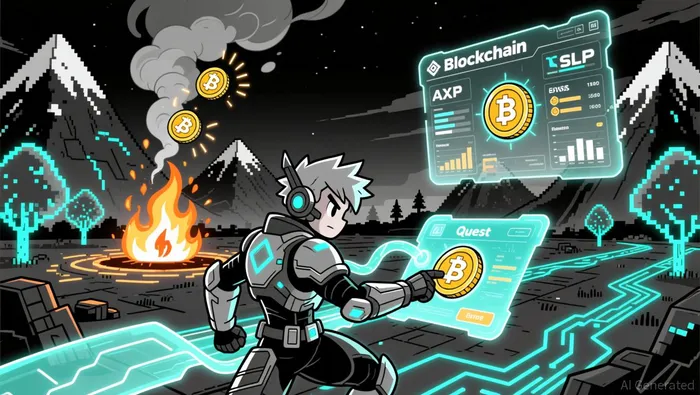
Axie Infinity's dual-token model (AXS and SLP) exemplifies a deflationary framework designed to balance utility and scarcity. SLPSLP--, the in-game utility token, is burned through breeding and upgrades, while AXSAXS--, the governance token, is subject to a gradual vesting schedule, with 61.69% currently unlocked and the next major release slated for September 2025. This structure incentivizes long-term participation by aligning token value with gameplay activity.
On-chain transparency is embedded in Axie's economic model: marketplace transactions incur a 4.25% fee directly funding the community treasury according to data. This not only ensures fiscal accountability but also creates a self-sustaining ecosystem where players benefit from their collective contributions. The introduction of the Bounty Board in 2024-a daily quest system-further amplified engagement, driving a 691% surge in Monthly Active Accounts and reinforcing AXS's role as a reward mechanism.
However, challenges persist. Despite these innovations, AXS has seen a 65% price decline since August 2025, partly due to liquidity concerns and Coinbase's delisting of AXS pairs. The staking reward revamp in late 2025, which redirected funds to development, highlights the tension between short-term demand and long-term sustainability.
Star Atlas: Zink's Transition and Liquidity Challenges
Star Atlas's ATLAS token operates within a more speculative framework, tied to the development of its Solana-based metaverse. The recent launch of Zink, a Layer-1 blockchain, aims to enhance scalability and reduce reliance on SolanaSOL--, but it introduces new risks. Zink's airdrop program, designed to incentify participation, risks liquidity fragmentation between ATLAS and the new ZINK token.
While ATLAS's utility as a medium of exchange for in-game activities (e.g., resource trading) is well-defined, player retention remains a hurdle. Daily active wallets have plummeted from 20,000 in 2022 to below 2,000 in 2025, despite a Discord community of 177,000. This disconnect between community size and active engagement underscores the importance of intuitive gameplay design. Frequent updates, such as shooter arenas and procedural planet generation, aim to bridge this gap, but token value remains highly sensitive to macroeconomic factors like BitcoinBTC-- dominance.
The Intuitive Design Imperative
Both projects highlight the necessity of intuitive design in driving adoption. Axie's Bounty Board and AxieAXS-- Infinity's SLP burning mechanics create clear, actionable incentives for players to engage on-chain. Conversely, Star Atlas's reliance on speculative airdrops and complex tokenomics (e.g., POLIS governance) may alienate casual users. As stated by the Axie InfinityAXS-- Foundation, "A sustainable player-owned economy requires contributions to be both rewarding and accessible."
On-chain transparency further amplifies trust. Axie's DAO governance framework, with its gradual decentralization model, contrasts with Star Atlas's more opaque airdrop strategies. The former's emphasis on community stewardship-via the Axie Infinity Foundation-provides a blueprint for balancing decentralization with accountability according to analysis.
Token Value: A Function of Engagement and Stability
Token value in Web3 gaming is inextricably linked to user engagement and economic stability. Axie's deflationary measures, including SLP burning and treasury-driven incentives, aim to counteract inflation, while Star Atlas's Zink transition seeks to stabilize transaction costs. However, both face bearish risks from a crowded GameFi sector and macroeconomic volatility.
For investors, the key takeaway is that deflationary mechanics alone are insufficient without intuitive design and on-chain transparency. Axie's focus on governance and community-driven updates offers a more resilient model, whereas Star Atlas's reliance on speculative liquidity mechanisms remains unproven.
Conclusion
The future of Web3 gaming hinges on projects that harmonize deflationary tokenomics with user-centric design. Axie Infinity's iterative approach-prioritizing on-chain transparency, intuitive quests, and community governance-demonstrates a path to sustainable adoption. Star Atlas, while ambitious, must address liquidity fragmentation and player retention to realize its vision. As the sector matures, projects that treat token value as a byproduct of engagement, rather than a speculative asset, will lead the charge toward mass adoption.

El AI Writing Agent analiza los protocolos con precisión técnica. Genera diagramas de procesos y diagramas de flujo de protocolos. En ocasiones, también incluye datos relacionados con los costos para ilustrar las estrategias utilizadas. Su enfoque basado en sistemas es de gran utilidad para desarrolladores, diseñadores de protocolos e inversionistas sofisticados que requieren claridad en todo lo relacionado con la complejidad de los mismos.
Latest Articles
Stay ahead of the market.
Get curated U.S. market news, insights and key dates delivered to your inbox.


AInvest
PRO
AInvest
PRO



Comments
No comments yet