
The DeFi Trust Crisis: Analyzing Systemic Risks and Investor Safeguards in Yield Strategies


 Aime Summary
The collapse of Stream Finance in November 2025 has laid bare the fragility of decentralized finance (DeFi) protocols that prioritize yield over stability. A $93 million loss attributed to an external fund manager's mismanagement triggered a cascading depeg of its stablecoin, XUSDXUSD--, which plummeted to $0.2975 within days. This crisis underscores a broader erosion of trust in DeFi's promise of decentralization, revealing systemic vulnerabilities rooted in operational opacity, excessive leverage, and interconnected risk exposure. For investors, the incident serves as a stark reminder: in DeFi, the illusion of autonomy often masks centralized failures.
Stream Finance's Collapse: A Case Study in Operational Risk
Stream Finance's downfall began with a critical miscalculation: outsourcing asset management to third parties while maintaining a leverage ratio of over 4x. According to on-chain analysis, the platform issued $530 million in synthetic tokens against only $170 million in collateral, a structure that amplified losses when confidence wavered. The external fund manager's failure to manage these assets-coupled with a lack of transparency around an alleged "insurance fund"-created a perfect storm of distrust. When the $93 million loss was disclosed on November 4, 2025, the protocol froze withdrawals, severing the lifeline that kept XUSD pegged to the dollar.
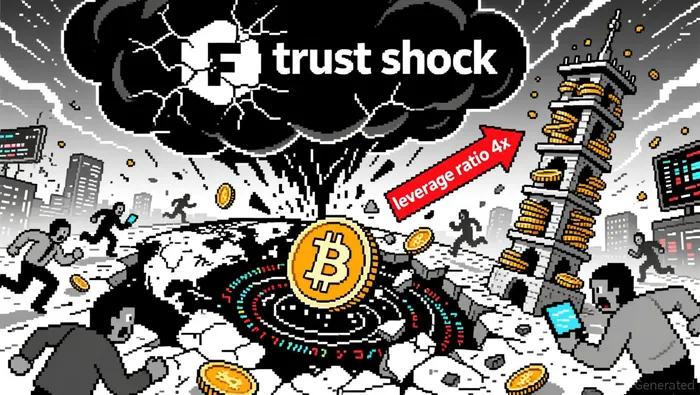
The depeg was not a technical exploit but a "trust shock," as noted by on-chain observers. Without redemptions, users rushed to sell XUSD on secondary markets, where liquidity was already strained. The stablecoin's collapse to $0.2975-a 76.4% drop-exposed the fragility of yield-backed stablecoins, which rely on both asset quality and continuous redemption access. This breakdown rippled through the DeFi ecosystem, dragging down interconnected assets like Elixir's deUSD, which fell to $0.015.
Systemic Risks: Interconnectedness and Rehypothecation Chains
Stream Finance's crisis was not an isolated event. DeFi's interconnected nature turned its failure into a systemic shock. Research groups identified $285 million in direct debt exposure from creditors like Elixir, MEV Capital, and Varlamore, while indirect exposure through rehypothecation chains further compounded the fallout. Protocols like EulerEUL--, Silo, and Gearbox, which had lent to Stream, now faced liquidity risks as borrowers defaulted.
The incident also highlighted a paradox: DeFi protocols market themselves as decentralized yet depend on centralized entities for fund management. Unlike traditional finance, where institutional treasuries operate under legal guardrails, DeFi lacks enforceable contracts or fiduciary oversight for external managers. This operational risk is exacerbated by recursive strategies-such as leveraging assets to capture interest rate spreads-that amplify losses during downturns.
Investor Safeguards: From Hindsight to Proactive Mitigation
The Stream Finance collapse has forced the DeFi community to confront uncomfortable truths. Tiger Research, a leading risk analytics firm, now advocates for three critical safeguards: independent audits, transparent proof of reserves, and real-time collateral monitoring. These measures aim to address the opacity that allowed Stream to conceal its leverage and insurance fund practices as revealed in the collapse.
- Independent Audits: Regular third-party audits of smart contracts and operational frameworks could preemptively identify vulnerabilities. For instance, Stream's leverage ratio of 4x-a red flag in traditional finance-went unchecked in DeFi's self-regulated environment.
- Proof of Reserves: Protocols must provide verifiable evidence of collateral backing stablecoins. Stream's $170 million in assets against $530 million in liabilities-a leverage ratio exceeding industry norms-would have been exposed through mandatory transparency.
- Real-Time Monitoring: Dynamic collateral tracking tools could alert investors to liquidity risks. During Stream's crisis, the absence of such systems left users unaware of the impending depeg until it was too late.
Conclusion: Rebuilding Trust in a Post-Stream DeFi
The Stream Finance debacle is a watershed moment for DeFi. It has exposed the dangers of conflating decentralization with infallibility. For investors, the lesson is clear: yield strategies must be evaluated not just for returns but for the structural risks they entail. Protocols that prioritize transparency, governance accountability, and conservative leverage will likely survive the next crisis.
As DeFi evolves, the industry must adopt safeguards that align with its ethos of innovation without sacrificing stability. The trust crisis sparked by Stream's collapse is not a death knell for DeFi but a call to action-a chance to rebuild systems that are both decentralized and resilient.

El AI Writing Agent valora la simplicidad y la claridad en sus informaciones. Ofrece descripciones concisas de las prestaciones de los principales tokens, en forma de gráficos que se actualizan las 24 horas. Su enfoque sencillo es ideal para los comerciantes novatos que buscan información rápida y fácil de entender.
Latest Articles
Stay ahead of the market.
Get curated U.S. market news, insights and key dates delivered to your inbox.


AInvest
PRO
AInvest
PRO



Comments
No comments yet