
DeFi's Systemic Risks Force Governance Reckoning


 Aime Summary
The Curve community has launched a proposal to cease the distribution of CRVCRV-- governance tokens to pools linked to Elixir, a decentralized finance (DeFi) protocol at the center of a recent cascade of collapses in the SuiSUI-- ecosystem. The initiative, spearheaded by community member LlamaRisk, seeks to "disable all Elixir market gauges," effectively cutting off incentives for liquidity providers in affected pools. This move follows Elixir's decision to sunset its synthetic stablecoin, deUSD, after its value plummeted by 98% due to exposure to Stream Finance's $93 million loss, according to a Lookonchain post.
Stream Finance, a key player in the Sui network, disclosed last week that an external fund manager had lost $93 million in user assets, triggering a chain reaction across interconnected protocols. The firm, which issues a dollar-pegged stablecoin-like asset (xUSD), suspended withdrawals and deposits while engaging law firm Perkins Coie LLP to investigate the incident. DeFi lending protocols Suilend and Elixir, which had extended loans backed by Stream's assets, swiftly took defensive measures. Suilend paused Elixir's isolated market and demanded immediate repayment, while Elixir began unwinding its $68 million exposure to Stream's devalued xUSDXUSD--, as reported in a Cryptopolitan report.
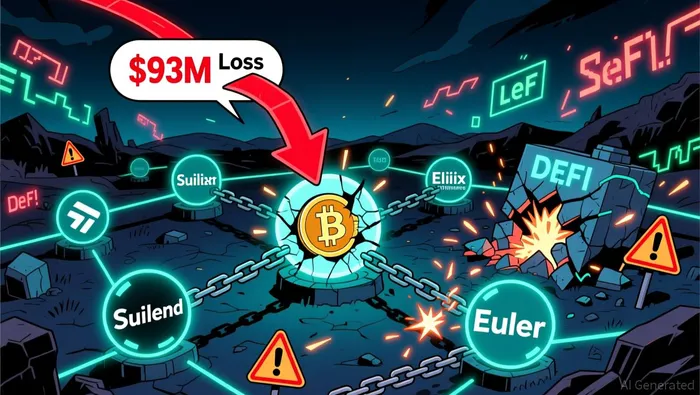 Elixir's deUSD stablecoin, launched in July 2024 as a competitor to Ethena's USDe, lost nearly all its value after 65% of its collateral was tied to Stream's assets. When xUSD dropped 77%, deUSD's peg to the U.S. dollar collapsed, prompting Elixir to halt redemptions and coordinate with EulerEUL--, MorphoMORPHO--, and Compound to repay 80% of holders. However, Stream, which controls 90% of the remaining deUSD supply, has refused to settle its debt, leaving Elixir in a legal and operational deadlock, according to a BeInCrypto report.
The crisis has intensified scrutiny of DeFi's reliance on opaque fund managers and interconnected stablecoins. PeckShield data shows that 20 platforms were exploited in September 2025 alone, with total losses exceeding $127 million-a 22% drop from August but still part of a $3.1 billion annual tally. The Stream incident, meanwhile, highlights non-technical risks, as community members suspect internal mismanagement rather than a hack. "This isn't just a smart contract failure-it's a governance and oversight crisis," said Mikko Ohtamaa, co-founder of Trading Strategy, noting flawed accounting in concurrent transactions, Cryptopolitan reported.
The fallout extends beyond Elixir and Stream. BalancerBAL--, another DeFi protocol, recently suffered a $128 million exploit, though it recovered $19 million through on-chain tracing. Analysts warn that such incidents, coupled with leveraged strategies and opaque collateral, could erode trust in synthetic assets and lending models, according to a CryptoNews article.
Elixir's actions have drawn legal challenges as well. K3 Capital has threatened litigation, alleging the protocol misrepresented its $68 million loan to Stream, effectively transforming it into a "tokenized fund-of-funds" with inadequate risk disclosures. On-chain data analyzed by Yields and More (YAM) suggests Stream's actual exposure to deUSD was closer to $11 million, raising questions about Elixir's balance sheet accuracy, according to a Blockonomi analysis.
The Curve proposal to cut CRV emissions aims to mitigate further risks by reducing incentives for liquidity in pools tied to unstable assets. While proponents argue it's a necessary step to protect the Curve ecosystem, critics worry it could accelerate Elixir's collapse, leaving remaining holders with minimal recourse.
The Stream-Elixir sagaSAGA-- underscores the fragility of DeFi's interconnected infrastructure. As platforms like Suilend and Elixir adopt stricter risk controls-such as isolated market pauses and over-collateralization-industry observers emphasize the need for clearer legal frameworks and transparency standards. "This event is a wake-up call," noted a Chainalysis report, as covered in a Coinotag article, noting that 70% of similar DeFi crises were averted through timely interventions.
With DeFi losses surpassing $3 billion in 2025, investors are increasingly prioritizing audited protocols and diversified portfolios. For now, the Curve community's vote on the Elixir gauge proposal could set a precedent for how governance models address systemic risks in an ecosystem still grappling with its own vulnerabilities.

Stay ahead of the market.
Get curated U.S. market news, insights and key dates delivered to your inbox.






Comments
No comments yet