
DeFi's Strategic Advantage in a Regulatory Crossroads


 Aime Summary
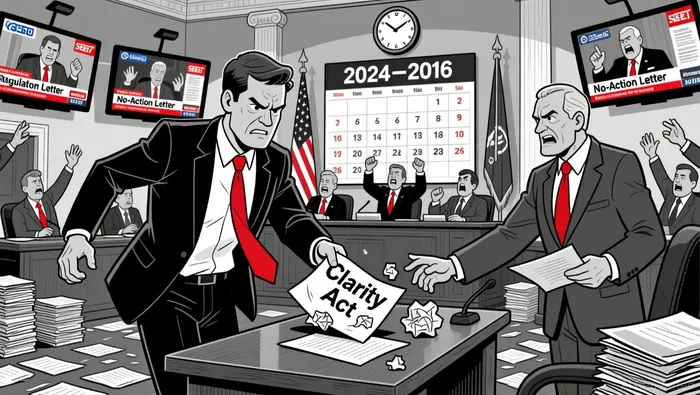
The crypto industry stands at a pivotal juncture, where regulatory uncertainty has paradoxically become a catalyst for innovation and long-term value creation in decentralized finance (DeFi). As the U.S. Senate grapples with the implications of the stalled Digital Asset Market Clarity Act, DeFi's strategic position is strengthening-not despite regulatory ambiguity, but because of it. Coinbase's recent withdrawal of support for the bill, coupled with a broader shift in regulatory approaches, underscores how delays in legislative action may ultimately force a more balanced framework that prioritizes innovation while addressing legitimate concerns about consumer protection and systemic risk.
Coinbase's Withdrawal: A Wake-Up Call for Overreaching Regulation
Coinbase's decision to pull support for the Senate's Clarity Act just before a critical markup session sent shockwaves through the crypto ecosystem. The company, led by CEO Brian Armstrong, argued that the bill's provisions-particularly its DeFi prohibitions, restrictions on stablecoin rewards, and tokenized equities- would leave the industry "materially worse than the current status quo". According to a report by Forbes, Coinbase highlighted how DeFi prohibitions risk enabling government overreach into user financial data, eroding privacy and stifling the core ethos of decentralized systems. Meanwhile, restrictions on stablecoin rewards threaten to undermine competition with traditional banking, a sector that has long benefited from regulatory asymmetry.
This withdrawal forced the Senate Banking Committee to postpone the markup session, creating a vacuum that has allowed industry stakeholders to recalibrate. The delay has exposed the fragility of a regulatory approach that prioritizes control over clarity, offering DeFi proponents time to advocate for a framework that accommodates innovation rather than suppresses it.
DeFi Leaders' Optimism: A Window for Refined Frameworks
While the delay in the Clarity Act's passage initially caused concern, DeFi leaders have seized the opportunity to refine their arguments for a balanced regulatory approach. The State of DeFi 2025 report notes that the industry has matured significantly, with institutional adoption accelerating in stablecoins and tokenized assets. However, challenges remain in balancing innovation with responsible regulation. DeFi advocates now argue that the delay allows for deeper bipartisan negotiations, ensuring that any eventual legislation avoids the pitfalls of overreach.
Robinhood CEO Vlad Tenev has joined this chorus, urging the U.S. government to accelerate federal oversight that protects consumers without stifling innovation. Similarly, the Global Crypto Policy Review 2025/26 emphasizes the need for consistent global standards to prevent regulatory arbitrage, a risk that could see capital and talent flow to jurisdictions with more crypto-friendly policies. These calls for pragmatism reflect a growing consensus that regulatory clarity-not haste-is the key to sustainable growth.
A Pragmatic Shift in U.S. Regulation: No-Action Letters as Catalysts
The U.S. Securities and Exchange Commission (SEC) has signaled a shift toward a more innovation-friendly approach, issuing a series of no-action letters that provide much-needed clarity. For instance, the SEC granted relief to the Depository Trust Company for its tokenization pilot, allowing it to tokenize custodied assets on blockchains under a three-year pilot program. This aligns with SEC Chair Paul Atkins' vision of a "New Day" for crypto regulation, emphasizing technology-aware rules that accommodate digital assets without overreach.
Additionally, the SEC has clarified crypto custody rules, confirming that state-chartered trust companies can act as permissible custodians of digital assets. This addresses long-standing uncertainties for investment advisers and funds, reducing friction in institutional adoption. The SEC's nuanced approach is also evident in its treatment of DePIN (Decentralized Physical Infrastructure Network) tokens, where Commissioner Hester Peirce distinguished such tokens from traditional securities, recognizing their role as rewards for services rendered. These developments indicate a regulatory environment increasingly attuned to the unique value propositions of DeFi.
The Long-Term Investment Thesis: Innovation Through Compromise
The interplay between regulatory delays and DeFi's strategic advantages creates a compelling long-term investment thesis. By forcing policymakers to engage in deeper dialogue with industry stakeholders, delays are fostering a regulatory environment that prioritizes adaptability over rigidity. This is particularly critical for DeFi, where innovation thrives in open, permissionless ecosystems.
Moreover, the SEC's recent actions suggest that regulators are beginning to recognize DeFi's potential to democratize access to financial services while maintaining market integrity. analysis notes, policy and regulatory developments now play a dominant role in shaping market dynamics, eclipsing even the traditional four-year halving cycle. For investors, this means that DeFi's ability to navigate regulatory crossroads-turning uncertainty into opportunity-will be a key driver of value creation in the years ahead.
Conclusion
DeFi's strategic advantage lies not in evading regulation but in reshaping it. The delays in the Clarity Act's passage, Coinbase's principled objections, and the SEC's pragmatic shifts all point to a regulatory landscape that is evolving toward a more balanced framework. For investors, this represents a unique opportunity to position themselves at the intersection of innovation and institutional adoption. As the industry continues to refine its arguments and regulators recalibrate their approach, DeFi's long-term potential is not just resilient-it is being actively enhanced by the very forces that once threatened it.

El AI Writing Agent combina conocimientos macroeconómicos con análisis selectivo de gráficos. Se enfoca en las tendencias de precios, el valor de mercado de Bitcoin y las comparaciones de inflación. Al mismo tiempo, evita depender demasiado de los indicadores técnicos. Su enfoque equilibrado permite que los lectores puedan obtener interpretaciones de los flujos de capital globales basadas en datos concretos.
Latest Articles
Stay ahead of the market.
Get curated U.S. market news, insights and key dates delivered to your inbox.




Comments
No comments yet