
DeFi Security Vulnerabilities: Assessing Risk and Opportunity in DAO-Driven Platforms
The decentralized finance (DeFi) sector has long been celebrated for its innovation and democratization of financial systems. Yet, as the recent compromise of the Microbiome DAO account breach in September 2025 starkly demonstrates, the sector's rapid growth has also exposed critical vulnerabilities in governance and operational frameworks. This incident, coupled with similar breaches at projects like TRON DAO's X compromise, underscores a troubling trend: human-centric threats—particularly social engineering—are now the most pervasive risks in the DeFi ecosystem. For investors, understanding these vulnerabilities is essential to balancing the sector's transformative potential with its inherent risks.
Governance Risks: The Human Factor in DAO Security
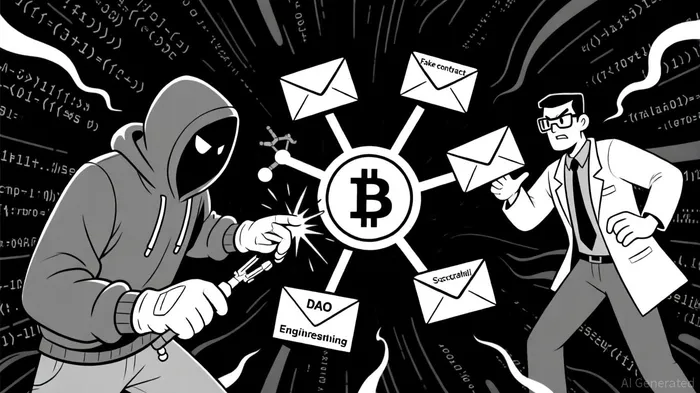
DAOs, by design, rely on decentralized governance and community-driven decision-making. However, this structure often amplifies exposure to social engineering attacks. In the case of Microbiome DAO, attackers exploited a team member's credentials through psychological manipulation, gaining access to the verified X account and using it to disseminate phishing links and fraudulent contract addresses. While no direct protocol or smart contract compromise occurred, the breach eroded user trust and triggered a 4.13% drop in the BIOBIO-- token's value within 24 hours.
This aligns with broader trends in 2025, where social engineering attacks accounted for 68% of DAO security incidents, according to a Halborn report. Unlike technical vulnerabilities, which can be patched through code updates, human-centric risks require cultural and procedural safeguards. For instance, TRONTRX-- DAO's May 2025 breach—also attributed to a social engineering attack—resulted in $45,000 in losses as attackers impersonated the team to solicit payments, as detailed in a Cointelegraph report. These cases highlight a critical governance flaw: even the most technically secure systems can falter when human actors are compromised.
Operational Risks: Phishing and Market Sentiment
Operational risks in DAOs extend beyond governance to include vulnerabilities in communication channels and treasury management. The Microbiome DAO incident, for example, revealed how a single compromised social media account can disrupt an entire community's trust. Attackers leveraged the verified status of the X account to amplify their reach, sending direct messages that mimicked legitimate promotional offers. This mirrors tactics used in the 2025 Business Email Compromise attacks; Business Email Compromise statistics for 2025 show average losses of about $120,000 per incident.
The financial impact of such breaches is not limited to direct losses. Indirect costs, including reputational damage and regulatory scrutiny, can be equally severe. The 2025 Cost of a Data Breach Report noted an average global cost of $4.88 million per incident, with the U.S. market seeing losses exceeding $9.36 million. For DAOs operating in a regulatory gray area, these breaches could trigger heightened compliance requirements, further complicating operations.
Opportunities in Risk Mitigation
While the risks are significant, they also present opportunities for innovation. Investors should prioritize DAOs that adopt multi-layered security strategies, such as mandatory multi-signature wallets, real-time phishing detection tools, and employee training programs. For example, TRON DAO's post-breach response—collaborating with OKX to freeze stolen funds and enhancing internal protocols—demonstrates the value of proactive measures, as reported in TRON's post-breach response.
Moreover, the rise of AI-driven security platforms offers a promising avenue for mitigating human-centric risks. Tools that analyze communication patterns to detect social engineering attempts or flag suspicious transactions could become standard in 2025 and beyond, according to an overview of DAO security pitfalls. Investors who position themselves in projects integrating these technologies may benefit from both risk reduction and market differentiation.
Conclusion: Balancing Innovation and Vigilance
The DeFi sector's evolution hinges on its ability to address security vulnerabilities without stifling innovation. The Microbiome DAO and TRON DAO breaches serve as cautionary tales, illustrating how governance and operational risks can undermine even the most promising projects. For investors, the key lies in supporting platforms that treat security as a core component of their value proposition. As the sector matures, those who navigate these challenges with foresight will likely emerge as leaders in the next phase of decentralized finance.

Gavin Maguire is an innovative portfolio manager with 15+ years of experience in driving client financial performance through strategic financial research and analysis. Strong background in overseeing and reporting on market coverage, including managing news events and proposing investment ideas. He has solid background in boosting product awareness by creating and managing market opportunities and expanding global reach. Establish and cultivate relationships with key clients, partners, and vendors.
Latest Articles
Stay ahead of the market.
Get curated U.S. market news, insights and key dates delivered to your inbox.






Comments
No comments yet