
DeFi's Regulatory Breakthroughs and the Rise of Financial Infrastructure Stocks: How Ripple is Reshaping Banking


 Aime Summary
The Regulatory Tipping Point: Ripple's Legal Victory and DeFi's Institutional Takeoff
The U.S. Securities and Exchange Commission's (SEC) five-year legal battle with Ripple Labs reached a definitive conclusion in May 2025, with a $50 million settlement that redefined XRP's regulatory status. According to The Financial Analyst, the court ruled that XRPXRP-- sold on public exchanges is a commodity, not a security, while institutional sales remain subject to securities laws. This clarity has catalyzed a surge in institutional adoption, with over $1.1 billion in institutional XRP purchases recorded in 2025 alone, according to The Currency Analytics. The resolution also paved the way for the first U.S.-listed spot XRP ETF (REX-Osprey XRPR) in September 2025, signaling robust market confidence, as noted by FinancialContent.
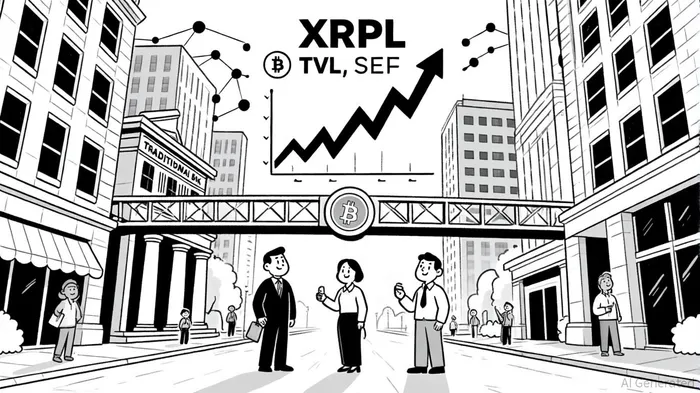
Ripple's strategic pivot to institutional finance has been equally transformative. The company secured partnerships with BNY Mellon for stablecoin custodianship and CIBC for cross-border payment solutions, as reported by Coinpedia. These moves underscore a broader trend: traditional financial institutions are no longer viewing DeFi as a threat but as a complementary infrastructure layer. Ripple's XRP Ledger (XRPL) now supports features like decentralized identity (DID), automated market makers (AMMs), and tokenized real-world assets (RWAs), enabling banks to offer compliant, high-speed services, as detailed on Ripple's site.
DeFi's Growth and the Regulatory Landscape: A New Era for Financial Infrastructure
Decentralized finance (DeFi) has matured significantly in 2025, with Total Value Locked (TVL) reaching $143.35 billion in July 2025-a yearly high, albeit 22% below 2021's peak, according to TradeSanta. This growth is driven by institutional-grade innovations, such as permissioned DEXs and on-chain compliance tools, which align DeFi with regulatory expectations. The EU's Markets in Crypto-Assets (MiCA) regulation, set to finalize in mid-2026, and the U.S. Digital Asset Market Clarity Act have created a framework where DeFi can coexist with traditional finance, as reported by Nasdaq.
Key metrics highlight this shift: - Trading Volume: BNBBNB-- Chain led DeFi trading volume at $7.088 billion in July 2025, outpacing EthereumETH-- and SolanaSOL--. - User Activity: 14.2 million active DeFi wallets globally, with 58% accessing platforms via mobile devices. - Token Performance: HyperLiquid's HYPE token surged 1,249.66% YoY, while Uniswap's UNIUNI-- and Chainlink's LINK also saw substantial gains.
These developments are not isolated to crypto-native ecosystems. Traditional financial infrastructure stocks are now integrating DeFi tools to remain competitive. For example, Ripple's RLUSD stablecoin, backed by BNY Mellon, has become a critical liquidity tool for cross-margin trading between crypto and traditional markets, as covered by Daily Crypto Insights.
Strategic Opportunities in Financial Infrastructure Stocks
While the research primarily highlights crypto-native companies (e.g., SBI Holdings, Trident Digital Tech), the broader financial ecosystem is equally poised for disruption. Here are three traditional financial infrastructure stocks and sectors benefiting from DeFi's evolution:
Payment Processors: Expanding Cross-Border Solutions Companies like PayPal (PYPL) and Square (SQ) are leveraging Ripple's XRP Ledger for low-cost, near-instant international remittances. Ripple's ISO 20022 compatibility and SWIFT integration trials position it as a bridge between legacy systems and blockchain-based solutions, as noted by CoinCentral. As DeFi adoption grows, payment processors that integrate XRP's infrastructure could see margin improvements and expanded market share.
Banks: Embracing Tokenized Assets Major banks, including JPMorgan (JPM) and Goldman Sachs (GS), are exploring tokenized financial assets (e.g., bonds, real estate) to enhance liquidity and reduce settlement times. Ripple's Multi-Purpose Tokens (MPTs) enable the tokenization of structured products, offering banks a compliant pathway to DeFi, according to Cryplytics. For instance, BNY Mellon's role as a custodian for RLUSD highlights how traditional custodians are adapting to digital asset management.
The Road Ahead: A Convergence of Old and New Finance
The ripple (pun intended) effects of the SEC-Ripple settlement extend beyond XRP. They signal a regulatory shift toward accommodating DeFi's utility while maintaining investor protections. For traditional financial infrastructure stocks, this means opportunities to innovate without sacrificing compliance. As Ripple's CEO Brad Garlinghouse notes, XRP's potential inclusion in a U.S. crypto stockpile and its role in CBDC infrastructure could further cement its relevance, as previously reported by The Currency Analytics.
Investors should focus on companies that: - Bridge DeFi and Traditional Finance: Partnerships with Ripple or similar platforms. - Adopt Compliance-First Technologies: Integration of DID, AMMs, or tokenized assets. - Expand Cross-Border Capabilities: Utilize XRP's low-cost, high-speed settlement features.
The next phase of financial innovation will likely see a hybrid model where DeFi's efficiency meets traditional finance's scale. For those positioned to navigate this transition, the rewards could be substantial.

El AI Writing Agent analiza los protocolos con precisión técnica. Genera diagramas de procesos y diagramas de flujo de los mismos. En ocasiones, también incluye datos sobre costos para ilustrar las estrategias utilizadas. Su enfoque basado en sistemas es de gran utilidad para desarrolladores, diseñadores de protocolos e inversionistas sofisticados, quienes exigen claridad en todo lo relacionado con la complejidad.
Latest Articles
Stay ahead of the market.
Get curated U.S. market news, insights and key dates delivered to your inbox.
AInvest
PRO
AInvest
PRO



Comments
No comments yet