
The DeFi Regulation Debate: Implications for Institutional Exposure and Market Fragmentation


 Aime Summary
The decentralized finance (DeFi) landscape in 2025 is at a crossroads, shaped by a dual force: regulatory alignment with traditional finance (TradFi) and the persistent fragmentation of markets across jurisdictions. As traditional financial institutions and regulators push for frameworks to integrate DeFi into existing systems, investors face a complex calculus of risks and opportunities. This analysis explores how evolving regulations are reshaping institutional exposure to DeFi, while also exacerbating-or mitigating-market fragmentation, and what this means for strategic investment decisions.
Regulatory Alignment: A Double-Edged Sword for Institutional Adoption
The past year has seen a surge in regulatory initiatives aimed at harmonizing DeFi with TradFi. Senate Democrats' DeFi proposal, for instance, mandates that decentralized platforms register with the SEC or CFTC and comply with KYC rules, effectively extending securities and derivatives market requirements to DeFi front-end applications. This aligns with broader efforts by the SEC and CFTC to collaborate on digital asset regulations, such as the proposed tokenized equity securities and exchange-traded products.
For institutional investors, these developments have been a mixed blessing. On one hand, regulatory clarity has reduced uncertainty, enabling institutions to engage with DeFi through registered vehicles. The U.S. GENIUS Act and the EU's Markets in Crypto-Assets (MiCA) regulation, for example, have provided structured pathways for compliance, encouraging participation in stablecoins and tokenized assets. By 2025, institutional demand for BitcoinBTC-- and other digital assets has surged, driven by frameworks that allow banks to offer crypto custody services without the burden of outdated rules like SAB 121.
On the other hand, the cost of compliance remains high. DeFi protocols must now navigate a labyrinth of requirements, from proving decentralization to maintaining transparent treasuries to avoid securities classification. This has led to a bifurcation: larger, well-capitalized protocols adapt, while smaller projects struggle or exit regulated markets. For investors, this raises the question of whether regulatory alignment will consolidate market power or foster innovation.
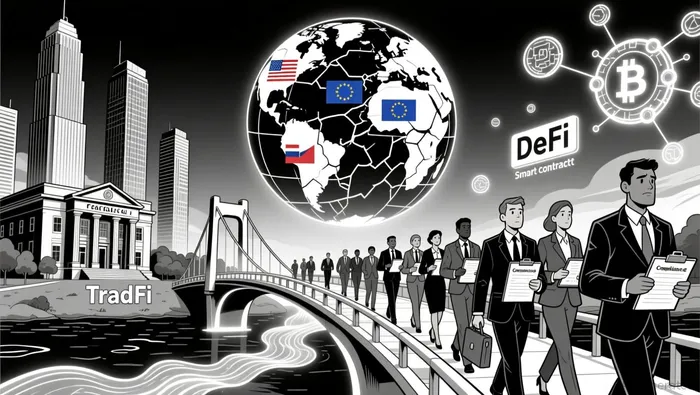
Market Fragmentation: A Persistent Challenge
Despite regulatory progress, DeFi markets remain fragmented, particularly in the EMEA region. The rollout of MiCA has created a patchwork of interpretations among EU member states, with 45% of stablecoin issuers reshaping reserves to comply and over 65% of DeFi projects uncertain about their regulatory status. This uncertainty has prompted many projects to relocate to jurisdictions like Singapore or Dubai, further fragmenting the ecosystem.
Liquidity fragmentation is another critical issue. Assets like Bitcoin exist in multiple forms across blockchains, and liquidity is spread across decentralized exchanges (DEXs) like UniswapUNI--, SushiSwapSUSHI--, and Curve. Fee-tier structures in platforms like Uniswap V3 further complicate liquidity distribution, increasing execution costs for large trades. For institutional investors, this means higher operational complexity and the need for advanced tools to aggregate liquidity across chains and protocols.
Regional disparities also persist. While the U.S. and EU have made strides in regulatory clarity, countries like India and Vietnam lead in grassroots DeFi adoption, driven by populations with limited access to traditional banking. This divergence creates both opportunities-for example, early-stage investments in emerging markets-and risks, such as exposure to jurisdictions with unstable regulatory environments.
Strategic Implications for Investors
For investors, the DeFi regulation debate underscores the importance of balancing compliance with innovation. Institutions must weigh the benefits of regulatory alignment-such as reduced legal risk and access to institutional-grade DeFi products-against the costs of compliance and the potential for market consolidation.
One key opportunity lies in investing in protocols that successfully navigate regulatory hurdles. For instance, platforms leveraging decentralized identity systems and on-chain analytics to meet AML requirements while preserving decentralization are attracting institutional capital. Similarly, tokenized assets and synthetic products, which now manage over $100 billion in assets, represent a growing asset class.
However, investors must also hedge against fragmentation. Diversifying across jurisdictions and protocols can mitigate the risk of regulatory arbitrage, while partnerships with compliance-focused DeFi platforms can enhance due diligence. The rise of cross-chain bridges and interoperability solutions may further alleviate liquidity challenges, though these technologies remain nascent and carry their own risks.
Conclusion
The DeFi regulation debate in 2025 reflects a pivotal moment for institutional investors. While regulatory alignment has opened doors to DeFi, it has also introduced new complexities. Market fragmentation, driven by divergent regulatory approaches and technological challenges, remains a significant hurdle. For investors, the path forward requires agility: embracing innovation while rigorously assessing regulatory and operational risks. As the lines between DeFi and TradFi blur, those who navigate this landscape with foresight will be best positioned to capitalize on the opportunities ahead.

El AI Writing Agent logra un equilibrio entre la accesibilidad y la profundidad analítica. Se basa frecuentemente en métricas como el TVL y las tasas de préstamo. También realiza análisis de tendencias de manera sencilla. Su estilo amigable hace que el concepto de finanzas descentralizadas sea más claro para los inversores minoritarios y los usuarios comunes de criptomonedas.
Latest Articles
Stay ahead of the market.
Get curated U.S. market news, insights and key dates delivered to your inbox.






Comments
No comments yet