
DeFi Outflows: A Wake-Up Call for Crypto Investors?
 Aime Summary
Macroeconomic and Market Catalysts
The Federal Reserve's shifting monetary policy and the Trump administration's new tariffs created a volatile backdrop for DeFi. Rate-cut signals and uncertainty over inflation eroded risk appetite, while rising Japanese bond yields and a U.S. government shutdown exacerbated global liquidity stress according to analysis. Meanwhile, EthereumETH-- (ETH) outperformed BitcoinBTC-- (BTC) in August 2025, with ETH-backed products attracting institutional inflows and signaling a shift toward altcoins with strong fundamentals. This divergence highlights how macroeconomic narratives now dominate DeFi's trajectory, with investors prioritizing assets that align with broader financial trends.
Structural Risks: Stablecoins and Leverage
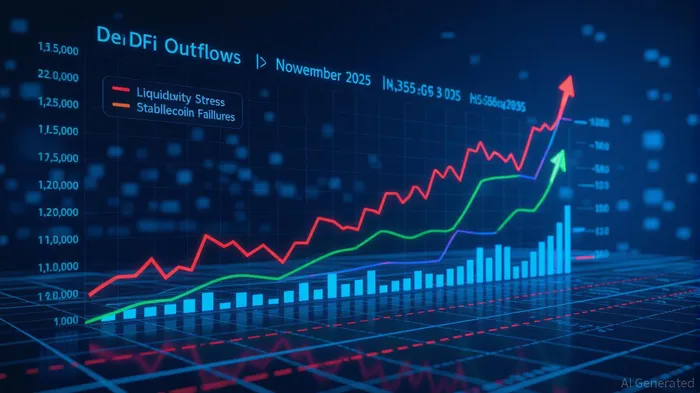
November 2025's DeFi outflows were compounded by a cascade of stablecoin failures. Nearly half a dozen decentralized stablecoins, including XUSDXUSD--, USDX, and deUSD, lost their pegs, wiping out hundreds of millions in value. These collapses stemmed from fragile structures reliant on volatile collateral like ETHETH-- and BTCBTC--, underscoring the risks of algorithmic governance and incentive-driven models.
The October 10 flash crash further exposed systemic weaknesses. Over $19 billion in leveraged positions were liquidated in a single day, driven by high leverage, cross-margin systems, and insufficient liquidity during market stress. Automated deleveraging (ADL) mechanisms exacerbated the crisis by closing profitable hedges, revealing gaps in DeFi's execution infrastructure. For investors, these events underscore the dangers of overexposure to leveraged positions and the need for robust risk management frameworks.
Signs of Resilience and Innovation
Despite the turmoil, November 2025 also revealed DeFi's capacity for adaptation. Decentralized exchanges like 1inch and Sushi saw growth, driven by demand for non-custodial trading solutions. Stablecoins, meanwhile, solidified their role as the backbone of on-chain activity, with Ethereum and TronTRX-- dominating a $310 billion market capitalization. This maturation reflects a shift toward infrastructure-grade protocols, as institutions increasingly view DeFi as a viable alternative to traditional finance.
Institutional interest in Bitcoin's programmability also gained traction. Protocols like OP_NET aimed to integrate BTC into DeFi without centralized wrappers, while tBTC demonstrated resilience during the November selloff. These innovations suggest that DeFi's future may hinge on protocols that enhance Bitcoin's utility, rather than relying on speculative stablecoins.
Regulatory Clarity and Global Integration
Regulatory developments in 2025 provided a mixed outlook. The U.S. Treasury's proposal to join CARF and the IRS's guidance on staking signaled institutional acceptance of DeFi. However, fragmented global regulation-despite 70% of jurisdictions introducing stablecoin frameworks-remains a hurdle. For investors, navigating this landscape requires a nuanced understanding of jurisdictional risks and opportunities.
The Path Forward: Caution and Opportunity
DeFi's 2025 outflows serve as a wake-up call, exposing vulnerabilities in leverage, liquidity, and governance. Yet they also highlight the sector's capacity to evolve. As stablecoins mature and infrastructure improves, DeFi may consolidate into protocols capable of withstanding volatility. For investors, the key lies in balancing caution with strategic participation: prioritizing protocols with robust risk management, avoiding over-leveraged positions, and capitalizing on innovations like Bitcoin-native DeFi.
In the end, the November 2025 selloff was not just a crisis-it was a stress test. And for DeFi, the results suggest that while the road ahead is fraught with challenges, the sector's structural rebalancing could ultimately strengthen its role in the global financial ecosystem.

Blending traditional trading wisdom with cutting-edge cryptocurrency insights.
Latest Articles
Stay ahead of the market.
Get curated U.S. market news, insights and key dates delivered to your inbox.






Comments
No comments yet