
DeFi Outflows Reflect Shifting Investor Sentiment and Market Volatility
 Aime Summary
- DeFi markets have seen significant outflows, with EthereumETH-- ETFs recording $82.9 million in outflows over two days.
- Institutional staking services are projected to grow due to regulatory clarity and infrastructure improvements.
- DeFi Technologies Inc. revised its earnings estimates downward due to weak crypto market performance and declining AUM levels.
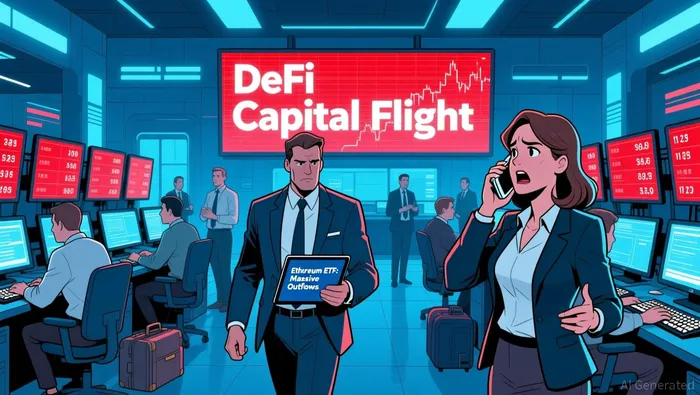
DeFi markets are currently experiencing outflows that reflect shifting investor sentiment and growing volatility. This trend is being closely monitored by investors and market participants, as it indicates a potential realignment inINIT-- risk appetite and liquidity management strategies. The recent outflows from spot Ethereum ETFs highlight the fragile nature of investor confidence, particularly in decentralized finance protocols.
The broader DeFi ecosystem is also being affected by these outflows. Platforms that rely on stable capital inflows are reassessing their risk profiles and adapting their strategies to align with the new market reality. At the same time, institutional staking services are gaining traction as a viable alternative for capital preservation and yield generation.
Regulatory developments remain a key factor in shaping the DeFi landscape. The stalled progress of the CLARITY Act has created uncertainty regarding the classification of digital assets and the jurisdiction of regulatory bodies. This regulatory ambiguity affects market stability and investor decisions, particularly for projects that depend on clear legal frameworks to operate.
What Are the Key Drivers Behind DeFi Outflows?
The primary driver of recent DeFi outflows appears to be market volatility and shifting investor sentiment. The decline in AUM levels for DeFi platforms underscores a broader trend of capital withdrawals and reallocation to more stable or regulated alternatives. Institutional investors are increasingly favoring staking services that provide greater transparency and regulatory alignment, which may contribute to long-term stability in DeFi markets. However, these services are still in the early stages of development and require further infrastructure improvements to scale effectively.
Another factor is the growing scrutiny from regulators and the ongoing debates over digital asset classification. The CLARITY Act has drawn significant attention due to its potential to reshape the regulatory landscape. The classification of digital assets as securities, commodities, or stablecoins will have a direct impact on how institutions and retail investors interact with the market. Until these frameworks are finalized, uncertainty will continue to affect investor behavior and capital flows.
What Innovations Are Addressing DeFi Limitations?
Several technological innovations are being introduced to address limitations in DeFi execution and scalability. OmniIntent's ICL framework, for example, allows users to define DeFi strategies with greater precision and flexibility. By enabling runtime constraints and trigger-based actions, this technology aims to reduce execution risks and improve capital efficiency.
DEX screeners are also playing a critical role in helping traders navigate the DeFi market. These tools consolidate data from multiple decentralized exchanges and provide real-time insights into liquidity and price movements. However, they still lack comprehensive integration with other DeFi protocols such as Maker or Compound, highlighting the need for further development in this area.
As the DeFi ecosystem evolves, the demand for advanced analytics and reporting tools is expected to grow. Investors and traders will need more robust platforms to manage risk, optimize returns, and adapt to the dynamic nature of the market. These innovations will be crucial in supporting broader adoption and institutional participation in DeFi.
What Challenges Remain for the DeFi Ecosystem?
Despite recent advancements, several challenges remain for the DeFi ecosystem. One of the most pressing issues is the lack of regulatory clarity, which affects investor confidence and market stability. The stalled progress of the CLARITY Act has left many questions unanswered, particularly regarding the classification of stablecoins and the regulatory jurisdiction of digital assets. This uncertainty may deter institutional participation and limit the growth potential of DeFi platforms.
Operational risks and execution challenges also remain a concern. The Aave swap error is a recent example of how technical limitations can lead to significant losses and reputational damage. To address these risks, DeFi platforms must invest in improved risk management protocols, transparency measures, and user education. Without these improvements, the long-term viability of the DeFi ecosystem may be compromised.
Ultimately, the success of DeFi will depend on its ability to adapt to changing market conditions, regulatory developments, and technological advancements. As investor sentiment continues to shift, DeFi platforms must remain agile and responsive to maintain relevance in a rapidly evolving market.

Blending traditional trading wisdom with cutting-edge cryptocurrency insights.
Latest Articles
Stay ahead of the market.
Get curated U.S. market news, insights and key dates delivered to your inbox.


AInvest
PRO
AInvest
PRO



Comments
No comments yet