
DeFi Liquidity Risks and Whale Manipulation in Pre-Launch Token Markets: Strategic Mitigation for Retail Investors


 Aime Summary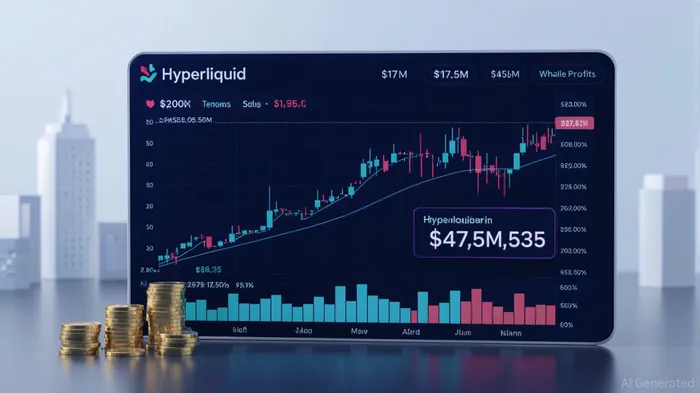
The recent XPL token manipulation incident on Hyperliquid has exposed the fragility of pre-launch token markets in decentralized finance (DeFi). In a matter of minutes, four whale addresses orchestrated a 200% price surge, generating $47.5 million in profits while triggering $17 million in liquidations for retail traders [1]. This case underscores the systemic risks inherent in low-liquidity environments and the urgent need for strategic risk mitigation.
The XPL Case: A Blueprint for Exploitation
The manipulation exploited Hyperliquid’s thin liquidity and reliance on isolated oracles, creating a 250% price divergence between Hyperliquid and Binance, where XPL peaked at only $0.55 [3]. Whales drained 70% of available liquidity, leaving retail traders vulnerable to cascading liquidations. One trader lost $4.5 million, while another lost $2.5 million in short positions [2]. The incident highlights how pre-launch tokens—often with undefined circulating supplies and minimal institutional-grade volume—become prime targets for predatory strategies [1].
Platform Responses: EMA Caps and External Data Integration
Hyperliquid responded by implementing a 10x exponential moving average (EMA) price cap and integrating external market data to stabilize prices [5]. The EMA cap limits extreme price movements by anchoring mark prices to a smoothed average, while external data integration references broader market signals to reduce volatility. However, experts argue these measures address symptoms rather than root causes, such as the absence of institutional liquidity and transparency-based predatory strategies [1].
Strategic Mitigation for Retail Investors
Retail investors must adopt proactive strategies to navigate these risks:
1. Avoid Low-Liquidity Tokens: Prioritize assets with robust order books and established market presence. Pre-launch tokens like XPL are inherently speculative and prone to manipulation [1].
2. Diversify Exposure: Spread investments across multiple DeFi projects and blockchains (e.g., EthereumETH--, Binance Smart Chain) to reduce portfolio volatility [2].
3. Position Sizing: Use the Kelly criterion or limit positions to a small percentage of trading capital to manage potential losses [2].
4. Leverage Risk Tools: Platforms like Hypurrscan and altFINS provide real-time analytics on liquidity depth and whale activity [1]. Stop-loss orders and stress-testing tools further enhance risk management [5].
Industry Trends and Institutional Safeguards
The DeFi industry is evolving with cross-chain liquidity aggregators and tools like Chainlink’s CCIP, which bridge regulatory gaps and enhance compliance [2]. Institutional-grade platforms such as AaveAAVE-- Arc and Lido are gaining traction, offering secure staking yields and hybrid strategies that combine staking with futures trading [2]. Regulatory clarity, including the U.S. SEC’s CLARITY Act and Europe’s MiCAR framework, is fostering institutional trust [4].
Conclusion
The XPL incident serves as a cautionary tale for retail investors. While platforms like Hyperliquid are implementing safeguards, the DeFi ecosystem remains vulnerable to whale-driven manipulation. Retail investors must treat pre-launch tokens as speculative assets and prioritize risk management frameworks. Until systemic safeguards mature, prudence and diversification will remain the cornerstones of DeFi investing.
**Source:[1] The XPL Surge: Whale Manipulation and the Fragile Ecosystem of Decentralized Trading [https://www.ainvest.com/news/xpl-surge-whale-manipulation-fragile-ecosystem-decentralized-trading-2508/][2] Risk Management Strategies for DeFi [https://www.aarna.ai/blogs/risk-management-strategies-for-defi][3] XPL Funding's 200% Surge: A Case Study in DeFi Arbitrage and Liquidity Vulnerabilities [https://www.ainvest.com/news/xpl-funding-200-surge-case-study-defi-arbitrage-liquidity-vulnerabilities-2508/][4] Institutional Adoption of Digital Assets in 2025 [https://thomasmurray.com/insights/institutional-adoption-digital-assets-2025-factors-driving-industry-forward][5] Hyperliquid introduces new safeguards after a whale-driven XPL price spike led to significant liquidations [https://coincentral.com/crypto-platform-hyperliquid-responds-to-xpl-market-chaos-with-key-updates/]

Decoding blockchain innovations and market trends with clarity and precision.
Latest Articles
Stay ahead of the market.
Get curated U.S. market news, insights and key dates delivered to your inbox.


AInvest
PRO
AInvest
PRO



Comments
No comments yet