
DeFi Liquidity Drought: Is the Decentralized Finance Era Losing Momentum?
 Aime Summary
Market Structure: From Speculation to Institutionalization
DeFi's market structure has undergone a profound transformation. In Q2 2025, the sector demonstrated signs of maturation, with capital consolidating into protocols capable of withstanding extreme volatility. Regulated investment wrappers, on-chain credit markets (RWAs), and standardized stablecoins emerged as pillars of this new paradigm. For instance, the RWA sector-tokenizing real-world assets like treasuries-reached an all-time high in TVL of $18 billion by late October 2025. Similarly, DeFi lending platforms such as AaveAAVE-- solidified their dominance, managing over $70 billion in supplied assets.
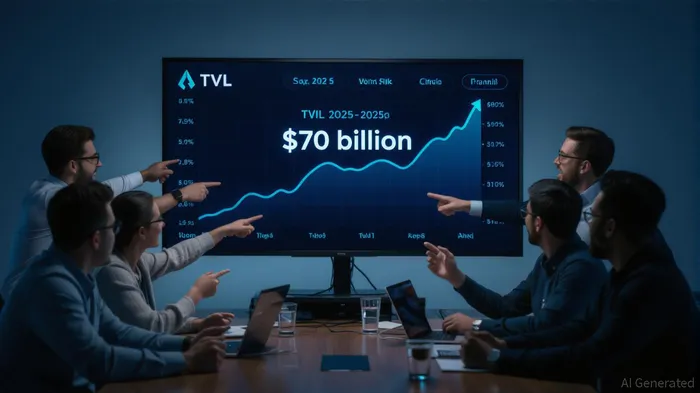 This institutionalization is further evidenced by the integration of spot markets, perpetuals, and primary issuance rails into a cohesive trading stack. Execution costs have declined, enabling scalability, while user behavior has shifted toward intent-based execution systems. Perpetuals, in particular, have matured rapidly, prioritizing execution quality and risk management over chain branding. These structural shifts suggest DeFi is evolving into a more robust, institutional-grade infrastructure rather than a speculative playground.
Investor Sentiment: Turbulence and Trust
Investor sentiment in 2025 has been shaped by both progress and turbulence. The "10/10 Flash Crash" in October-a $3 billion liquidation event and a $36 billion open interest wipeout within 24 hours-exposed vulnerabilities in basis trade strategies and highlighted the need for transparency in DeFi vaults. Similarly, the collapse of platforms like StreamDATA-- Finance and Elixir triggered a $1 billion exodus from yield-generating protocols within a week. These events underscored operational and counterparty risks, eroding trust among retail and institutional participants alike.
Yet, institutional interest remains resilient. Sustained inflows into spot Bitcoin exchange-traded products and new corporate treasury allocations indicate that DeFi's role as a capital allocation tool is far from obsolete. By Q3 2025, stablecoins-now a $310 billion asset class-had become central to payments, trading, and collateral operations, driving 30% of on-chain transaction volume. This duality-systemic fragility coexisting with institutional adoption-reflects a market in transition.
Systemic Capital Allocation: Diversification or Diversification?
The liquidity drought cannot be understood without examining capital allocation patterns. In Q3 2025, DeFi TVL experienced notable outflows as investors prioritized durability over speculation. A handful of sectors achieved "escape velocity," resembling scaled financial businesses, while others faltered once incentives waned and risk repricing took effect. This divergence signals a shift toward specialized infrastructure rather than broad-based speculation.
Stablecoins, in particular, have emerged as a linchpin of the digital economy. Their role as a global settlement layer has been reinforced by their integration into institutional-grade systems and their dominance in on-chain activity. Meanwhile, RWAs and lending platforms continue to attract capital, albeit with heightened scrutiny. The key question is whether these trends represent a temporary reallocation or a permanent reorientation of capital toward DeFi's most resilient components.
Is This a Correction or a Structural Shift?
The evidence points to a structural reorientation rather than a temporary correction. DeFi's market structure is increasingly aligned with institutional demands for transparency, efficiency, and risk management. However, the liquidity drought reflects a natural pruning of speculative excesses, not a collapse of the ecosystem. The challenges of 2025-such as the Flash Crash and platform collapses-have accelerated the need for robust governance and risk controls, which are now prerequisites for long-term viability.
For investors, the path forward lies in distinguishing between durable infrastructure and fragile experiments. Protocols that integrate with global capital markets, leverage RWAs, and prioritize stablecoin liquidity are likely to thrive. Conversely, yield-generating platforms lacking transparency or institutional-grade safeguards remain vulnerable to outflows.
Conclusion
The DeFi liquidity drought is not a death knell but a catalyst for evolution. As the ecosystem matures, it is shedding speculative excesses and embracing institutional-grade rigor. While systemic risks persist, the structural shifts in market design, capital allocation, and investor behavior suggest that DeFi is not losing momentum-it is redefining it. The challenge for stakeholders is to navigate this transition with prudence, recognizing that the future of DeFi will be shaped by resilience, not just innovation.

Mezclando la sabiduría tradicional en el comercio con las perspectivas de vanguardia en el área de las criptomonedas.
Latest Articles
Stay ahead of the market.
Get curated U.S. market news, insights and key dates delivered to your inbox.


AInvest
PRO
AInvest
PRO



Comments
No comments yet