
DeFi Lending's $40B Surge: A Strategic Opportunity for Yield Optimization in a Fragmented Crypto Market


 Aime Summary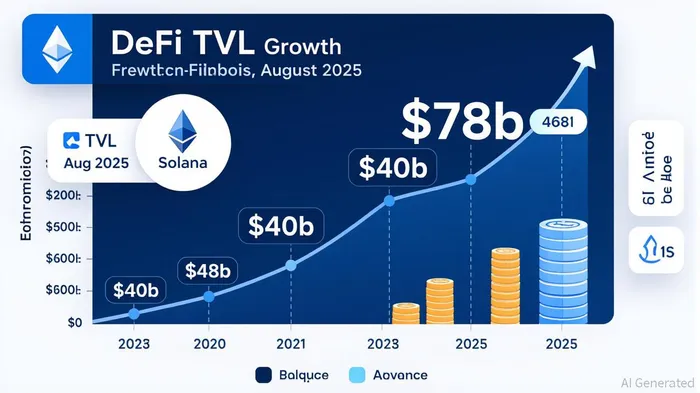
The DeFi lending sector has entered a new era of institutional-grade yield generation, with total value locked (TVL) surging past $78 billion as of August 2025. This growth is driven by a confluence of regulatory clarity, cross-chain innovation, and the strategic integration of stablecoins into lending protocols. For investors seeking high-conviction, low-risk opportunities, the current landscape offers a compelling case for leveraging stablecoin-driven DeFi platforms to optimize capital efficiency while mitigating volatility risks.
The Stablecoin-Driven Yield Paradigm
Stablecoins have become the backbone of DeFi lending, accounting for roughly one-third of protocol revenues and facilitating over $27.6 trillion in on-chain transaction volume in 2024 [4]. Platforms like AaveAAVE-- and Pendle have capitalized on this trend by offering modular yield strategies. Aave, for instance, now secures $40 billion in TVL—80% of Ethereum’s outstanding debt—through its modular vaults and GHO stablecoin issuance [3]. Meanwhile, Pendle’s fixed-rate tokenization model allows users to lock stablecoins for predictable returns, a feature critical for risk-averse investors.
USDG, a Paxos-issued stablecoin compliant with EU MiCA regulations, exemplifies the next phase of stablecoin innovation. With a 3.05% APY offered by LBank’s USD1 Points Program and cross-chain liquidity enabled by partnerships with OKX and VisaV--, USDGUSDC-- bridges the gap between DeFi and traditional finance [2]. This hybrid model not only enhances yield potential but also aligns with institutional demand for regulatory transparency.
Risk Mitigation and Protocol Resilience
While high yields are attractive, the fragmented nature of the crypto market necessitates robust risk management. Aave’s integration of ChainlinkLINK-- for MEV optimization and Morpho’s institutional-grade lending infrastructure demonstrate how protocols are addressing smart contract vulnerabilities and liquidity volatility [3]. Additionally, fiat-backed stablecoins like USDCUSDC-- and DAI—emphasizing transparency and overcollateralization—provide a safer alternative to algorithmic stablecoins, reducing exposure to systemic shocks [4].
Strategic Opportunities in a Consolidating Market
Institutional adoption is accelerating, with asset managers increasing DeFi and real-world asset (RWA) exposures by 3.5% to capitalize on yield opportunities [4]. Protocols like UniswapUNI--, now a full-stack trading superapp with a 95% gas fee reduction, and Ethena’s USDe—surging 75% monthly—highlight the sector’s capacity for innovation [2]. For investors, the key lies in diversifying across protocols while prioritizing those with strong governance frameworks and multi-chain capabilities.
Conclusion
The $40 billion surge in DeFi lending underscores a maturing ecosystem where stablecoin-driven protocols offer a unique balance of yield and security. By strategically allocating capital to platforms like Aave, Pendle, and USDG, investors can navigate the fragmented crypto market with confidence, leveraging institutional-grade tools to optimize returns while adhering to evolving regulatory standards.
**Source:[1] Top 10 Chains by TVL Driving DeFi Growth in August 2025 [https://phemex.com/news/article/top-10-chains-by-tvl-driving-defi-growth-in-august-2025-15935][2] The Rise of USDG and Its Implications for Yield-Generating ... [https://www.ainvest.com/news/rise-usdg-implications-yield-generating-stablecoin-strategies-2508/][3] What Are the Top 10 DeFi Lending Protocols to Watch in 2025 [https://bingx.com/en/learn/what-are-the-top-defi-lending-protocols-to-watch][4] Stablecoins in 2025: Full Overview of the $230B Market [https://medium.com/@monolith.vc/stablecoins-in-2025-full-overview-of-the-230b-market-bab96c680c44]

Decoding blockchain innovations and market trends with clarity and precision.
Latest Articles
Stay ahead of the market.
Get curated U.S. market news, insights and key dates delivered to your inbox.


AInvest
PRO
AInvest
PRO



Comments
No comments yet