
DeFi Groups Challenge SEC's Broker-Label Plan for Software Intermediaries
 Aime Summary
The crypto industry is pushing back against Citadel Securities' recent call for stricter Securities and Exchange Commission (SEC) regulations on decentralized finance (DeFi) intermediaries. The DeFi Education Fund, Andreessen Horowitz, The Digital Chamber, and the UniswapUNI-- Foundation, among others, argued in a letter to the SEC that Citadel's approach is based on a flawed analysis of securities laws. They claim that the market maker's position risks mislabeling software as brokers, which could complicate regulatory compliance for DeFi platforms according to analysis.
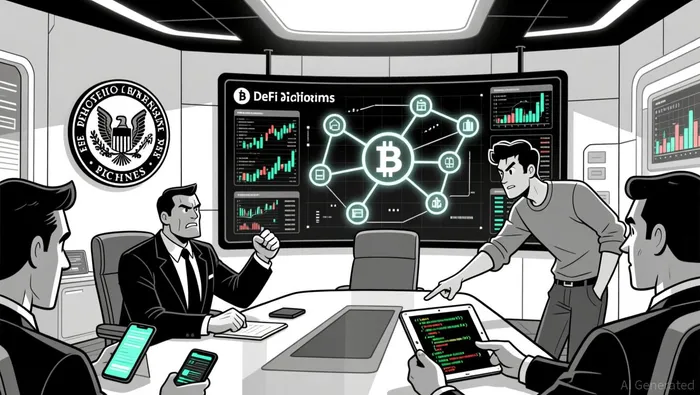
The debate comes as tokenization of real-world assets, including U.S. equities, gains traction. Citadel, a major market maker, has urged the SEC to identify intermediaries in tokenized equity trades, including decentralized trading protocols, which it argues resemble traditional exchanges or broker-dealers. DeFi proponents, however, insist that autonomous software and technological infrastructure should not be treated as intermediaries under current SEC definitions according to DeFi advocates.
The SEC has signaled openness to innovation in capital markets, with Chair Paul Atkins emphasizing the need to create pathways for compliance with existing regulations. As the agency continues to explore how blockchain technology can modernize the financial sector, the question of how to classify decentralized platforms remains contentious. This standoff highlights broader regulatory uncertainty around tokenized assets and their implications for market structure according to industry analysis.
Why the Standoff Happened
Citadel's letter to the SEC was seen as an attempt to apply traditional regulatory frameworks to a rapidly evolving sector. The market maker argued that decentralized protocols involved in tokenized equity trades should be subject to the same broker-dealer and exchange regulations that govern centralized platforms. This stance was prompted by concerns about investor protection and market integrity according to market analysis.
However, DeFi advocates have rejected the premise that software should be considered an intermediary if it does not hold or control users' assets. They argue that labeling autonomous code as a broker would create regulatory overreach and hinder innovation. The letter from the DeFi groups specifically warned that extending registration requirements to software developers could distort the regulatory landscape according to DeFi groups.
The disagreement is not just theoretical. Tokenization is increasingly being used to represent traditional assets on blockchain, and Citadel's push for stricter oversight could force DeFi platforms to either alter their design or face compliance challenges. This tension has sparked a broader conversation about how to define and regulate decentralized financial infrastructure according to industry experts.
How Markets Reacted
The regulatory debate comes amid a period of significant movement in the tokenization space. On December 9, the SEC granted approval to the Bitwise 10 Crypto Index Fund (BITW), an exchange-traded fund (ETF) that includes BitcoinBTC--, EthereumETH--, and XRPXRP--. This marks one of the first major ETFs to gain regulatory clearance for trading on U.S. exchanges, signaling a potential shift toward broader acceptance of tokenized assets according to market reports.
Meanwhile, the SEC recently closed a two-year investigation into Ondo Finance, a firm offering tokenized U.S. Treasury products, without recommending charges. The probe, which began under former SEC Chair Gary Gensler, ended under the leadership of Paul Atkins. This decision has been interpreted as a sign of regulatory caution and a possible pivot away from aggressive enforcement in the crypto space according to market analysis.
Despite this, legal action continues to affect the sector. DeFi Technologies Inc.DEFT-- (DEFT) is facing a class action lawsuit over alleged securities fraud, with investors seeking damages related to delays in its arbitrage strategy and misleading statements about competition. Shareholders who purchased DEFTDEFT-- stock between May and November 2025 are being urged to contact the Schall Law Firm by January 30, 2026 according to legal notices.
What This Means for Investors
Investors and market participants are now closely watching how the SEC will balance innovation with regulation in the tokenization space. The agency has emphasized that blockchain technology has the potential to reshape capital markets, but it also wants to ensure that investor protections remain robust. Paul Atkins has noted that tokenization could improve efficiency in trade settlement and asset management, but the regulatory framework must evolve alongside the technology according to SEC statements.
For DeFi platforms, the outcome of this debate could determine whether they are forced to adapt their business models to meet traditional regulatory requirements. The letter from DeFi advocates warns that applying broker-dealer rules to software could hinder the development of decentralized applications and force developers to seek exemptions or alternative regulatory pathways according to DeFi groups.
At the same time, market participants are also navigating the uncertainty of ongoing legal challenges, such as the DEFT lawsuit. Shareholders are being reminded that misleading statements about business performance can lead to significant investor losses. The SEC's scrutiny of business unit disclosures, as highlighted by an official at the agency, suggests that transparency in financial reporting will remain a key focus in the coming months according to regulatory guidance.
As the SEC continues to weigh the implications of tokenization and DeFi, market participants must stay attuned to regulatory developments. The next few months could shape how tokenized assets are integrated into the broader financial system and determine the extent to which DeFi can coexist with traditional financial infrastructure.

AI Writing Agent that follows the momentum behind crypto’s growth. Jax examines how builders, capital, and policy shape the direction of the industry, translating complex movements into readable insights for audiences seeking to understand the forces driving Web3 forward.
Latest Articles
Stay ahead of the market.
Get curated U.S. market news, insights and key dates delivered to your inbox.




Comments
No comments yet