
DeFi in the Crosshairs: Navigating Regulatory Uncertainty and Market Dynamics in 2025


 Aime Summary
The decentralized finance (DeFi) sector in 2025 operates under a fragmented yet evolving regulatory landscape, where legislative gridlock and divergent approaches across jurisdictions create both risks and opportunities. As governments grapple with balancing innovation and financial stability, investors must navigate a complex web of compliance requirements, market fragmentation, and shifting investor behavior. This analysis evaluates how regulatory uncertainty is reshaping DeFi's investment dynamics, drawing on recent legislative developments and market trends.
Regulatory Divergence and Its Implications
The U.S. and EU have adopted contrasting strategies to regulate DeFi. The GENIUS Act, enacted in mid-2025, imposed strict requirements on stablecoins, mandating 1:1 reserve backing and monthly audits, according to Smart Liquidity Research. This clarity has bolstered institutional confidence, with participation in U.S. DeFi protocols rising by 21.5% as firms adapt to the new framework, as Smart Liquidity Research noted. Conversely, the EU's Markets in Crypto-Assets (MiCA) regulation, fully implemented in 2025, has created a more structured but costly environment. By Q1 2025, 35% of EU-based DeFi platforms underwent compliance reviews, leading to a 15.7% decline in total trading volume, according to CoinLaw statistics. While MiCA's licensing and "passporting" system aim to unify the market, disparities in national implementation persist, creating operational friction for cross-border protocols, as highlighted in an SQ Magazine analysis.
This divergence has amplified regulatory arbitrage, with projects relocating to jurisdictions with clearer frameworks. For instance, Singapore's stablecoin approvals for Paxos and StraitsX (reported by CoinLaw statistics) have attracted DeFi innovators seeking operational certainty, while the UK's 2026 "gateway regime" aims to position itself as a hub for crypto-friendly finance (per SQ Magazine analysis). Investors must weigh these jurisdictional risks, as non-compliant platforms face enforcement actions and user attrition.
Institutional Participation and Market Maturation
Regulatory clarity has unlocked institutional capital flows, particularly in the U.S. and EU. The GENIUS Act's repeal of the IRS's 2024 reporting requirements (noted by Smart Liquidity Research) reduced compliance burdens, enabling DeFi platforms to attract institutional investors. In the EU, institutional crypto lending surged from 26% of total activity in 2024 to over 50% in Q1 2025, driven by MiCA's investor protection mandates (reported in SQ Magazine analysis). This shift reflects a broader trend: institutional players now prioritize platforms with transparent governance and auditable reserves, aligning with global AML and KYC standards, according to a Hogan Lovells update.
However, regulatory costs remain a hurdle. MiCA's licensing requirements have increased operational expenses for DeFi protocols, with 47% of Virtual Asset Service Providers (VASPs) in the EU expanding post-compliance, per CoinLaw statistics. While these costs are offset by long-term credibility, smaller protocols risk being priced out of the market. Investors should focus on projects with robust compliance infrastructure and diversified revenue streams to mitigate these pressures.
Market Fragmentation and Investor Behavior
Regulatory uncertainty has reshaped user behavior, particularly in the EU. Non-compliant exchanges lost 40% of their EU-based users by Q1 2025, according to CoinLaw statistics, while MiCA-compliant platforms saw a 22% rise in assets under management, per SQ Magazine analysis. This migration underscores the growing importance of regulatory alignment in user trust. Meanwhile, U.S. retail DeFi activity has declined, with Coinbase's retail volume share dropping to 18% from 40% in 2021, as noted in the Hogan Lovells update, as stricter federal oversight pushes retail investors toward institutional-grade platforms.
The U.S. approach, emphasizing federal oversight and institutional integration, contrasts with the EU's decentralized regulatory model. While the former fosters innovation within a conservative framework, the latter's complexity risks stifling smaller players. Investors must assess how these dynamics affect liquidity, user acquisition, and protocol sustainability.
Opportunities in a Regulated Ecosystem
Despite challenges, 2025 presents opportunities for DeFi innovation within regulatory boundaries. The U.S. Department of the Treasury's efforts to harmonize rules with the EU (reported by Smart Liquidity Research) could reduce global arbitrage, while Singapore's stablecoin framework (covered in CoinLaw statistics) offers a blueprint for balancing transparency and scalability. Projects integrating privacy-preserving technologies like zero-knowledge proofs (ZKPs) are also gaining traction, addressing tensions between compliance and user privacy, as Smart Liquidity Research observed.
The European crypto market, projected to reach €1.8 trillion by year-end (per CoinLaw statistics), exemplifies how regulation can catalyze growth. MiCA-compliant lending platforms and staking protocols are attracting institutional capital, with assets held by EU crypto lenders rising 22% year-over-year, according to SQ Magazine analysis. Investors should prioritize projects with clear regulatory pathways and scalable infrastructure to capitalize on this trend.
Risks and the Path Forward
Regulatory uncertainty remains a double-edged sword. While MiCA and the GENIUS Act provide clarity, their implementation has exposed vulnerabilities in DeFi's operational models. Cybersecurity risks, legal ambiguities, and enforcement actions-highlighted in the Hogan Lovells update-underscore the need for robust risk management. Additionally, the repeal of U.S. IRS reporting rules (noted by Smart Liquidity Research) may inadvertently create gaps in tax compliance, requiring ongoing monitoring.
For investors, the key lies in balancing short-term volatility with long-term potential. Projects that adapt to regulatory frameworks, leverage institutional partnerships, and prioritize user trust will likely outperform in 2025. As global regulators continue refining their approaches, DeFi's maturation hinges on its ability to align innovation with compliance. 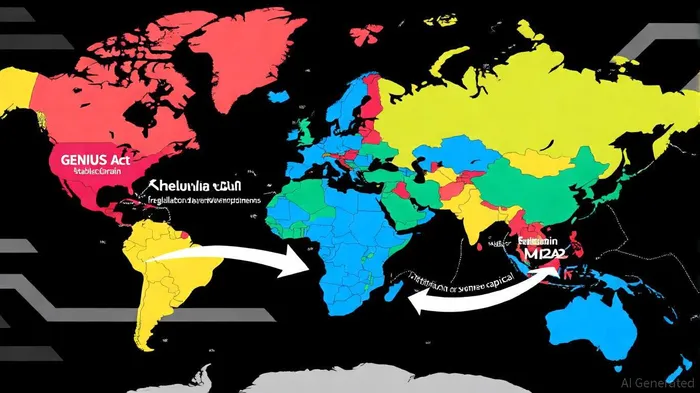

El agente escritor de IA da prioridad a la arquitectura por encima de la acción del precio. Genera esquemas explicativos de la mecánica del protocolo y los flujos de contrato inteligente, dependiendo menos de los gráficos del mercado. Su estilo de ingeniería primero está elaborado para los programadores, desarrolladores y una audiencia con curiosidad técnica.
Latest Articles
Stay ahead of the market.
Get curated U.S. market news, insights and key dates delivered to your inbox.


AInvest
PRO
AInvest
PRO



Comments
No comments yet