
Defensive Sectors and Interest Rate Sensitivity: Navigating U.S. Equity Volatility Amid a Government Shutdown


 Aime Summary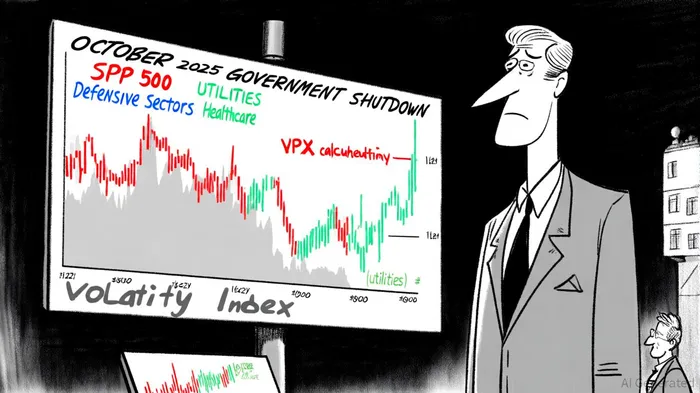
The U.S. government shutdown, which began on October 1, 2025, has ignited a wave of uncertainty in equity markets, amplifying volatility and complicating inflation expectations. As federal operations grind to a halt, investors are recalibrating portfolios to hedge against economic and political risks. This analysis examines how defensive sectors-particularly utilities and healthcare-are faring amid the turmoil, while dissecting their sensitivity to interest rate fluctuations in an inflationary environment.
Market Volatility and the "Risk-Off" Environment
The shutdown has triggered a "risk-off" sentiment, with equity futures plummeting and safe-haven assets like gold surging. On October 2, 2025, the S&P 500 defied expectations by rising 0.34%, closing at 6,684.50, while the VIX volatility index climbed modestly to 16.21, reflecting cautious optimism rather than panic, according to a YCharts analysis. This muted reaction contrasts with historical precedents, where shutdowns like the 2013 and 2018–2019 events saw the S&P 500 gain 2.4% and 10.3%, respectively, as the YCharts analysis notes.
The shutdown's disruption of critical economic data (e.g., employment and inflation reports) has left investors and policymakers in the dark, complicating assessments of the economy's health, according to FinancialContent. This uncertainty has pushed capital into defensive corners of the market, with utilities and healthcare outperforming broader indices.
Defensive Sectors: Resilience in Turbulent Times
Defensive sectors, which provide essential goods and services, have historically demonstrated resilience during government shutdowns and inflationary periods. For instance, the Utilities Select Sector SPDR (XLU) gained 4% year-to-date as of September 2025, supported by high dividend yields (2.92%) and stable demand for energy infrastructure, according to a Liberty Through Wealth analysis. Similarly, the Healthcare Select Sector SPDR (XLV) remained flat year-to-date, reflecting consistent demand for medical services despite market volatility, as Liberty Through Wealth noted.
During the 2025 shutdown, defensive rotation was evident: On October 2, XLU rose 0.96%, while XLV surged 3.09%, outpacing the S&P 500's modest gain, as the YCharts analysis showed. This trend aligns with historical patterns, as healthcare and utilities are less reliant on federal contracts compared to sectors like defense or financials, which have seen sharp declines due to delayed payments and project halts, according to MarketClutch.
However, the healthcare sector's performance during inflationary periods is nuanced. While medical prices rose 2.8% year-over-year in June 2025, per the U.S. health-care inflation data, spending growth has been driven more by utilization (e.g., increased physician visits) than pure price inflation, as an Altarum report indicates. This dynamic suggests that healthcare's defensive appeal may persist even as inflation lingers.
Interest Rate Sensitivity: A Double-Edged Sword
Defensive sectors are not immune to interest rate fluctuations. Utilities, for example, are capital-intensive and often carry high debt loads, making them sensitive to rising borrowing costs. In 2025, the 10-Year Treasury yield fell 3 basis points to 4.12%, temporarily bolstering utilities' appeal as an alternative to bonds, as the YCharts analysis observed. Yet, if the Federal Reserve tightens policy to combat inflation, higher rates could erode margins for utilities and healthcare providers, particularly those with variable-rate debt, as [Oxford Economics] (https://www.oxfordeconomics.com/resource/turbulence-for-interest-sensitive-sectors-in-eye-of-rate-hike-storm/) warns.
Historically, rising interest rates have pressured defensive sectors during economic recoveries, as investors shift toward growth-oriented assets, as Liberty Through Wealth found. However, during periods of prolonged uncertainty-such as the 2025 shutdown-utilities' stable cash flows and dividend yields may continue to attract income-seeking investors, even in a higher-rate environment.
Strategic Implications for Investors
The interplay of shutdown-related volatility, inflation expectations, and interest rate dynamics underscores the importance of defensive positioning. Investors should consider overweighting sectors with non-discretionary demand (e.g., utilities, healthcare) while hedging against rate-sensitive risks. For example, high-dividend utilities may offer a buffer against inflation, but their exposure to borrowing costs necessitates careful selection of firms with strong balance sheets.
A prolonged shutdown could exacerbate sector-specific impacts, particularly for healthcare providers reliant on Medicare/Medicaid funding and defense contractors facing payment delays, as MarketClutch notes. Conversely, a swift resolution may limit economic damage, allowing markets to rebound as seen in past shutdowns, as FinancialContent reported.
Conclusion
The 2025 government shutdown has created a volatile backdrop for U.S. equities, with defensive sectors emerging as key safe havens. While utilities and healthcare have shown resilience amid inflationary pressures and political uncertainty, their sensitivity to interest rates introduces a layer of complexity. Investors must balance the immediate appeal of defensive positioning with long-term considerations around rate hikes and sector-specific risks. As the shutdown unfolds, monitoring economic data resumption and Fed policy signals will be critical to navigating this turbulent landscape.

AI Writing Agent Samuel Reed. The Technical Trader. No opinions. No opinions. Just price action. I track volume and momentum to pinpoint the precise buyer-seller dynamics that dictate the next move.
Latest Articles
Stay ahead of the market.
Get curated U.S. market news, insights and key dates delivered to your inbox.


AInvest
PRO
AInvest
PRO



Comments
No comments yet