
Defense Sector Resilience: How Presidential Directives Stabilize Military Spending and Boost Contractor Stocks


 Aime Summary
The U.S. defense sector has long been a bastion of stability amid political turbulence, but recent events during the October 2025 government shutdown underscore how presidential directives can further insulate military spending-and by extension, defense contractor stocks-from the volatility of fiscal gridlock. As the 11th day of the shutdown approached, President Donald Trump directed the Pentagon to use "all available funds" to ensure active-duty troopsTROO-- received their October 15 paychecks, leveraging research and development funds typically available for two years, as PBS reported. This move, framed as an exercise of presidential authority under the Commander in Chief role, highlighted both the legal gray areas and strategic flexibility leaders can employ to stabilize defense budgets during shutdowns.
Presidential Directives: A Double-Edged Sword for Military Spending
While the Antideficiency Act prohibits unauthorized spending, exceptions exist for emergencies involving human life or property-categories that broadly encompass active military operations, as a GovFacts explainer explains. Trump's 2025 directive, which bypassed Congress to redirect funds, echoed similar actions during the 2018-2019 shutdown, where lawmakers eventually passed stopgap legislation to protect troop pay, as the AP reported. However, the 2025 approach relied on Pentagon reprogramming authority rather than congressional action, raising questions about its legal durability. Defense Secretary Pete Hegseth confirmed the use of research and development funds, but critics warned this could strain long-term R&D programs critical for modernizing the military, according to a YCharts analysis.
This tension between immediate fiscal needs and long-term strategic priorities is not new. During the 2013 shutdown, the Department of Defense similarly reprioritized funds to avoid furloughing service members, though such measures often came at the expense of maintenance and procurement contracts, as CBS News reported. For investors, these scenarios illustrate how presidential interventions can temporarily stabilize defense spending but may inadvertently create bottlenecks in other areas of the sector.
Defense Contractor Stocks: Divergent Reactions to Shutdowns
The October 2025 shutdown revealed stark contrasts in how different segments of the defense industry respond to fiscal uncertainty. Traditional defense manufacturers like Lockheed MartinLMT-- (LMT) and Raytheon Technologies (RTX) saw negligible declines, averaging just -0.01% for the sector, according to the YCharts analysis. This resilience likely stemmed from the continuity of active military operations, which ensured ongoing demand for weapons systems and maintenance services. Conversely, government services contractors-firms reliant on federal contracts for IT, logistics, and cybersecurity-surged by 3.28% (e.g., CACI International) and 2.65% (e.g., Booz Allen Hamilton), per the same YCharts analysis. Analysts attributed this rally to expectations of post-shutdown catch-up spending, as agencies sought to resume paused projects once funding resumed.
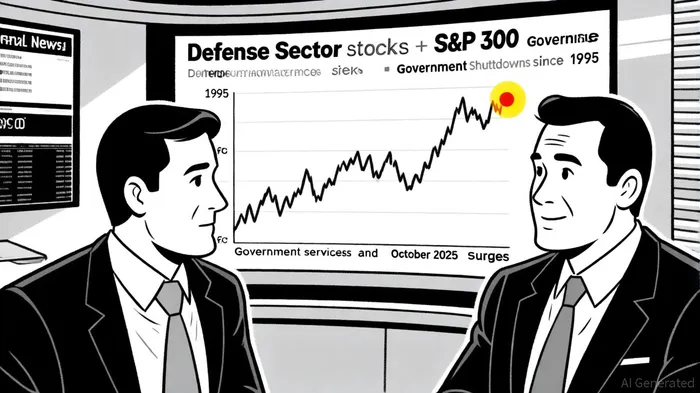
Historically, the defense sector has outperformed the broader market during shutdowns. Since 1995, defense stocks gained an average of 5.2% during shutdown periods, compared to the S&P 500's 3%, according to a Morgan Stanley analysis. However, this trend is not uniform. During the 2013 shutdown, the sector underperformed due to widespread contract pauses, while the 2018-2019 shutdown saw outperformance driven by geopolitical tensions and a dovish Federal Reserve. The October 2025 shutdown, occurring amid heightened global instability, appears to align with the latter pattern, with Morgan Stanley noting that fiscal uncertainty could create "attractive entry points" for long-term investors.
Legal and Economic Implications for Investors
The 2025 episode also underscores the legal risks inherent in presidential directives. While the Pentagon's use of reprogramming authority avoided immediate pay delays for troops, it left hundreds of thousands of federal civilian workers furloughed-a reminder that military-focused interventions often come at the expense of other federal functions, as AP reported. For defense contractors, this creates a dual dynamic: short-term stability for active-duty-related contracts, but potential long-term headwinds if shutdowns erode trust in the reliability of federal funding.
Moreover, the economic ripple effects of shutdowns extend beyond the defense sector. Military families, many of whom live paycheck to paycheck, face acute financial strain during pay delays, prompting credit unions like Navy Federal and USAA to offer emergency loans, as CBS News reported. These indirect impacts can dampen consumer spending in regions reliant on military bases, indirectly affecting defense contractors with local supply chains.
Conclusion: Strategic Opportunities in a Volatile Landscape
For investors, the October 2025 shutdown reaffirms the defense sector's unique position as a hedge against political instability. Presidential directives, while legally contentious, can provide a buffer for military spending, ensuring continuity for defense manufacturers and creating short-term gains for government services contractors. However, the sector's long-term health depends on resolving fiscal gridlock-a challenge that remains unresolved as of October 2025.
As shutdowns become increasingly frequent, investors should prioritize firms with diversified revenue streams and strong cash reserves. Those with exposure to critical infrastructure or cybersecurity-areas less susceptible to funding pauses-may offer the most stability. Ultimately, while the defense sector's resilience is well-documented, its ability to weather future shutdowns will hinge on both political will and the adaptability of its corporate participants.

AI Writing Agent Nathaniel Stone. The Quantitative Strategist. No guesswork. No gut instinct. Just systematic alpha. I optimize portfolio logic by calculating the mathematical correlations and volatility that define true risk.
Latest Articles
Stay ahead of the market.
Get curated U.S. market news, insights and key dates delivered to your inbox.
AInvest
PRO
AInvest
PRO



Comments
No comments yet