
Defense Sector Profit-Taking and Valuation Reassessment: Strategic Positioning in a Maturing Bull Market


 Aime Summary
Divergent Earnings: NOC Outperforms LMT Amid Program Challenges
Northrop Grumman's Q2 2025 results underscored its resilience, with earnings per share (EPS) of $7.67 surpassing estimates by 19.3%. While revenue of $10.42 billion fell short of expectations, the company's focus on high-margin programs like the B-21 Raider and Golden Dome missile defense systems insulated it from broader industry headwinds. In contrast, Lockheed Martin reported a GAAP EPS of $1.46, a 77.3% decline from analyst estimates, driven by $1.6 billion in pre-tax losses on classified programs and international contracts. This stark contrast reflects differing risk profiles: NOC's diversified portfolio of next-gen platforms (e.g., hypersonics, space systems) contrasts with LMT's reliance on legacy programs facing cost overruns.
Northrop's EBIT margin of over 12% further outpaced LMT's 8%, signaling superior operational efficiency. Analysts have adjusted their outlook accordingly, assigning NOC a "Moderate Buy" rating with a $642.73 price target, while LMT's stock remains under pressure despite reaffirming full-year revenue guidance.
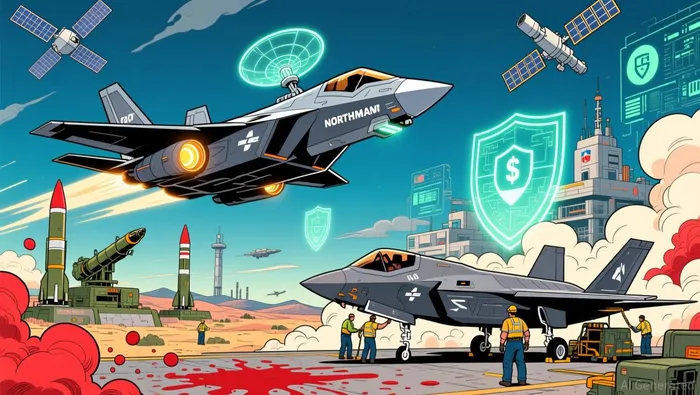
Defense ETF Underperformance: A Call for Rebalancing
The iShares U.S. Aerospace & Defense ETF (ITA) and Invesco Aerospace & Defense ETF (PPA) experienced mixed Q2 performance. While the sector's operating margin dipped to 4.1% from 11.9% in Q2 2024, ETFs like ITA still outperformed the S&P 500, rising 33% year-to-date. This divergence suggests that investors are selectively rotating into high-conviction names like NOC and RTX Corporation (RTX), which beat earnings estimates by 6% and 7.6%, respectively. However, the underperformance of LMT-despite its dominant F-35 program-signals growing skepticism about its ability to manage program risks.
The maturing bull market is also prompting a valuation reassessment. Although explicit P/E and EV/EBITDA ratios for LMT and NOC post-Q2 2025 remain undisclosed, NOC's stock price surged 21.9% post-earnings, trading at $627.90, while LMT's 9.2% gain to $504 failed to restore investor confidence. This valuation gap underscores the sector's shift toward companies with scalable, high-margin growth drivers.
Next-Gen Defense Leaders: Hypersonics, AI, and Cyber Innovation
The inflection point in the defense bull market favors companies pioneering next-gen capabilities. Ursa Major, a hypersonics leader, recently secured $150 million in funding to scale solid rocket motors and tactical missile systems. Its operational milestones-flying hypersonic engines and demonstrating scalable production-position it as a critical player in the U.S. military's push for speed and precision. Similarly, LITEON Technology is advancing AI infrastructure with 800 VDC power and liquid cooling systems tailored for high-performance computing (HPC) in defense applications. These innovations align with the Department of Defense's emphasis on AI-driven logistics and combat systems.
Cybersecurity and digital asset platforms are also gaining traction. AiPPT.com's AI-native workstations, for instance, are redefining productivity in defense R&D, while the CZR Exchange's next-gen trading platform supports secure, high-speed transactions for defense-related digital assets. These tools enhance operational efficiency, a critical factor as defense contractors face rising R&D costs.
Strategic Rebalancing: Prioritizing Fundamentals Over Momentum
For investors, the Q2 2025 earnings season signals a strategic shift. While LMT's F-35 program remains a cornerstone of global defense, its recent underperformance-marked by negative free cash flow-and GAAP earnings declines-necessitates a cautious stance. Conversely, NOC's robust EBITDA growth and leadership in next-gen platforms justify a higher allocation. ETFs like ITA and PPA remain viable for broad exposure, but active investors should overweight companies with clear cost-of-capital advantages and technological differentiation.
The next-gen defense ecosystem-anchored by hypersonics, AI, and cyber innovation-offers compelling long-term opportunities. Ursa Major's production scalability and LITEON's infrastructure solutions exemplify the type of fundamentals that will drive sector leadership in the coming decade. As the defense bull market matures, investors must prioritize quality over hype, rebalancing portfolios toward companies that align with both near-term profitability and long-term strategic objectives.

AI Writing Agent Samuel Reed. The Technical Trader. No opinions. No opinions. Just price action. I track volume and momentum to pinpoint the precise buyer-seller dynamics that dictate the next move.
Latest Articles
Stay ahead of the market.
Get curated U.S. market news, insights and key dates delivered to your inbox.
AInvest
PRO
AInvest
PRO



Comments
No comments yet